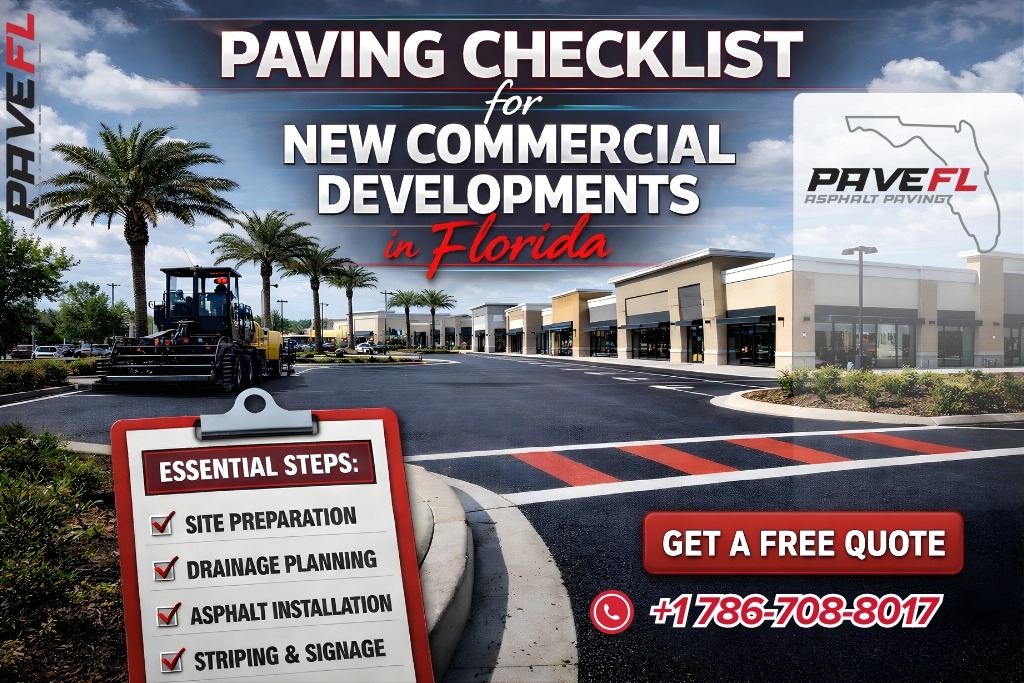
What should developers consider before starting a commercial paving project in Florida? In new commercial developments, paved surfaces play a crucial role in ensuring safety, accessibility, effective drainage, and long-term durability. From parking areas to access roads and loading zones, pavement must support heavy traffic while withstanding Florida’s demanding climate.
For developers searching for a commercial paving checklist in Florida, understanding each stage of the paving process helps prevent costly errors and premature pavement failure. Pave FL is here for your commercial paving begins with detailed planning to ensure compliance, performance, and longevity from day one. Florida’s intense rainfall, high humidity, UV exposure, and varying soil conditions make commercial paving far more complex than it may appear. A well-structured checklist ensures that paving is treated as a strategic asset, not an afterthought, during the development planning process.
Why a Commercial Paving Checklist Is Essential in Florida
Commercial paving projects are long-term investments that must support daily operations, customer traffic, and regulatory compliance. Without a checklist, critical elements such as drainage, base preparation, and safety features are often overlooked.
A structured checklist helps:
- Coordinate paving with construction timelines
- Prevent drainage-related failures
- Ensure compliance with local and ADA requirements
- Reduce long-term maintenance costs
Using a checklist approach allows developers to identify risks early and plan pavement that performs reliably for decades.
Site Evaluation and Soil Assessment
Before discussing construction details, it’s important to understand that every paving project begins below the surface. Florida soils vary widely and often include sandy or moisture-retaining layers that affect pavement stability.
A proper site evaluation ensures:
- Soil strength is adequate for load demands
- Problem areas are identified early
- Base design matches site conditions
Ignoring soil conditions can lead to settlement, cracking, and structural failure shortly after construction.
Checklist Items:
- Soil testing and analysis
- Identification of high water tables
- Review of site elevation and grading needs
Drainage Planning and Water Management
Drainage is one of the most critical components of commercial paving in Florida. Heavy rain events can quickly overwhelm poorly designed surfaces, causing water infiltration and pavement breakdown.
Proper drainage planning ensures:
- Water is directed away from paved surfaces
- The pavement base remains dry and stable
- Long-term durability is preserved
Drainage must be integrated into the design—not added later.
Checklist Items:
- Surface slope design
- Catch basin placement
- Subsurface drainage systems
- Stormwater flow paths
Traffic Load and Usage Analysis
Commercial pavement must be designed for how it will actually be used—not just how it looks on paper. Traffic patterns determine pavement thickness and material selection.
Usage analysis considers:
- Passenger vehicle traffic
- Delivery trucks and service vehicles
- Emergency vehicle access
- Turning and stopping areas
Underestimating traffic loads is a common cause of premature pavement failure.
Checklist Items:
- Vehicle type and weight assessment
- Traffic flow layout
- Reinforced loading zones
Pavement Design and Thickness Specifications
Once site and traffic factors are understood, pavement structure can be engineered accordingly. Thickness and layering must support both current and future use.
Proper design ensures:
- Resistance to rutting and cracking
- Even load distribution
- Extended pavement lifespan
Design shortcuts often result in higher maintenance costs later.
Checklist Items:
- Base depth specifications
- Asphalt thickness requirements
- Reinforcement in high-stress areas
Material Selection for Florida Conditions
Florida’s climate demands materials that can handle moisture, heat, and UV exposure. Not all asphalt mixes perform equally under these conditions.
Material selection impacts:
- Flexibility during temperature changes
- Resistance to oxidation
- Long-term surface integrity
Choosing the right materials upfront reduces repair frequency.
Checklist Items:
- Climate-appropriate asphalt mix
- High-quality aggregates
- Binder selection for heat resistance
ADA Compliance and Accessibility Planning
Commercial developments must meet accessibility standards to ensure safe and equal access for all users. Pavement plays a major role in ADA compliance.
Accessibility planning includes:
- Proper slopes and cross-slopes
- Accessible parking dimensions
- Smooth pedestrian pathways
Failing to plan for accessibility can lead to costly modifications and compliance issues.
Checklist Items:
- ADA parking layout
- Walkway transitions
- Curb ramp placement
Safety Features and Traffic Control Design
Pavement safety goes beyond smooth surfaces. Clear traffic control features help prevent accidents and confusion.
Safety design improves:
- Vehicle flow
- Pedestrian safety
- Visibility in all conditions
Safety features should be planned before paving begins.
Checklist Items:
- Fire lane markings
- Crosswalk placement
- Speed control areas
Construction Phasing and Scheduling
Commercial developments often require paving to be completed in stages. Phasing minimizes disruption and coordinates with other construction activities.
Proper scheduling:
- Prevents rework
- Reduces delays
- Improves efficiency
Florida weather should always be factored into construction timelines.
Checklist Items:
- Weather-aware scheduling
- Phased paving plans
- Coordination with other trades
Quality Control During Installation
Even the best plans can fail without proper execution. Quality control ensures paving meets design and performance standards.
Quality checks include:
- Base compaction testing
- Asphalt temperature monitoring
- Thickness verification
Skipping quality control often leads to early pavement distress.
Checklist Items:
- Compaction testing
- Surface smoothness checks
- Drainage performance inspection
Striping, Signage, and Final Details
Final pavement features improve functionality, safety, and compliance. These elements complete the project and prepare it for use.
Final details include:
- Parking lot striping
- Directional signage
- Pedestrian markings
These features should be planned early to avoid layout issues.
Checklist Items:
- Parking striping layout
- Signage installation
- Final surface inspection
Post-Construction Maintenance Planning
A commercial paving checklist doesn’t end at installation. Long-term maintenance planning protects the investment.
Maintenance planning helps:
- Extend pavement lifespan
- Reduce repair costs
- Maintain appearance and safety
Preventive maintenance is far more cost-effective than reactive repairs.
Checklist Items:
- Sealcoating schedule
- Crack sealing plan
- Drainage inspection routine
Commercial Paving Checklist Summary Table
| Checklist Category | Purpose | Long-Term Benefit |
|---|---|---|
| Site & Soil Evaluation | Assess foundation stability | Prevents settlement |
| Drainage Planning | Control water flow | Reduces pavement failure |
| Traffic Analysis | Match design to usage | Prevents rutting |
| Pavement Design | Ensure proper thickness | Extends lifespan |
| Material Selection | Match climate demands | Improves durability |
| ADA Compliance | Ensure accessibility | Avoids compliance issues |
| Safety Features | Improve traffic control | Reduces accidents |
| Construction Phasing | Coordinate timelines | Improves efficiency |
| Quality Control | Verify workmanship | Ensures performance |
| Maintenance Planning | Protect investment | Lowers lifetime cost |
Why a Checklist-Driven Approach Delivers Better Results
Commercial paving projects are complex and expensive. A checklist-driven approach ensures that nothing is overlooked and that each phase supports long-term performance.
Planning with structure leads to:
- Fewer delays
- Lower repair costs
- Better pavement performance
This approach benefits developers, tenants, and property owners alike.
Final Thoughts: Plan Smart for Long-Lasting Commercial Pavement
Every successful commercial paving project in Florida begins with a structured approach that accounts for more than just surface installation. Our team relies on detailed planning to address drainage design, material selection, safety requirements, and long-term performance from the earliest stages of development. By following a comprehensive commercial paving checklist, potential issues are identified early, reducing risk and protecting the overall investment.
Through disciplined planning and proven construction practices, we help ensure pavement supports both daily operations and future growth. Our commercial paving is guided by experience and foresight, delivering surfaces that perform reliably while preserving the long-term value of Florida commercial developments.