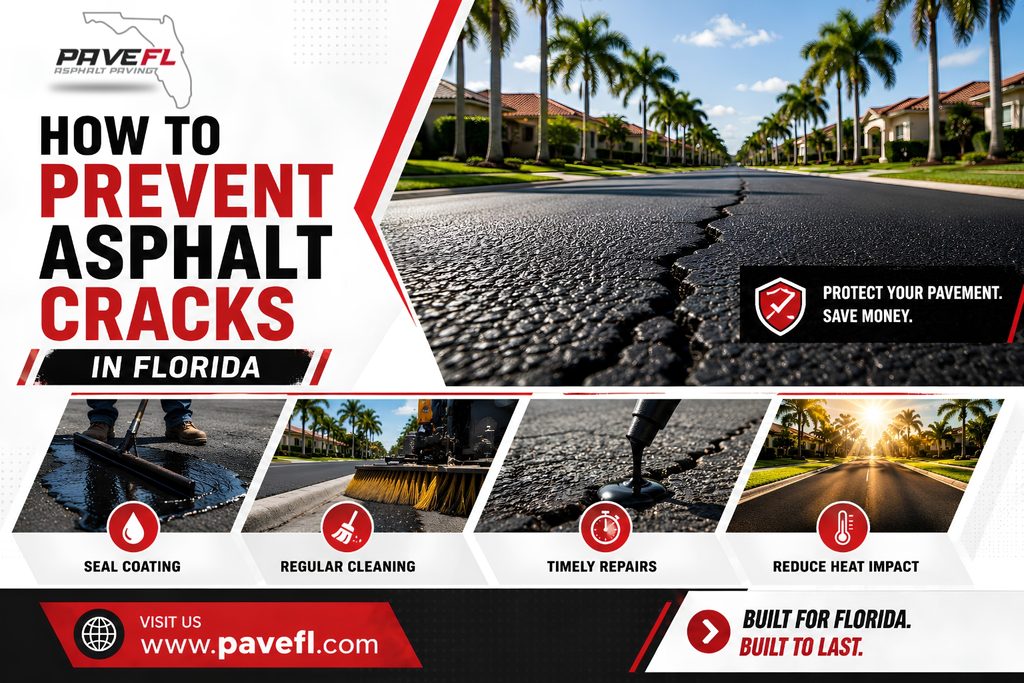
Are you seeing cracks developing in florida asphalt? Yes small asphalt cracks should be addressed early because Florida’s heat, intense UV exposure, humidity, and frequent rainfall can quickly turn minor surface damage into a larger pavement problem. The most effective way to prevent asphalt cracks Florida property owners deal with is to combine proper pavement installation with good drainage, timely crack sealing, sealcoating, routine inspections, and prompt repairs. Florida asphalt faces continuous environmental stress, so waiting until cracks become wide or widespread can allow water to reach the pavement’s supporting layers and accelerate deterioration.
For Florida homeowners, commercial property managers, and business owners, crack prevention should be viewed as an ongoing pavement-care strategy rather than a one-time task. Pave FL‘s guidance emphasizes that heat can dry and weaken asphalt, while rainwater entering cracks can contribute to foundation deterioration. Regular inspections and early maintenance help protect the surface before relatively manageable defects develop into potholes, uneven pavement, or deeper structural problems.
Why Does Asphalt Crack in Florida?
Florida doesn’t experience the severe freeze-thaw cycles found in northern states, but that doesn’t mean asphalt is protected from cracking. Instead, Florida pavement faces a different combination of stresses that can gradually weaken the asphalt surface.
The major contributors include:
- Intense sunlight and UV radiation
- Extreme surface temperatures
- Heavy rainfall
- Persistent humidity
- Poor drainage
- Soil movement and erosion
- Heavy traffic
- Aging asphalt
- Improper installation
- Delayed maintenance
Pave FL notes that South Florida’s heat, humidity, and frequent rainfall can contribute to cracks, potholes, fading, and other pavement problems.
Understanding these causes is important because preventing cracks isn’t simply about repairing them after they appear. The goal is to reduce the environmental and structural conditions that allow cracks to develop in the first place.
How Florida’s Climate Accelerates Asphalt Cracking
Florida’s climate creates a combination of heat and moisture that can continuously stress pavement.
Intense UV Exposure
Ultraviolet radiation accelerates oxidation in asphalt. As the asphalt binder oxidizes, it gradually loses flexibility and becomes more brittle.
A brittle pavement surface cannot respond as effectively to normal movement and traffic stress. Eventually, cracking becomes easier to initiate and spread.
Pave FL explains that prolonged UV exposure can cause asphalt to dry out, lose flexibility, and become increasingly vulnerable to cracking.
Extreme Heat
Florida pavement can become extremely hot under direct sunlight.
Heat can soften asphalt, particularly when pavement materials aren’t appropriately selected or installed. Repeated vehicle loading over softened pavement can contribute to deformation and surface distress.
Heavy Rainfall
Water is another major threat.
A crack provides a pathway for water to move beneath the asphalt surface. If drainage is poor, moisture can remain around the pavement foundation, potentially weakening supporting materials.
Pave FL identifies water infiltration and poor drainage as important contributors to Florida pavement deterioration.
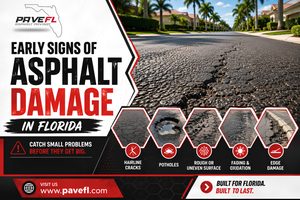
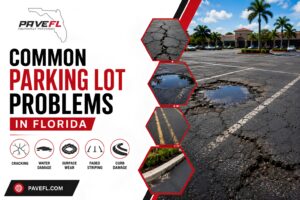
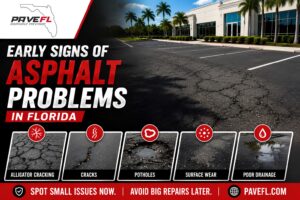
Common Types of Asphalt Cracks in Florida
Not every crack has the same cause or requires the same treatment.
| Crack Type | Typical Appearance | Potential Concern |
|---|---|---|
| Hairline cracks | Very thin surface lines | Early surface aging |
| Longitudinal cracks | Run generally parallel to pavement direction | Construction, traffic, or movement |
| Transverse cracks | Cross the pavement | Temperature or material movement |
| Block cracks | Form interconnected rectangular patterns | Oxidation and aging |
| Edge cracks | Develop along pavement edges | Weak support or drainage |
| Alligator cracking | Interconnected network resembling scales | Possible structural/base failure |
Identifying the type of cracking helps determine whether preventative maintenance is appropriate or whether the pavement requires a deeper evaluation.
1. Seal Cracks Before Water Gets Inside
One of the most important ways to prevent asphalt deterioration is to address cracks while they’re still relatively small.
Crack sealing places a flexible material into the damaged area, helping reduce the ability of water to penetrate through the pavement.
This is especially important in Florida because frequent rainfall can turn a small crack into an entry point for moisture.
Why early crack sealing matters:
- It reduces water infiltration.
- It helps prevent cracks from widening.
- It protects supporting pavement layers.
- It slows deterioration around the crack.
- It helps preserve the surrounding asphalt.
Pave FL specifically recommends prompt crack repair because untreated cracks allow moisture to reach deeper pavement layers and potentially contribute to base damage.
2. Maintain Proper Drainage
Good drainage is one of the strongest defenses against pavement deterioration.
Even well-installed asphalt can experience problems if water consistently pools on or around the surface.
Property owners should watch for:
- Standing water after rainfall
- Depressions
- Blocked drains
- Water flowing toward pavement
- Eroded pavement edges
- Repeated potholes in the same area
Pave FL explains that drainage planning is particularly important in Florida because heavy downpours can quickly overwhelm poorly designed or poorly maintained drainage systems.
Why drainage prevents cracks
When water remains around the pavement structure, it can weaken supporting materials and contribute to settlement. As the pavement moves or loses support, cracking becomes more likely.
Keeping drains clear and correcting drainage problems therefore protects more than the surface—it protects the foundation underneath.
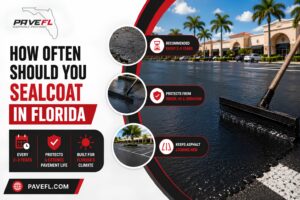
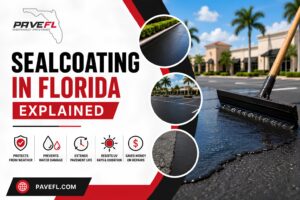
3. Use Professional Sealcoating
Sealcoating provides an additional protective layer over asphalt.
Florida’s intense UV radiation gradually oxidizes exposed asphalt. Sealcoating helps shield the surface from environmental exposure while also helping reduce moisture penetration.
Pave FL describes sealcoating as an important preventative treatment that protects asphalt against UV rays, moisture, oxidation, and surface wear.
Sealcoating can help:
- Slow oxidation
- Protect against UV exposure
- Reduce moisture penetration
- Improve pavement appearance
- Preserve surface flexibility
- Extend the effectiveness of preventative maintenance
However, sealcoating should not be used to cover serious structural problems. Existing cracks and damaged areas should be properly evaluated and repaired before protective treatments are applied.
4. Inspect Asphalt Regularly
Waiting until a pothole develops is not a good maintenance strategy.
Regular pavement inspections help identify early warning signs while repairs may still be relatively localized.
During an inspection, property owners should look for:
- New cracks
- Widening cracks
- Surface fading
- Loose aggregate
- Small depressions
- Standing water
- Edge deterioration
- Early pothole formation
Pave FL recommends routine inspections as part of preventative pavement care because early detection allows property owners to address problems before they spread.
For commercial properties, inspections should also consider high-traffic areas, loading zones, entrances, exits, and locations where water commonly accumulates.
5. Address Potholes Immediately
Potholes and cracks are closely connected.
A crack allows moisture into the pavement. As the supporting structure weakens, the surface can begin breaking apart. Traffic then accelerates the deterioration, potentially turning the damaged area into a pothole.
Pave FL recommends prompt pothole repairs to restore surface integrity and prevent water from continuing to reach underlying pavement layers.
Why delayed pothole repair is risky
A pothole rarely remains isolated forever. Vehicle tires repeatedly impact its edges, causing additional asphalt to break away.
As the opening expands, more water can enter and surrounding pavement becomes increasingly vulnerable.
Early repair helps stop that progression.
6. Make Sure the Asphalt Has a Strong Foundation
Crack prevention begins before the asphalt is even installed.
A pavement system depends on properly prepared supporting layers beneath the surface. If the base or subgrade is unstable, the pavement can settle, shift, or develop stress-related cracking.
Florida’s sandy soils, moisture conditions, and potential erosion make proper preparation particularly important.
Pave FL’s Florida paving guidance emphasizes proper base preparation and compaction as important components of durable asphalt construction.
Professional installation should address:
- Subgrade preparation
- Base material selection
- Proper compaction
- Appropriate asphalt thickness
- Surface grading
- Drainage
- Edge support
A strong foundation gives the asphalt a better ability to withstand traffic and environmental stress.
7. Control Water Around Pavement Edges
Edges are particularly vulnerable because they may have less structural support than the center of a driveway or parking lot.
Water can collect alongside pavement, erode supporting soil, and weaken the edge.
Over time, this may produce:
- Edge cracking
- Crumbling
- Settlement
- Break-off
- Vegetation intrusion
Maintaining clean pavement edges and ensuring water moves away from the asphalt can reduce these risks.
Pave FL notes that soil movement, erosion, and drainage problems can contribute to driveway deterioration in South Florida.
8. Avoid Delaying Minor Repairs
A common pavement-maintenance mistake is assuming that a small crack isn’t important.
A narrow crack might not immediately affect pavement performance, but it creates an opening through which water can enter.
Over time, Florida’s rainfall can repeatedly expose that vulnerable location to moisture.
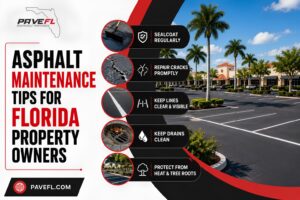
A better approach is:
Inspect → Identify → Repair → Protect → Monitor
This preventative cycle allows property owners to address small defects before they become larger maintenance problems.
9. Protect High-Traffic Areas
Traffic doesn’t affect every section of pavement equally.
Areas receiving repeated vehicle loads experience more stress than lightly used areas.
Common high-stress locations include:
- Driveway entrances
- Parking lot entrances and exits
- Loading zones
- Delivery areas
- Turning areas
- Dumpster locations
- Commercial drive lanes
Heavy vehicle loads can accelerate cracking and deformation, particularly where the pavement structure wasn’t designed for that level of traffic.
Pave FL notes that heavy vehicle loads and ongoing wear are among the factors that contribute to pavement deterioration.
10. Keep the Pavement Clean
Routine cleaning may seem like a cosmetic task, but keeping asphalt clean can support better maintenance.
Oil, fuel, dirt, vegetation, and other contaminants can affect the pavement surface.
Regular cleaning helps property owners:
- See new cracks more easily
- Identify surface deterioration
- Prevent debris accumulation
- Keep drainage paths clear
- Maintain a cleaner appearance
Cleaning doesn’t replace structural maintenance, but it makes regular pavement inspections and preventative care easier.
Asphalt Crack Prevention Checklist
| Maintenance Action | What It Helps Prevent |
|---|---|
| Crack sealing | Water intrusion and crack expansion |
| Sealcoating | UV and oxidation damage |
| Drainage maintenance | Water-related foundation problems |
| Regular inspections | Delayed detection |
| Prompt pothole repair | Spreading pavement deterioration |
| Proper grading | Standing water |
| Base preparation | Settlement and structural cracking |
| Edge maintenance | Edge deterioration |
| Traffic monitoring | Excessive localized stress |
| Routine cleaning | Hidden defects and drainage obstruction |
A combination of these practices is more effective than relying on one maintenance treatment.
When Should Florida Property Owners Repair Cracks?
The best time to address cracks is before they become widespread or structurally significant.
Consider scheduling a professional evaluation when:
- Cracks are getting wider
- New cracks appear frequently
- Several cracks connect together
- Water collects near damaged areas
- Potholes begin forming
- Repairs keep failing
- Pavement begins settling
- Cracking covers large sections of the surface
Pave FL notes that widespread cracking, recurring potholes, and standing water can indicate that pavement problems extend beyond the visible surface.
When Cracks May Indicate a Deeper Problem
Not every crack can be solved with crack filler or sealcoating.
Alligator cracking is particularly important because interconnected cracking can indicate structural problems beneath the asphalt.
Other warning signs include:
- Deep depressions
- Repeated settlement
- Extensive potholes
- Cracks accompanied by soft pavement
- Recurring damage in the same location
- Major drainage problems
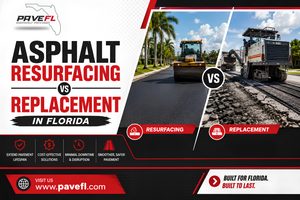
In these situations, a professional should determine whether the pavement needs patching, resurfacing, or more extensive reconstruction.
Pave FL explains that widespread alligator cracking, deep potholes, persistent drainage issues, and uneven or sinking surfaces may indicate that replacement is more appropriate than simply adding a new surface layer.
How Florida Weather Changes Maintenance Requirements
Florida asphalt doesn’t receive much of a seasonal break.
Instead, pavement can experience:
Sun → Heat → Rain → Humidity → Traffic → Repeat
This continuous exposure means maintenance should be proactive.
Pave FL explains that South Florida’s combination of UV radiation, heat, heavy rain, and humidity creates year-round stress on asphalt.
Climate Factor vs. Preventative Response
| Florida Condition | Pavement Risk | Preventative Response |
|---|---|---|
| UV exposure | Oxidation and brittleness | Sealcoating |
| Extreme heat | Softening and deformation | Appropriate materials and design |
| Heavy rain | Water intrusion | Crack sealing and drainage |
| Humidity | Moisture retention | Proper installation and drainage |
| Heavy traffic | Surface stress | Adequate pavement design |
| Soil movement | Settlement | Proper base preparation |
| Storms | Flooding and debris | Drainage planning and inspections |
The goal isn’t to eliminate Florida’s weather—it is to make the pavement better prepared to withstand it.
Preventing Cracks Starts With Proper Installation
Maintenance cannot fully compensate for poor initial construction.
A professionally installed pavement system should be designed around the property’s expected use and environmental conditions.
Important installation considerations include:
Proper Site Preparation
Weak soil or unstable areas should be addressed before paving begins.
Adequate Base
The aggregate base supports the asphalt and helps distribute traffic loads.
Correct Compaction
Proper compaction improves pavement stability and reduces the risk of premature deterioration.
Appropriate Asphalt Mix
Materials should be selected with local climate and traffic demands in mind.
Proper Drainage
Water should move away from the pavement rather than collect around or beneath it.
Pave FL’s paving guidance emphasizes that climate-specific material selection, base preparation, grading, and drainage are important for durable Florida pavement.
Why Professional Asphalt Maintenance Matters
Preventing asphalt cracks Florida property owners encounter requires more than applying a product whenever a crack becomes visible.
Professionals can evaluate whether the problem is:
- Surface-related
- Moisture-related
- Traffic-related
- Drainage-related
- Base-related
- Installation-related
- Age-related
That distinction matters because the wrong treatment can leave the underlying cause untouched.
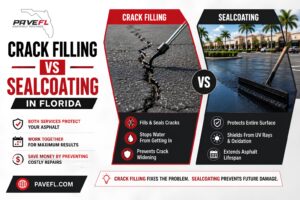
For example, sealcoating can protect a sound pavement surface, but it cannot rebuild a failed base. Similarly, crack filling can seal an opening, but it cannot correct major settlement beneath the pavement.
A professional assessment helps determine the right maintenance strategy for the actual condition of the pavement.
Why Choose Pave FL?
At Pave FL, we understand that Florida pavement requires maintenance strategies designed around heat, UV exposure, rainfall, humidity, traffic, and local ground conditions.
Our team provides comprehensive pavement solutions for residential and commercial properties, including:
- Asphalt paving
- Asphalt repair
- Crack sealing
- Pothole repair
- Sealcoating
- Asphalt resurfacing
- Parking lot maintenance
- Driveway repair
- Drainage correction
- Pavement inspections
Pave FL serves Miami-Dade, Broward, and Palm Beach counties and has more than 15 years of local paving experience. The company emphasizes professional preparation, quality materials, proper drainage, and repair methods designed for South Florida’s environmental conditions.
Our professionals can inspect existing cracks, determine whether they are surface-level or signs of deeper deterioration, and recommend an appropriate repair and maintenance plan. Whether your pavement needs crack sealing, patching, drainage correction, resurfacing, or more extensive work, we can help restore the surface and protect it against future Florida weather exposure.
Final Thoughts
Preventing asphalt cracks Florida property owners face starts with understanding that Florida’s pavement challenges are different from those in colder climates. Intense UV radiation, extreme heat, heavy rainfall, humidity, soil movement, traffic, and drainage problems can all contribute to asphalt deterioration.
The most effective approach is preventative: install asphalt correctly, establish proper drainage, inspect the pavement regularly, seal cracks early, maintain protective sealcoating, repair potholes promptly, and address structural problems before they spread.
A crack may look like a minor cosmetic defect, but it can become an entry point for water and the beginning of more extensive pavement deterioration. With consistent maintenance and professional evaluation, Florida property owners can keep their driveways, parking lots, and other asphalt surfaces smoother, safer, and more durable.
Pave FL can help you stay ahead of asphalt deterioration with professional paving, repair, crack sealing, sealcoating, resurfacing, and maintenance services throughout South Florida. Our experienced professionals can evaluate your pavement, identify the causes of cracking, and provide the appropriate solution to help protect your asphalt through Florida’s demanding year-round conditions.