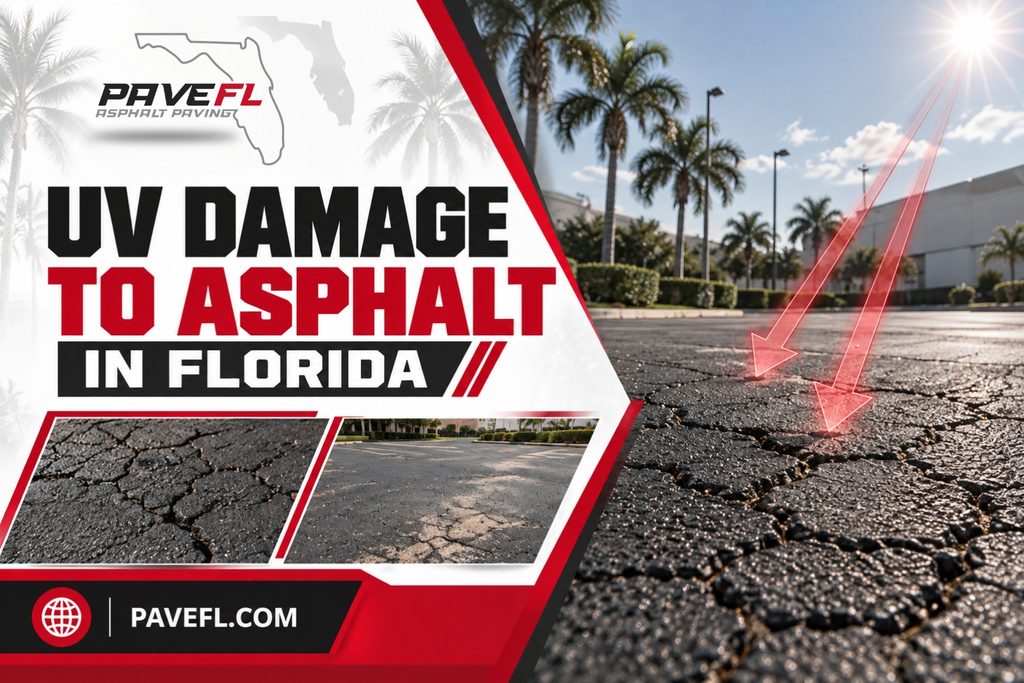
How Does UV Exposure Damage Asphalt in Florida? Why does asphalt gradually turn from dark black to gray, develop a dry appearance, and become more vulnerable to cracking under Florida’s intense sunlight? The answer lies in ultraviolet (UV) radiation and oxidation. Prolonged sun exposure accelerates the aging of the asphalt binder, the material that holds the aggregate together and helps pavement maintain its flexibility. As the binder ages, asphalt can become harder, less flexible, and more susceptible to surface deterioration.
For property owners concerned about asphalt UV damage Florida, understanding how sunlight affects pavement is an important step toward protecting driveways, parking lots, and other asphalt surfaces. Florida’s strong sunshine, high pavement temperatures, frequent rainfall, and humidity can work together to accelerate pavement aging. Without appropriate maintenance, small surface changes can eventually develop into cracks, loose aggregate, and more extensive deterioration.
Pave FL helps property owners maintain asphalt surfaces through professional paving service, sealcoating, crack repair, and pavement maintenance services. By identifying early signs of UV-related deterioration and selecting appropriate treatments, property owners can help protect suitable asphalt and maintain its appearance for longer.
1. Understanding UV Damage to Asphalt
Asphalt pavement contains aggregates held together by an asphalt binder. This binder provides cohesion and helps the pavement accommodate normal traffic and environmental stresses.
However, the binder gradually ages when exposed to oxygen, sunlight, and heat. UV radiation contributes to this aging process, while Florida’s high temperatures can accelerate the effects.
As oxidation progresses, the binder becomes harder and less flexible. The pavement may then become more susceptible to cracking, surface wear, and aggregate loss.
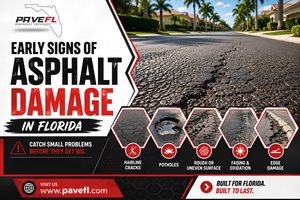
Common signs of UV damage include:
- Asphalt fading from black to gray
- A dry or dull surface appearance
- Small cracks developing across the pavement
- Loose aggregate appearing on the surface
- Increasing surface roughness
- Greater susceptibility to weather-related deterioration
These signs do not automatically mean that the pavement needs replacement. However, they indicate that the surface should be inspected to determine whether preventive maintenance or repairs are appropriate.
2. Why Florida’s Sunshine Creates Additional Challenges
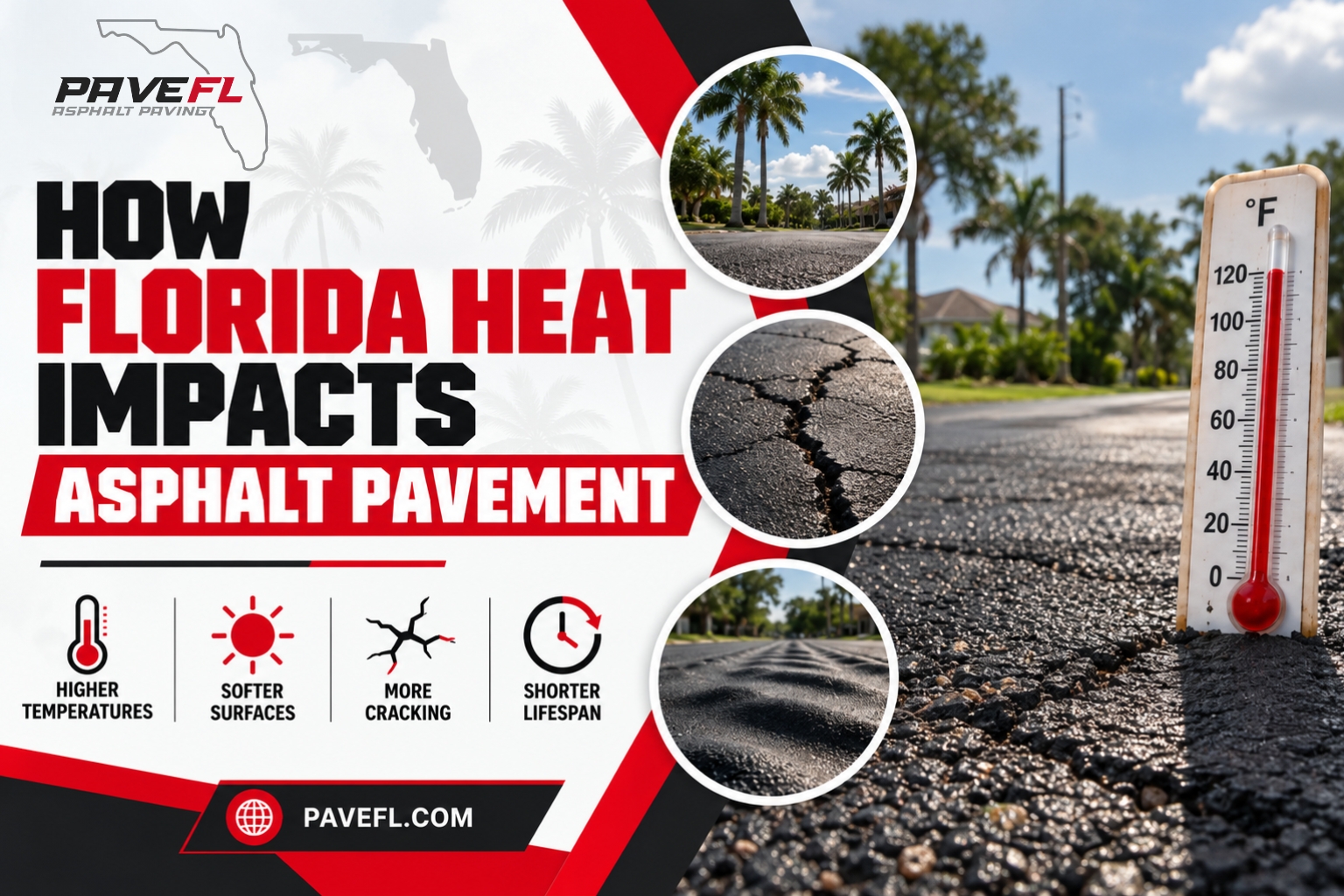
Florida asphalt receives prolonged sunlight throughout much of the year. Unlike regions with long, cold winters, many Florida properties experience continuous exposure to strong sunlight and high temperatures.
This creates several challenges for asphalt pavement.
First, UV radiation contributes to oxidation of the binder. Second, high pavement temperatures can soften asphalt under certain conditions, particularly when materials or pavement structure are unsuitable for the traffic loads. Finally, heavy rainfall can enter existing cracks and contribute to damage beneath the surface.
These factors can compound one another.
For example, an oxidized surface may become more brittle and susceptible to cracking. Once cracks develop, rainwater can enter the pavement and contribute to deterioration of the supporting layers.
Pave FL recognizes UV exposure, extreme heat, and moisture as important considerations in Florida pavement maintenance.
3. How Oxidation Changes Asphalt Over Time
Oxidation is a natural asphalt-aging process. It occurs as the binder reacts with oxygen, gradually changing its physical properties.
UV radiation and heat contribute to faster surface aging, particularly when asphalt remains exposed without suitable maintenance.
The process often develops gradually.

Stage 1: Fresh asphalt
The pavement has a relatively dark appearance and a cohesive surface. The binder helps hold the aggregate together.

Stage 2: Surface fading
Continued exposure to sunlight and oxygen gradually ages the binder. The surface may appear lighter, duller, or less uniform.

Stage 3: Increased brittleness
As the binder loses flexibility, the pavement may become more vulnerable to cracking and surface deterioration.

Stage 4: Advanced surface deterioration
If deterioration continues, cracks may widen and aggregate may loosen. Repairs beyond a protective surface treatment may become necessary.
The speed of this progression depends on the pavement’s age, materials, installation quality, traffic, drainage, and maintenance history.
4. Signs Your Asphalt May Have UV Damage
Recognizing early warning signs helps property owners decide when an inspection is appropriate.
Fading from black to gray
One of the most recognizable signs of asphalt aging is a gradual change in color. Strong sunlight and oxidation can make the pavement appear gray or dull.
Fading alone does not establish that the pavement has structural damage, but it can indicate surface aging.
A dry or brittle appearance
A weathered surface may look dry or rough compared with newer asphalt. This can be associated with aging binder and oxidation.
Small surface cracks
Asphalt that loses flexibility can become more vulnerable to cracking under traffic and environmental stress.
Loose aggregate
When the binder no longer holds surface aggregate as effectively, small stones may begin loosening from the pavement.
Increasing roughness
The surface may become less uniform as weathering and traffic gradually wear away the asphalt.
If several of these signs appear together, a professional pavement evaluation can help identify the underlying cause and determine the appropriate treatment.
5. UV Damage and Asphalt Cracking
Cracking is one of the more important consequences of advanced asphalt aging.
Healthy asphalt accommodates ordinary pavement movement and traffic stresses through its flexible binder and pavement structure. As the binder ages and becomes harder, the surface can become less capable of accommodating those stresses.
Cracks may initially appear as narrow lines. Over time, they can widen or connect with nearby cracks.
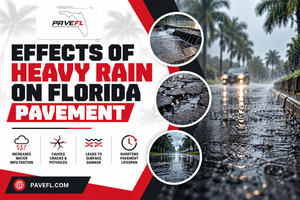
Once cracks form, Florida’s rainfall becomes an additional concern because water can enter the openings.
Why early crack treatment matters
- It helps reduce water entry through suitable cracks.
- It can help limit further deterioration around the damaged area.
- It supports an effective preventive maintenance plan.
- It allows property owners to identify whether deeper repairs are needed.
Pave FL provides asphalt maintenance and repair services to help property owners address pavement damage before it becomes more extensive.
6. The Combined Effect of UV Rays, Heat, and Rain
UV radiation is only one part of Florida’s pavement challenges. Heat and moisture can also affect asphalt, sometimes at the same time.
| Environmental Factor | Effect on Asphalt | Maintenance Consideration |
|---|---|---|
| UV radiation | Accelerates oxidation and surface aging | Inspect fading and surface condition |
| High temperatures | Can soften asphalt under certain conditions | Evaluate rutting and deformation |
| Heavy rainfall | Allows water to enter cracks and damaged areas | Maintain drainage and repair suitable cracks |
| High humidity | Can affect drying and curing conditions | Schedule maintenance under suitable weather conditions |
| Vehicle traffic | Adds repeated stress to the pavement | Monitor worn areas and cracking |
| Tropical storms | Can cause flooding, erosion, and debris damage | Inspect pavement after significant storms |
Because these factors can interact, asphalt maintenance in Florida should address both surface protection and the underlying condition of the pavement.
7. How Sealcoating Helps Protect Asphalt From UV Exposure
Sealcoating is a protective treatment applied to suitable existing asphalt.
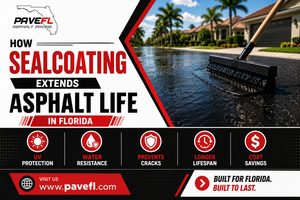
It creates a surface layer that helps reduce direct exposure to sunlight, moisture, and certain contaminants. It can also improve the pavement’s appearance by restoring a darker, more uniform finish.
For property owners concerned about asphalt UV damage Florida, sealcoating can be a useful part of a preventive maintenance program when the pavement remains structurally sound.
Main benefits of sealcoating
- Helps reduce UV exposure: The protective layer reduces direct exposure of the underlying asphalt surface.
- Helps slow surface aging: It can reduce environmental exposure that contributes to oxidation.
- Helps limit moisture penetration: It provides surface protection, although existing cracks and drainage issues still require attention.
- Improves appearance: It can restore a darker, more consistent appearance.
- Supports pavement preservation: It helps maintain suitable asphalt as part of a broader maintenance plan.
Sealcoating does not reverse advanced oxidation or restore failed pavement structure. Significant cracks, potholes, severe rutting, and base problems need appropriate repairs rather than simply being covered with sealant.
8. Why Proper Surface Preparation Matters
Applying sealcoat over a dirty, damaged, or poorly prepared surface can compromise the result.
Before sealcoating, the pavement should be evaluated to identify the repairs and preparation it needs.
A typical process includes:
- Inspecting the asphalt for visible deterioration.
- Cleaning dirt, leaves, and loose debris.
- Identifying and treating appropriate cracks.
- Repairing potholes and other localized damage.
- Checking for drainage concerns.
- Applying the protective coating under suitable conditions.
- Allowing adequate curing time before reopening the surface to traffic.
Pave FL emphasizes pavement preparation and appropriate repairs as part of its asphalt maintenance approach.
Good preparation helps ensure that sealcoating is applied to a suitable surface instead of concealing unresolved problems.
9. How Often Should Florida Asphalt Be Sealcoated?
There is no universal schedule that works for every asphalt driveway or parking lot.
Sealcoating frequency depends on several factors:
- Age of the pavement
- Existing coating condition
- Exposure to direct sunlight
- Traffic volume and vehicle types
- Surface cracking and wear
- Drainage conditions
- Previous maintenance
- Manufacturer and application requirements
Many properties consider sealcoating at intervals of a few years, but the correct timing should be based on the pavement’s actual condition.
Applying sealcoat too frequently is not necessarily beneficial. The surface should be inspected to determine whether another application is appropriate and whether repairs are required first.
10. Practical Ways to Reduce UV-Related Asphalt Deterioration
Although property owners cannot control Florida’s sunshine, they can take steps to maintain their pavement.
Inspect the surface regularly
Look for fading, cracking, rough texture, and loose aggregate. Regular inspections help identify changes before they become more extensive.
Keep the pavement clean
Remove leaves, dirt, and loose debris so that the surface remains easier to inspect.
Address cracks promptly
Have suitable cracks treated before water and traffic contribute to further deterioration.
Maintain proper drainage
Make sure water does not repeatedly collect on or beside the pavement. Persistent pooling may indicate a grading or drainage issue.
Consider sealcoating when appropriate
A protective coating can help preserve suitable asphalt against environmental exposure.
Repair localized damage
Potholes and severely deteriorated areas need appropriate repairs before a surface coating is considered.
Plan maintenance around weather conditions
Sealcoating and pavement repairs require suitable weather and surface conditions. High humidity, rainfall, and unsuitable temperatures can affect application and curing.
These practices help address multiple sources of deterioration rather than focusing on UV exposure alone.
11. Protecting Residential Driveways From UV Damage
Residential driveways are often exposed to direct sunlight for much of the day. Their condition can also be affected by household vehicles, vehicle-fluid leaks, poor drainage, and occasional heavy loads.
Homeowners should watch for fading, small cracks, rough surface areas, and loose aggregate.
A practical residential maintenance routine includes:
- Inspecting the driveway periodically.
- Cleaning away debris.
- Checking for standing water after rain.
- Addressing suitable cracks early.
- Correcting recurring drainage problems.
- Evaluating whether sealcoating is appropriate.
- Arranging repairs for potholes or structural damage.
If a driveway is faded but remains structurally sound, preventive maintenance may be sufficient. If it has widespread interconnected cracks, sinking sections, or repeated potholes, a more comprehensive evaluation is advisable.
12. Protecting Commercial Asphalt Parking Lots
Commercial parking lots may experience more demanding conditions than residential driveways because of repeated traffic, turning vehicles, delivery trucks, and concentrated loading.
UV exposure can gradually age the surface, while heavy traffic adds mechanical stress.
Property managers should monitor:
- Fading throughout the parking area
- Cracks near entrances and exits
- Worn turning areas
- Loose aggregate
- Rutting or depressions
- Water pooling
- Damage around drainage structures
Preventive maintenance should account for both the surface condition and the demands placed on the pavement.
Pave FL helps commercial property owners maintain asphalt surfaces through paving, repairs, sealcoating, and related maintenance services.
13. How UV Damage Can Affect Long-Term Pavement Performance
UV-related deterioration can affect more than appearance.
As the binder ages, the pavement may become more vulnerable to cracking and surface wear. If cracks then allow water to reach the supporting layers, the damage may extend beyond the visible surface.
This can create a progression such as:
UV exposure → oxidation → reduced flexibility → increased cracking risk → moisture entry → further deterioration.
This sequence is not inevitable for every driveway or parking lot. Pavement materials, installation quality, traffic, drainage, and maintenance all influence how deterioration develops.
The important lesson is that fading and surface changes should be considered alongside other signs of pavement condition.
14. When Is Sealcoating Not Enough?
Sealcoating is most appropriate when the asphalt remains structurally sound and needs preventive surface protection.
It is not designed to correct:
- Deep potholes
- Severe alligator cracking
- Major settlement
- Deep wheel-path rutting
- Failed pavement foundations
- Significant drainage problems
If these conditions are present, the pavement may need localized repairs, resurfacing, or replacement.
Pave FL can help property owners evaluate their pavement and identify a suitable maintenance or repair approach.
15. How Pave FL Helps Protect Asphalt in Florida
Pave FL understands that asphalt surfaces in South Florida face prolonged sunlight, high temperatures, moisture, and regular traffic.
Its paving and maintenance services can help property owners address these conditions through appropriate pavement care.
Depending on the pavement’s condition and the property’s needs, the company can help with:
- Asphalt paving
- Asphalt repairs
- Crack treatment
- Pothole repairs
- Sealcoating
- Resurfacing
- Ongoing pavement maintenance
The goal is to identify the condition of the existing asphalt, address damage appropriately, and apply protective treatments when they are suitable.
For property owners concerned about UV-related fading, oxidation, and cracking, Pave FL can help determine whether preventive sealcoating or a more extensive repair is the right next step.
16. Asphalt UV Damage: Warning Signs and Recommended Responses
| Warning Sign | Possible Explanation | Recommended Next Step |
|---|---|---|
| Gray or faded asphalt | Surface aging and oxidation | Inspect pavement and consider preventive maintenance |
| Dry or brittle appearance | Aging binder or surface deterioration | Arrange an evaluation if the condition is progressing |
| Small cracks | Aging, traffic stress, or other pavement movement | Assess and treat suitable cracks |
| Loose aggregate | Surface wear or binder deterioration | Evaluate the severity and repair needs |
| Standing water | Drainage or grading problem | Investigate and correct the drainage issue |
| Potholes | Localized pavement deterioration | Arrange an appropriate patch repair |
| Widespread interconnected cracks | Possible structural deterioration | Obtain a professional assessment before sealcoating |
These signs can have multiple causes, so a pavement inspection is the best way to determine which treatment is appropriate.
17. A Simple Annual Asphalt Maintenance Plan for Florida
A planned inspection routine can help homeowners and property managers stay ahead of pavement deterioration.
Spring
Inspect the pavement for cracks, fading, surface wear, and drainage problems. Address damage that developed or became more noticeable during the previous season.
Summer
Monitor the effects of direct sunlight and high temperatures. Consider appropriate repairs or sealcoating when pavement and weather conditions are suitable.
Fall
Clean the pavement, check drainage, and evaluate any maintenance needs before periods of heavier rainfall or tropical weather.
After major storms
Inspect for standing water, erosion, displaced materials, new cracks, and potholes.
Throughout the year
Address visible damage promptly and keep records of inspections, repairs, and sealcoating dates.
This routine can help property owners make maintenance decisions based on the actual condition of their asphalt rather than waiting for major deterioration.
Final Thoughts
UV exposure is an important cause of asphalt aging in Florida. Prolonged sunlight and heat contribute to oxidation, which can make the asphalt binder harder and less flexible. Over time, the surface may fade, develop cracks, and become more vulnerable to deterioration caused by traffic and moisture.
The most effective approach to asphalt UV damage Florida is preventive maintenance. Regular inspections, suitable crack treatment, proper drainage, timely repairs, and sealcoating when appropriate can help protect sound asphalt and maintain its appearance.
Pave FL helps property owners protect their pavement through professional paving, sealcoating, repairs, and maintenance solutions suited to the condition of the surface. By recognizing early signs of UV damage and choosing the right treatment, Florida property owners can make informed decisions about preserving their driveways and parking lots.
The key is to remember that sealcoating helps protect suitable asphalt, but it cannot repair structural damage. Inspect the pavement regularly, address problems early, and seek a professional evaluation when deterioration becomes widespread.