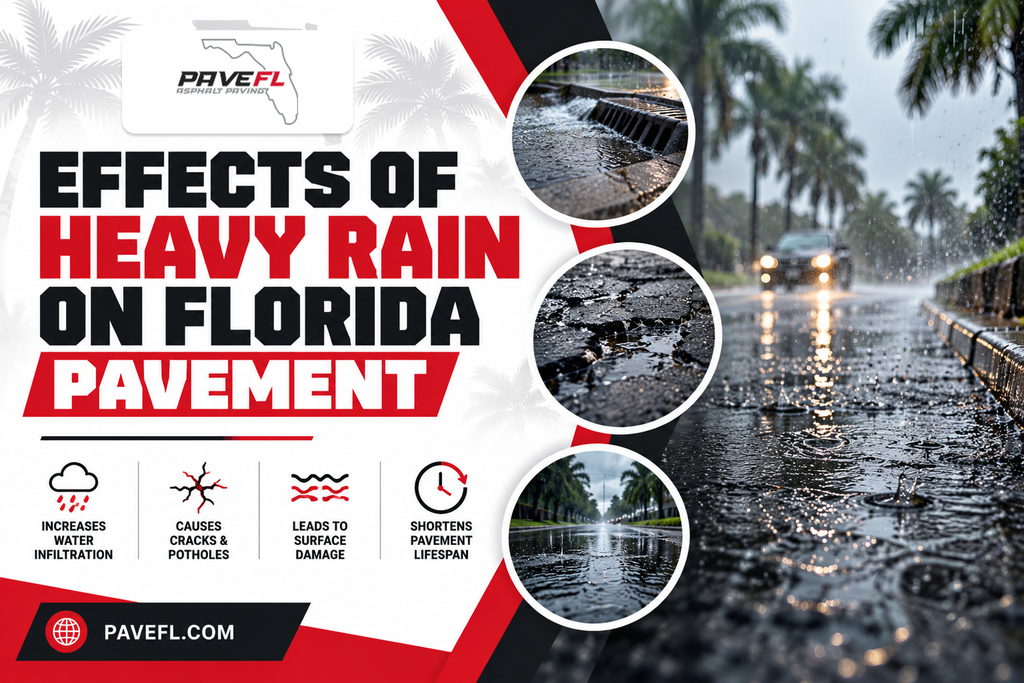
Florida’s frequent heavy rainfall can place significant stress on asphalt pavement. Rain itself does not automatically damage a properly designed and maintained pavement surface, but water becomes a serious concern when it can enter cracks, collect on the pavement, overwhelm drainage, or remain around the pavement foundation.
Once moisture reaches the layers beneath the asphalt, it can reduce the stiffness and strength of supporting materials. Heavy traffic can then make the effects more severe. Research on pavement moisture shows that excessive water can reduce the performance of asphalt, aggregate base, subbase, and soil layers.
This makes asphalt rain damage Florida conditions something property owners should take seriously. A small crack or drainage problem may appear insignificant at first, but repeated rainfall can gradually turn it into a larger pavement issue.
PaveFL can help property owners evaluate these problems and determine whether maintenance, repair, resurfacing, or new pavement is appropriate.
1. Heavy Rain Can Allow Water to Enter Asphalt
A healthy asphalt surface provides a relatively continuous barrier between traffic and the pavement structure underneath.
As asphalt ages, however, cracks, joints, damaged edges, potholes, and other openings can develop.
These defects create pathways for rainwater.
Once water gets beneath the surface, it can affect the supporting layers rather than simply remaining a surface-level problem.
Research on pavement moisture identifies surface cracks and pavement edges as important pathways through which water can enter pavement structures.
Common water-entry points include:
- Asphalt cracks
- Potholes
- Failed patches
- Pavement edges
- Open joints
- Depressed areas
- Damaged drainage locations
This is why maintaining the surface can be an important part of protecting the pavement beneath it.
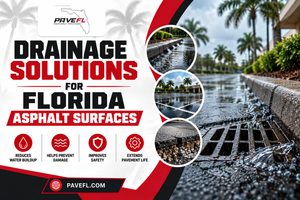
2. Standing Water Can Signal a Drainage Problem
One of the easiest signs of a pavement drainage issue is standing water.
After a heavy storm, some water may temporarily remain on a surface. However, if the same locations repeatedly collect water or remain wet significantly longer than surrounding pavement, the property may have a drainage, grading, or pavement-settlement problem.
Common causes include:
- Poor surface slope
- Settlement
- Depressions
- Blocked drainage
- Damaged drainage features
- Inadequate runoff paths
PaveFL’s Florida pavement guidance also identifies standing water and drainage problems as important warning signs that property owners should monitor.
3. Water Can Weaken the Pavement Foundation
The asphalt surface is only one part of a pavement system.
Beneath it are supporting layers that help distribute traffic loads.
When excessive water saturates these materials, their stiffness can decrease. Research on pavement moisture indicates that saturated aggregate bases and fine-grained soils can experience substantial reductions in stiffness.
This creates a potentially damaging sequence:
Heavy rain → water infiltration → saturated supporting layers → reduced support → traffic loading → pavement deterioration
That is why a pavement problem that appears to be a simple surface defect may sometimes have a deeper cause.
4. Heavy Rain Can Contribute to Potholes
Potholes are often associated with a combination of water, pavement deterioration, and traffic.
A typical progression can look like this:
Step 1: A crack develops
The crack creates an opening in the asphalt.
Step 2: Rain enters
Water moves through the damaged area.
Step 3: Supporting materials weaken
Moisture can reduce the strength or stiffness of underlying layers.
Step 4: Vehicles repeatedly load the area
Traffic places additional stress on the weakened pavement.
Step 5: The damaged section breaks apart
The surface can eventually develop a pothole.
Heavy rainfall does not mean a pothole will automatically form, but moisture can accelerate deterioration when pavement already has defects or drainage problems.
5. Rain Can Make Existing Cracks Worse
A small crack may not immediately cause major pavement damage.
The problem is that an open crack provides a route for water to move below the surface.
With repeated rainfall, moisture can reach areas that would otherwise remain protected.
PaveFL’s existing Florida asphalt guidance notes that cracks can allow water to reach the pavement structure and contribute to deterioration.
Watch for:
- Long transverse cracks
- Longitudinal cracks
- Interconnected cracking
- Cracks near pavement edges
- Cracks around potholes
- Cracking near drainage areas
Early inspection can help determine whether a crack is suitable for maintenance or whether it is part of a larger pavement problem.
6. Heavy Rain Can Cause Edge Damage
Pavement edges can be particularly vulnerable to water.
If runoff repeatedly travels along the edge of a driveway, parking lot, or private roadway, it may contribute to erosion of surrounding soil or supporting materials.
Over time, this can result in:
- Crumbling edges
- Edge settlement
- Exposed base material
- Cracking
- Separation between asphalt and surrounding surfaces
Water does not always attack pavement from directly above. It can also move laterally from the sides.
Research on pavement drainage specifically recognizes pavement edges as potential pathways for water entering the pavement structure.
7. Poor Drainage Can Make Rain Damage More Severe
Rainfall becomes more problematic when water has nowhere to go.
A properly planned pavement system should provide suitable paths for runoff.
When drainage is inadequate, water may:
- Pool on the surface
- Flow toward pavement edges
- Enter cracks
- Remain around the foundation
- Saturate supporting materials
- Erode surrounding soil
Research on pavement drainage emphasizes the importance of removing water that enters pavement systems and reducing the time that pavement materials remain saturated.
This is particularly important in Florida because heavy downpours can deliver large amounts of water over a relatively short period.
8. Heavy Rain Can Affect Pavement After Flooding
A particularly severe rainfall event can produce flooding or prolonged standing water.
Flooding is different from ordinary rainfall because pavement and its supporting layers may remain saturated for a much longer period.
A recent Florida case study found that flooding can substantially weaken pavement layers and that some effects on the asphalt layer can persist even after underlying materials begin recovering. The researchers also emphasized that the magnitude of damage depends on site-specific conditions and the particular flooding event.
For property owners, this means a pavement surface should be inspected after significant flooding rather than assuming that it returned to normal once the water disappeared.
9. Heavy Rain and Traffic Can Work Together
Rain alone is only one part of the problem.
Traffic becomes particularly important when pavement materials have been weakened by moisture.
Heavy vehicles place greater loads on pavement than ordinary passenger vehicles.
If the supporting layers have become saturated, repeated traffic can accelerate deformation and deterioration.
This can be especially important around:
- Commercial entrances
- Loading zones
- Delivery areas
- Parking lot drive lanes
- Truck routes
- Frequently used driveways
The combination can be summarized as:
Water weakens → traffic loads → pavement deteriorates
10. Water Can Contribute to Rutting
Rutting is the development of grooves or depressions along vehicle wheel paths.
Heat, traffic, pavement structure, materials, and moisture can all influence rutting.
When water weakens the underlying layers, those layers may provide less support for traffic loads.
Research on pavement moisture indicates that saturation can reduce the stiffness of supporting materials, which can affect overall pavement performance.
Therefore, if rutting repeatedly develops in areas with poor drainage, the drainage and supporting structure should be considered—not just the visible rut.
11. Heavy Rain Can Lead to Soil Erosion Around Asphalt
Water does not only affect asphalt.
Runoff can also move soil around the pavement.
If soil beside the asphalt becomes eroded, the pavement edge may lose support.
This can create:
- Edge cracking
- Settlement
- Gaps beside asphalt
- Crumbling edges
- Uneven pavement
- Additional water pathways
For this reason, property owners should inspect the area surrounding their pavement after particularly heavy storms.
12. Rain Can Expose Existing Pavement Weaknesses
Sometimes heavy rain does not create a pavement problem from scratch.
Instead, it reveals a problem that was already developing.
For example, a pavement may already have:
- Weak base material
- Poor drainage
- Small cracks
- Settlement
- Thin pavement
- Failed patches
A major storm can make those weaknesses much more visible.
This is why property owners should look carefully at pavement after heavy rainfall.
13. Repeated Water Exposure Can Accelerate Asphalt Deterioration
One heavy rain event does not necessarily destroy asphalt.
The greater concern is repeated exposure combined with existing pavement defects.
Over time:
Cracks open → rain enters → moisture remains → supporting materials weaken → traffic adds stress → cracks and surface damage increase
Research on pavement moisture explains that deterioration can accelerate as pavement ages because cracks and other defects provide increasing opportunities for water infiltration.
That makes preventative maintenance particularly useful.
14. Why Florida Asphalt Needs Drainage Planning
Drainage should be considered before asphalt installation—not only after water problems appear.
A paving project should account for:
- Surface slope
- Site grading
- Runoff direction
- Drainage outlets
- Pavement edges
- Existing water-flow patterns
- Soil conditions
- Expected traffic
Proper drainage helps move water away from the pavement instead of allowing it to remain on or beneath the surface.
PaveFL can help property owners consider drainage as part of a broader pavement plan.
15. How Property Owners Can Identify Rain-Related Asphalt Damage
After a significant storm, look for changes in the pavement.
Check for standing water
Does water remain in the same location after the surrounding surface has dried?
Inspect cracks
Have existing cracks become wider or more numerous?
Look for potholes
Did new holes appear after heavy rainfall?
Check pavement edges
Are edges beginning to crumble or settle?
Look for depressions
Are vehicles traveling through areas that appear lower than the surrounding pavement?
Inspect surrounding soil
Has water washed away soil beside the asphalt?
These observations can help identify areas that may need further evaluation.
16. Common Signs of Water-Related Pavement Problems
| Warning Sign | Possible Concern |
|---|---|
| Standing water | Drainage or grading issue |
| New potholes | Moisture + traffic deterioration |
| Expanding cracks | Water infiltration |
| Soft or unstable areas | Possible weakened foundation |
| Edge erosion | Runoff or drainage problem |
| Rutting | Traffic + structural weakness |
| Depressions | Settlement or foundation issue |
| Repeated pavement failure | Underlying drainage or structural problem |
These signs do not automatically identify the exact cause. A professional evaluation may be necessary when deterioration continues or repeatedly returns.
17. How to Protect Asphalt Before Heavy Rain
Property owners can take several practical steps before periods of heavy rainfall.
Maintain drainage areas
Keep drainage paths clear of debris and obstructions.
Address appropriate cracks
Do not allow manageable cracks to remain open indefinitely.
Repair damaged areas
Potholes and failed sections can provide additional entry points for water.
Monitor low spots
Identify areas where water repeatedly collects.
Inspect pavement edges
Look for erosion and loss of surrounding support.
Watch high-traffic areas
Heavy vehicles can accelerate deterioration when pavement has been weakened by moisture.
The objective is not to eliminate every effect of rainfall but to reduce opportunities for water to cause unnecessary pavement damage.
18. What Should Happen After a Major Storm?
After a particularly heavy rainfall or flooding event, property owners should inspect the pavement once conditions are safe and the surface can be properly observed.
Look for:
- New potholes
- Washed-out edges
- New cracks
- Standing water
- Soil erosion
- Depressions
- Loose pavement material
- Damaged drainage areas
If damage is significant or continues to worsen, a professional assessment can help determine the appropriate repair strategy.
19. When Should Asphalt Be Professionally Evaluated?
Professional evaluation becomes particularly useful when:
- Water repeatedly collects on the pavement
- Potholes keep returning
- Cracks continue spreading
- Pavement edges are eroding
- The pavement has settled
- Heavy vehicles use the damaged area
- Flooding has occurred
- Previous repairs have failed
- Drainage problems continue
A recurring pavement problem may indicate that repairing the visible surface alone is not enough.
20. How PaveFL Can Help With Rain-Damaged Pavement
PaveFL can help Florida property owners evaluate asphalt affected by heavy rainfall, drainage problems, moisture infiltration, and recurring surface deterioration.
Depending on the pavement’s condition, the appropriate solution may involve:
- Asphalt repair
- Crack treatment
- Pothole repair
- Resurfacing
- New asphalt installation
- Drainage-related improvements
- Preventive maintenance
The right solution depends on the actual condition of the pavement and the reason the damage is occurring.
For example, repeatedly filling a pothole may not address the underlying problem if water continues entering the pavement foundation. Identifying the cause can help determine a more appropriate long-term approach.
21. Heavy Rain and Asphalt Maintenance Should Be Considered Together
Florida pavement maintenance should account for both the asphalt surface and the surrounding drainage conditions.
A good maintenance approach includes:
Surface inspection + crack maintenance + drainage monitoring + timely repair + professional evaluation
Ignoring one part can undermine the others.
For example, repairing a crack while leaving a major drainage problem unresolved may allow moisture-related deterioration to continue.
Similarly, improving drainage without addressing severely damaged pavement may not restore the surface.
A complete evaluation helps connect these issues.
22. Why Preventive Maintenance Matters
Preventive maintenance is generally easier when pavement is still in reasonably good condition.
Small defects can become larger when water repeatedly enters them.
Regular maintenance allows property owners to:
- Identify cracks earlier
- Monitor drainage
- Address potholes
- Protect pavement edges
- Identify recurring problems
- Plan larger projects
- Reduce unexpected deterioration
PaveFL can help property owners determine what type of maintenance or paving work is appropriate for their property’s condition.
23. Heavy Rain Does Not Automatically Mean Asphalt Will Fail
It is important to make a distinction.
Florida’s rainfall is challenging, but properly designed, constructed, and maintained asphalt can handle wet conditions.
Problems become more likely when several risk factors occur together:
- Poor drainage
- Existing cracks
- Weak pavement foundation
- Heavy traffic
- Standing water
- Repeated flooding
- Poor surface maintenance
The goal is therefore not to prevent rain from touching the pavement.
The goal is to control water and protect the pavement system from unnecessary moisture-related deterioration.
24. Planning New Asphalt for Florida Rainfall
If a property needs new asphalt, drainage should be considered from the beginning.
Before installation, property owners should consider:
Site grading
Where will rainwater naturally flow?
Pavement slope
Will water move away from the surface efficiently?
Drainage features
Are there suitable locations for water to leave the property?
Pavement structure
Is the supporting system appropriate for expected traffic and site conditions?
Edges
Will the pavement edges have adequate support?
Maintenance
How will the pavement be inspected and maintained after installation?
These questions can help create a more complete pavement plan.
For a new asphalt paving service Florida project, considering drainage and rainfall conditions from the planning stage can help reduce avoidable moisture-related problems later.
25. Florida Rainfall, Heat, and Asphalt Work Together
Florida pavement experiences multiple environmental stresses at the same time.
During a typical cycle, asphalt may experience:
Intense heat → high pavement temperature → heavy rainfall → moisture exposure → drying → renewed heat
At the same time, vehicles continue using the pavement.
This combination means Florida asphalt maintenance should not focus on one environmental factor alone.
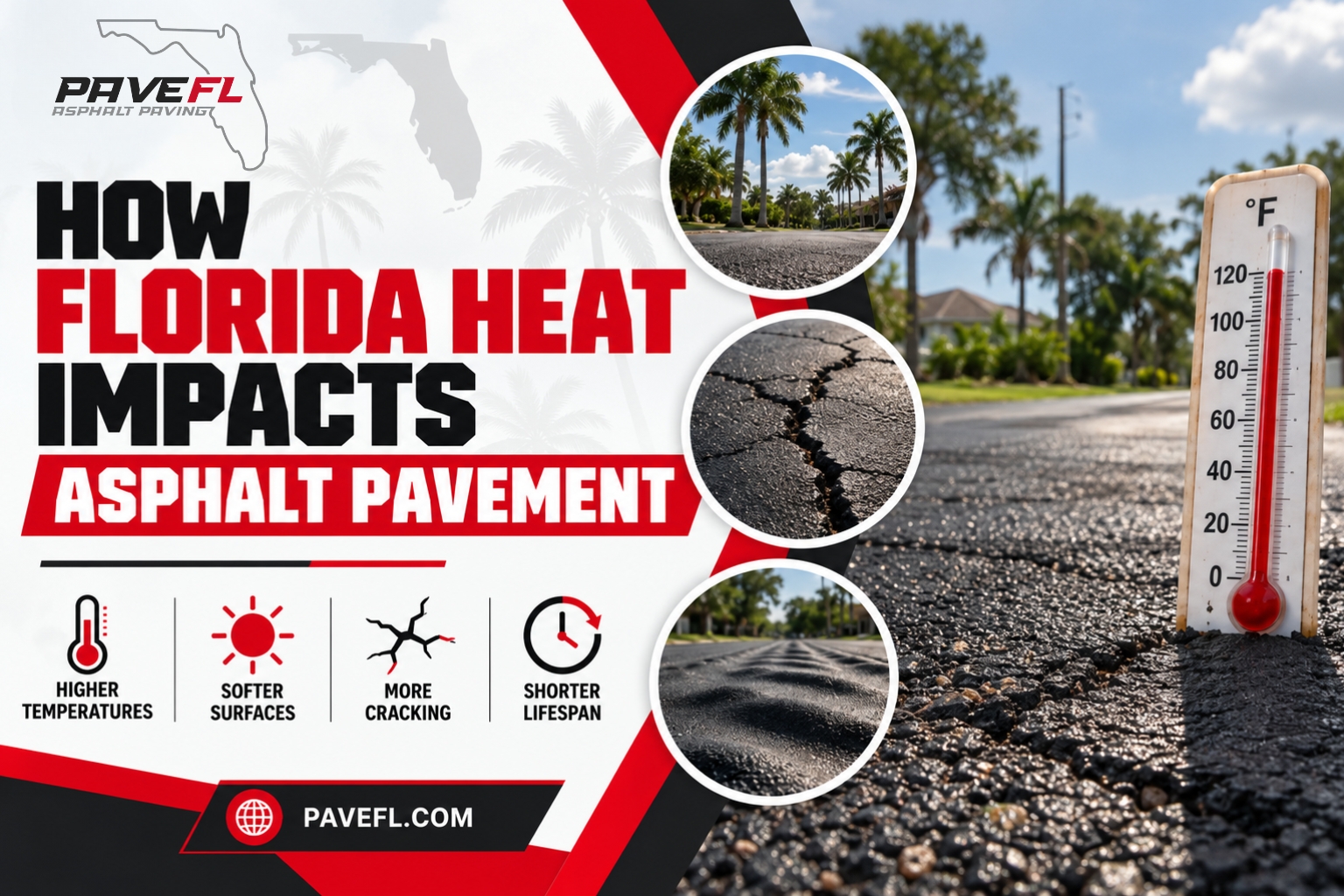
Heat can contribute to softening and aging, while water can enter defects and affect supporting layers.
Together with traffic, these conditions can gradually accelerate deterioration.
Final Thoughts
The effects of asphalt rain damage Florida property owners experience are often connected to how water interacts with the entire pavement system. Heavy rain can enter cracks and damaged edges, collect in low areas, saturate supporting materials, contribute to erosion, and make existing pavement weaknesses deteriorate faster.
The key is not simply to repair the visible damage after every storm. Property owners should also consider why water is reaching the pavement, where it is collecting, and whether the underlying pavement structure has been affected.
Regular inspections, appropriate crack and pothole maintenance, effective drainage, and timely professional evaluation can help Florida property owners manage rainfall-related pavement problems.
PaveFL can help property owners evaluate damaged or aging asphalt and determine whether the appropriate solution is maintenance, repair, resurfacing, or new pavement.
For anyone planning an asphalt paving service Florida project, rainfall and drainage should be considered from the beginning. With proper planning, quality installation, effective water management, and ongoing maintenance, asphalt can be better prepared to handle Florida’s demanding wet-weather conditions.