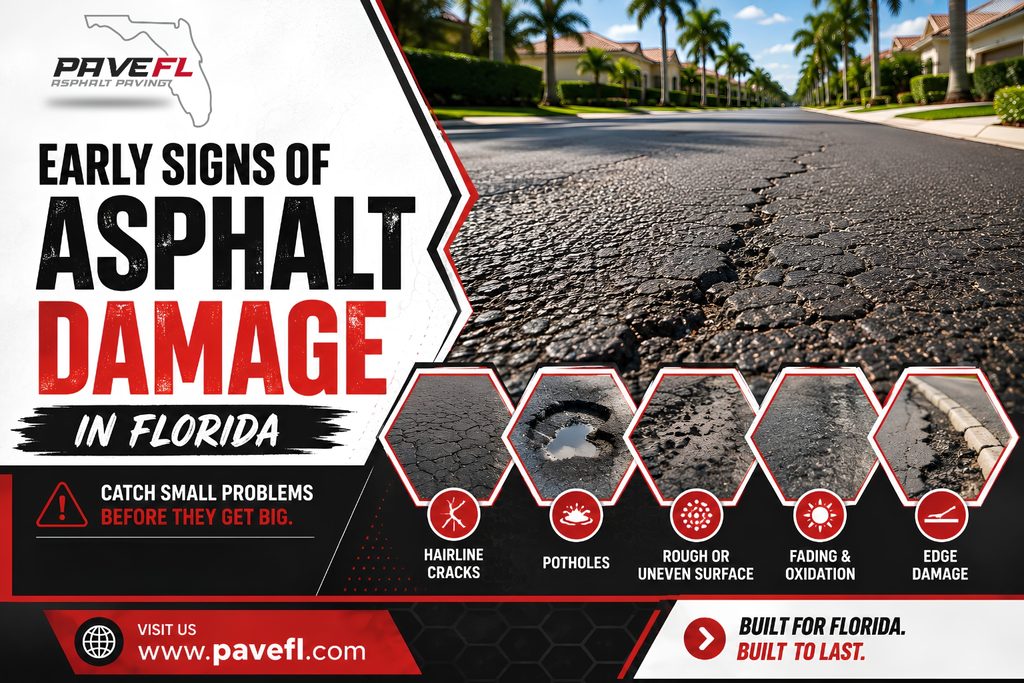
Is Your Florida Asphalt Showing Signs of Damage? Small cracks, fading, uneven areas, loose aggregate, and standing water can all be early warning signs of asphalt damage Florida property owners should not ignore. Florida’s combination of intense heat, strong UV exposure, heavy rainfall, humidity, and constant traffic can accelerate pavement deterioration. A problem that appears minor today can become much more difficult to address when water enters the pavement structure or repeated traffic continues to weaken damaged areas. Pave FL recommends addressing pavement problems early because timely maintenance can help protect the surface and underlying foundation.
Unlike colder climates, Florida asphalt does not primarily face freeze-thaw damage. Instead, the biggest concerns include heat-related softening, UV oxidation, moisture infiltration, drainage problems, soil movement, and traffic stress. Recognizing the warning signs allows homeowners, property managers, and business owners to arrange an evaluation before deterioration spreads.
Why Florida Asphalt Can Deteriorate Quickly
Florida’s weather exposes asphalt to demanding conditions throughout the year. High temperatures can soften the asphalt binder, while UV radiation accelerates oxidation and causes the surface to become dry and brittle. Heavy rain can enter cracks and contribute to moisture-related damage beneath the pavement.
Pave FL identifies several common causes of asphalt deterioration in South Florida, including heat and UV degradation, water infiltration, poor drainage, soil movement, erosion, tree roots, heavy vehicle loads, and normal aging.
This combination makes regular pavement inspections especially important.
1. Small Cracks Appearing on the Surface
One of the earliest and most noticeable signs of pavement distress is cracking.
A few narrow cracks may not appear serious, but they create openings in an otherwise continuous asphalt surface. Rainwater can enter these openings and move toward the underlying pavement layers.
Watch for:
- Hairline cracks
- Long cracks running across the pavement
- Cracks running parallel to the pavement
- Small interconnected cracks
- Cracks near pavement edges
- Cracking around drainage areas
Pave FL explains that cracks can allow moisture to reach the pavement structure, where water can weaken the base and contribute to additional deterioration.
Why early repair matters
The earlier cracks are identified, the easier it is to determine whether crack sealing, localized repair, resurfacing, or another treatment is appropriate.
2. Fading From Black to Gray
Have you noticed that asphalt that was once deep black has gradually become gray?
Color fading can be more than an appearance issue.
Long-term exposure to sunlight and UV radiation causes asphalt binders to oxidize. As oxidation progresses, the pavement can lose flexibility and become more vulnerable to cracking and surface deterioration.
Signs of oxidation include:
- Gray or dull pavement
- A dry-looking surface
- Chalky appearance
- Increasing brittleness
- Small surface cracks
Regular maintenance, including appropriate sealcoating, can help protect asphalt from environmental exposure and slow the effects of oxidation.
3. Loose Aggregate or Rough Texture
Another early warning sign is surface raveling.
Raveling occurs when aggregate particles begin loosening from the asphalt surface. Instead of having a relatively smooth, cohesive texture, the pavement may feel rough or appear covered with small loose stones.
Pave FL identifies raveling as a common asphalt repair concern in South Florida and explains that surface wear can expose pavement to additional heat and moisture damage.
Look for:
- Loose gravel on the pavement
- Rough surface texture
- Small stones accumulating near edges
- Areas becoming increasingly uneven
- Surface material breaking away
Early evaluation can help determine whether the problem can be addressed with surface treatment or requires more extensive rehabilitation.
4. Standing Water After Rain
Florida receives frequent heavy rainfall, making drainage one of the most important aspects of pavement performance.
If water remains on asphalt after a storm, there may be a problem with grading, drainage, settlement, or surface depressions.
Pave FL explains that standing water can seep into cracks and contribute to erosion and weakening of the pavement foundation.
Pay particular attention to:
- Water collecting in the same location repeatedly
- Puddles remaining long after rainfall
- Water near pavement edges
- Depressions around drains
- Areas where cracks and water occur together
Standing water isn’t simply an inconvenience. It can be an indication that the pavement or drainage system needs professional attention.
5. Small Depressions or Uneven Areas
Does part of your driveway or parking lot look slightly lower than the surrounding pavement?
A small depression may indicate changes beneath the asphalt.
Possible contributing factors include:
- Water-related erosion
- Soil movement
- Inadequate compaction
- Base deterioration
- Drainage problems
- Repeated heavy loading
Pave FL notes that uneven surfaces can result from water intrusion and base erosion, particularly under Florida’s heavy rainfall conditions.
Why depressions matter
Low areas can collect water. That water can then contribute to further deterioration, creating a cycle of settlement, pooling, and additional pavement damage.
6. Early Pothole Formation
A pothole usually doesn’t appear without warning.
Before a noticeable pothole develops, surrounding pavement may already show:
- Cracking
- Loose material
- Small depressions
- Weak or soft areas
- Water accumulation
- Broken pavement edges
Pave FL explains that water infiltration and weakened pavement foundations are major contributors to pothole formation in Florida.
Once a pothole appears, traffic can quickly make it larger.
Prompt repair can help:
- Restore surface integrity
- Reduce water infiltration
- Protect surrounding pavement
- Improve driving conditions
- Prevent damage from spreading
A small pothole should therefore be treated as a warning rather than something to ignore.
7. Rutting in High-Traffic Areas
Rutting refers to depressions that develop along vehicle wheel paths.
It is particularly relevant for:
- Commercial parking lots
- Drive lanes
- Loading zones
- Frequently used driveways
- Areas exposed to heavy vehicles
Florida’s heat can soften asphalt, and repeated vehicle loading can contribute to permanent deformation. Pave FL reports that extreme pavement temperatures can contribute to rutting, tire scuffing, and deformation in high-traffic areas.
Check high-use areas regularly
If wheel paths are becoming visibly lower than the surrounding surface, professional evaluation can help determine whether the issue is surface-related or connected to deeper pavement structure.
8. Crumbling or Damaged Pavement Edges
The edges of asphalt are particularly vulnerable when they lack adequate support.
Water can collect beside the pavement, erode supporting soil, and contribute to edge deterioration.
Early edge-damage signs include:
- Small pieces breaking away
- Crumbling asphalt
- Cracks running along the edge
- Exposed aggregate
- Soil erosion beside pavement
- Vegetation growing through damaged areas
Pave FL provides asphalt edge repair because broken edges can continue deteriorating when water and traffic remain involved.
Maintaining proper drainage and edge support can help prevent localized deterioration from spreading inward.
9. Alligator Cracking
Alligator cracking is more concerning than a few isolated surface cracks.
It appears as a network of interconnected cracks that resembles the pattern of an alligator’s skin.
This type of cracking can indicate pavement fatigue or problems within the underlying structure.
Pave FL explains that alligator cracking may be associated with deeper pavement or base failure and that damaged areas may require removal and replacement rather than simple surface treatment.
Don’t simply cover extensive alligator cracking
If widespread structural cracking is present, applying a surface treatment without addressing the underlying problem may not provide a lasting solution.
A professional assessment is the better starting point.
10. Repeated Repairs in the Same Location
Have you repaired the same section several times?
Repeated failure can indicate that the visible damage isn’t the real problem.
For example, recurring damage may be connected to:
- Poor drainage
- Weak base material
- Soil movement
- Heavy traffic
- Inadequate previous repairs
- Persistent water infiltration
Pave FL recommends evaluating pavement condition, base stability, drainage, traffic use, and existing damage before selecting a repair method.
If the same defect keeps returning, it’s worth investigating why.
Asphalt Damage Warning Signs at a Glance
| Early Warning Sign | What It May Indicate | Recommended Action |
|---|---|---|
| Small cracks | Surface aging or moisture entry | Inspect and repair |
| Gray/faded surface | Oxidation and UV exposure | Consider protective maintenance |
| Loose aggregate | Raveling or surface wear | Professional evaluation |
| Standing water | Drainage or grading issue | Correct water-management problem |
| Small depressions | Settlement or base concerns | Inspect underlying conditions |
| Small potholes | Moisture and structural deterioration | Prompt patching/repair |
| Wheel-path depressions | Rutting or traffic stress | Professional assessment |
| Crumbling edges | Weak edge support or water damage | Repair edges and drainage |
| Alligator cracking | Possible structural failure | Detailed pavement evaluation |
| Recurring repairs | Underlying unresolved problem | Investigate root cause |
What Causes Early Asphalt Damage in Florida?
Early deterioration is often caused by a combination of factors rather than one specific issue.
Heat and UV Exposure
High temperatures and UV rays can accelerate oxidation and affect asphalt flexibility.
Heavy Rain
Water entering cracks can reach the base and weaken the pavement structure.
Poor Drainage
Standing water creates repeated moisture exposure and can contribute to erosion and pavement settlement.
Heavy Traffic
Repeated vehicle loading can accelerate cracking, rutting, raveling, and general wear.
Soil Movement
Changes in supporting soil can cause settlement and uneven pavement.
Delayed Maintenance
Minor defects become more vulnerable when they remain untreated for long periods.
How to Prevent Early Asphalt Damage
Recognizing damage is only the first step. Preventative maintenance can help extend pavement performance.
Keep Drainage Systems Clear
Make sure drains, channels, and runoff paths remain free of debris so rainwater can move away efficiently.
Seal Cracks Promptly
Crack sealing helps prevent water from entering the pavement structure.
Consider Sealcoating
Appropriate sealcoating can provide additional protection against UV exposure, oxidation, moisture, and surface wear.
Repair Potholes Quickly
Potholes can expand when exposed to continued traffic and rainfall.
Inspect High-Traffic Areas
Pay particular attention to entrances, exits, loading zones, turning areas, and frequently used driveways.
Address Drainage Problems
If water repeatedly pools in one location, repairing the drainage or grading issue may be more important than simply repairing the visible asphalt.
When Should You Call an Asphalt Professional?
You don’t necessarily need professional intervention for every tiny surface imperfection. However, certain warning signs deserve a closer evaluation.
Consider contacting a paving professional if you notice:
- Widespread cracking
- Rapidly expanding cracks
- Repeated potholes
- Standing water
- Severe rutting
- Sunken pavement
- Alligator cracking
- Crumbling edges
- Extensive surface raveling
- Repairs that repeatedly fail
These symptoms can indicate that pavement deterioration has progressed beyond a simple surface issue.
Pave FL evaluates pavement condition, drainage, base stability, traffic use, and existing damage before recommending the appropriate repair approach.
Why Early Detection Saves Your Pavement
The most important lesson for Florida property owners is simple: don’t wait for obvious failure before inspecting your asphalt.
A small crack can allow water to enter. Water can weaken supporting materials. A weakened area can deform under traffic. Deformation can create depressions where additional water collects. Eventually, a localized problem can become a much larger pavement failure.
Pave FL emphasizes early intervention because addressing cracks, potholes, raveling, and drainage problems promptly can help prevent deterioration from spreading.
Routine inspections give property owners an opportunity to identify these problems while they are still manageable.
Residential vs. Commercial Asphalt Damage
The warning signs are similar, but the stresses can differ.
| Residential Properties | Commercial Properties |
|---|---|
| Passenger vehicles | Cars, delivery vehicles, and trucks |
| Driveway cracking | Parking lot cracking |
| Edge deterioration | High-traffic lane wear |
| Water pooling | Large-scale drainage issues |
| Small potholes | Repeated potholes |
| Soil movement | Heavy-load pavement stress |
| Surface fading | Extensive UV and traffic exposure |
Commercial pavement generally requires closer monitoring because traffic volumes and vehicle weights can be substantially higher.
Pave FL provides asphalt repair for residential, commercial, and industrial properties throughout South Florida.
Why Professional Asphalt Evaluation Matters
Two pavement surfaces can look similar but have completely different problems underneath.
One driveway might only need crack sealing and preventative maintenance. Another might have the same-looking cracks but also have base deterioration or drainage problems.
That is why professional evaluation matters.
A proper assessment can examine:
- Crack patterns
- Surface condition
- Base stability
- Drainage
- Pavement age
- Traffic loads
- Settlement
- Previous repairs
- Overall structural condition
Pave FL’s asphalt repair process begins with an inspection before selecting a repair method, allowing the treatment to be matched to the actual condition of the pavement.
Why Choose Pave FL?
At Pave FL, we understand the challenges that Florida’s climate creates for asphalt surfaces. Intense heat, UV exposure, heavy rainfall, humidity, traffic, and drainage issues can all contribute to pavement deterioration.
Pave FL provides asphalt repair solutions for residential, commercial, and industrial properties throughout South Florida. Services include pothole repair, crack repair, alligator-cracking repair, parking lot repair, driveway repair, edge repair, drainage correction, raveling repair, and asphalt removal and replacement when necessary.
The team evaluates the condition of the pavement before determining the appropriate repair method. Depending on the problem, that may involve crack sealing, patching, full-depth repair, drainage correction, resurfacing, or replacement.
Final Thoughts
Recognizing the early signs of asphalt damage Florida property owners encounter can make a significant difference in pavement performance. Small cracks, fading, loose aggregate, standing water, depressions, potholes, rutting, damaged edges, and alligator cracking are all signs that deserve attention.
Florida’s combination of intense sunlight, high temperatures, heavy rainfall, humidity, and year-round traffic can accelerate pavement deterioration.
The best strategy is to inspect asphalt regularly and address problems while they are still localized. Keep drainage systems functioning, repair cracks and potholes promptly, consider appropriate protective maintenance, and investigate recurring problems instead of repeatedly treating only the visible damage.
Pave FL provides professional asphalt repair, maintenance, resurfacing, and paving services throughout South Florida. Whether you’re dealing with early cracking, potholes, raveling, rutting, drainage-related deterioration, or more serious structural damage, a professional pavement evaluation can help identify the right solution before a small problem becomes a major one.