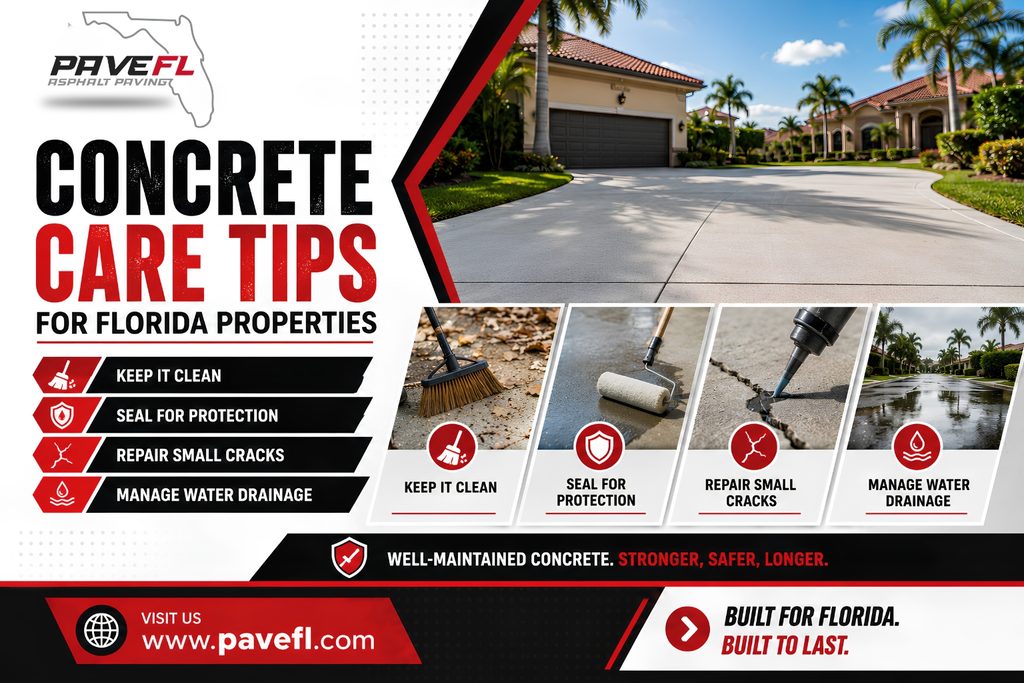
Is your Florida concrete ready for year-round heat and rain? Florida’s climate can be tough on concrete. Intense heat, humidity, heavy rainfall, moisture, soil movement, and everyday traffic can gradually affect concrete surfaces, even when they were professionally installed. The best way to protect your investment is to follow a consistent concrete maintenance Florida property owners can rely on. Regular cleaning, crack repair, joint maintenance, sealing, drainage management, and professional inspections can help preserve both the appearance and performance of concrete driveways, patios, sidewalks, parking areas, curbs, and slabs. Pave FL provides concrete services throughout South Florida and emphasizes durable materials and construction methods designed to handle local heat, rain, and wear.
Concrete is often considered a low-maintenance paving material, but low maintenance does not mean no maintenance. Small cracks, dirty surfaces, damaged joints, standing water, or minor settlement can become more serious when ignored. Florida properties benefit from a proactive maintenance routine because addressing minor problems early can help prevent moisture infiltration, surface deterioration, and more extensive repairs.
Why Florida Weather Affects Concrete
Florida’s weather creates several different stresses for concrete throughout the year.
Intense Heat
High temperatures can cause concrete surfaces to expand. When temperatures change, concrete naturally experiences movement. Properly designed control and expansion joints help manage this movement, but damaged joints or existing cracks can still become pathways for water.
Heavy Rainfall
Florida receives significant rainfall, particularly during the wet season. Water can collect around concrete slabs when drainage or grading is inadequate. Over time, persistent moisture can contribute to soil movement, erosion, settlement, and surface deterioration.
Humidity and Moisture
High humidity keeps outdoor surfaces exposed to moisture for extended periods. Areas that remain damp can also become more susceptible to algae, mildew, staining, and surface discoloration.
Soil Movement
Concrete is rigid, so movement underneath a slab can result in cracking or uneven areas. Pave FL notes that South Florida conditions require careful attention to soil, moisture, grading, and compaction during concrete installation.
Concrete Maintenance Checklist
| Maintenance Task | Recommended Purpose |
|---|---|
| Regular cleaning | Removes dirt, algae, stains, and debris |
| Crack inspection | Identifies problems before they expand |
| Joint maintenance | Helps accommodate normal slab movement |
| Sealing | Adds protection against moisture and environmental exposure |
| Drainage checks | Reduces standing water around slabs |
| Weed removal | Prevents vegetation from affecting joints and edges |
| Surface inspection | Helps identify settlement and deterioration |
| Professional repairs | Addresses damage before it becomes extensive |
Following a maintenance checklist makes it easier to identify small problems before they affect larger sections of a property.
1. Clean Concrete Regularly
One of the simplest ways to care for concrete is regular cleaning.
Outdoor concrete can collect:
- Dirt
- Leaves
- Mud
- Algae
- Mildew
- Oil and automotive residue
- Organic debris
- Other surface contaminants
If these materials remain on the surface for long periods, they can make the concrete appear aged and neglected. Damp debris can also create slippery conditions, particularly on walkways and patios.
Pave FL includes power washing and sealing among its concrete maintenance and repair capabilities.
Why cleaning matters
Regular cleaning allows property owners to maintain appearance while making it easier to spot cracks, stains, settlement, and other developing problems.
For commercial properties, clean concrete can also contribute to a more professional appearance around entrances, walkways, storefronts, and parking areas.
2. Inspect Cracks Before They Become Larger
Small cracks should never automatically be dismissed as cosmetic.
Concrete naturally experiences some movement, but cracks can also be associated with settlement, shrinkage, moisture, heavy loads, or other conditions.
Inspect concrete regularly for:
- Hairline cracks
- Widening cracks
- Cracks around joints
- Cracks near edges
- Multiple interconnected cracks
- Areas where the surface has begun to break away
Pave FL provides concrete crack repair and patching services as part of its concrete maintenance solutions.
Why early attention matters
A crack can allow water to reach areas beneath the slab. In Florida, repeated exposure to rain and moisture can make underlying drainage or soil problems more significant.
Professional evaluation can determine whether a crack requires sealing, patching, joint repair, leveling, or more extensive work.
3. Maintain Concrete Joints
Control joints are an important part of concrete construction.
They provide planned locations where concrete can accommodate some movement and shrinkage.
Over time, however, joints can deteriorate.
Property owners should watch for:
- Missing joint material
- Crumbling joint edges
- Vegetation growth
- Open gaps
- Water entering damaged joints
Pave FL specifically lists joint sealing among its concrete repair and maintenance services.
Keeping joints in good condition can help protect the surrounding slab and reduce opportunities for moisture to enter beneath the concrete.
4. Keep Water Away From Concrete
Proper drainage is one of the most important aspects of maintaining outdoor concrete in Florida.
Water should not consistently remain against or underneath a concrete slab.
Check for:
- Standing water after storms
- Depressed sections
- Blocked drains
- Water flowing toward the slab
- Erosion along edges
- Soil washing away near the concrete
Pave FL emphasizes grading, compaction, and drainage as important components of durable concrete construction in South Florida.
Why drainage matters
If water repeatedly collects around a slab, it can affect the soil supporting that concrete. Soil erosion or movement can eventually contribute to settlement and cracking.
Fixing drainage problems early can therefore protect both the concrete surface and the foundation beneath it.
5. Seal Concrete When Appropriate
Concrete can benefit from professional sealing, particularly when the surface is exposed to moisture, staining, or demanding outdoor conditions.
A suitable sealer can provide an additional layer of surface protection and help reduce moisture and contaminant penetration.
Pave FL offers concrete sealing as part of its concrete maintenance services and describes sealing as part of its approach to protecting concrete surfaces in South Florida.
Sealing can help with:
- Moisture exposure
- Surface staining
- Environmental wear
- Appearance preservation
- General surface protection
Sealing does not repair structural damage, however. Cracks, settlement, or severely deteriorated concrete should be evaluated and repaired before relying on a protective treatment.
6. Remove Algae and Mildew
Florida’s warm and humid conditions can create an environment where algae and mildew develop on outdoor surfaces.
These growths are particularly common in:
- Shaded walkways
- Pool decks
- Patios
- Areas near landscaping
- Damp sections of driveways
- Surfaces with poor drainage
Regular cleaning helps prevent buildup and keeps the concrete looking cleaner.
It can also improve surface usability by reducing slippery organic buildup.
For commercial properties, routine cleaning is particularly important around pedestrian routes and building entrances.
7. Address Concrete Settlement Early
Uneven concrete can result from movement or changes in the supporting soil.
You may notice:
- One section sitting lower than another
- Gaps developing beneath slab edges
- Uneven walkways
- Water collecting in depressed areas
- Cracks appearing alongside settled sections
South Florida’s soil and moisture conditions make proper base preparation and compaction important for long-term concrete performance. Pave FL’s installation process includes excavation, grading, and subbase compaction before concrete placement.
Why settlement shouldn’t be ignored
A small uneven area can affect drainage and create additional stress on the slab. Addressing the underlying issue may help prevent further movement and reduce the chance of more extensive damage.
8. Protect Concrete Edges
Concrete edges can experience additional stress because they are more exposed to impact and environmental conditions.
Driveway edges, walkway edges, and parking-area boundaries should be inspected regularly.
Look for:
- Chipped corners
- Crumbling edges
- Soil erosion
- Cracks along the perimeter
- Vegetation growth
- Exposed supporting material
Maintaining proper edge support can help preserve the shape and stability of the slab.
9. Keep Vegetation Under Control
Plants and weeds can create maintenance issues around concrete.
Vegetation may grow:
- Through damaged joints
- Along pavement edges
- Through existing cracks
- Around drainage areas
Roots and growing vegetation can contribute to movement around vulnerable sections.
Keeping landscaping controlled around concrete helps property owners maintain cleaner edges and makes it easier to identify developing damage.
10. Avoid Excessive Loads on Residential Concrete
Concrete is strong, but every surface has design limitations.
A driveway designed primarily for passenger vehicles should not automatically be treated as a heavy-duty loading area.
Repeated heavy loads can contribute to:
- Cracking
- Settlement
- Surface deterioration
- Edge damage
If a property regularly receives delivery trucks, construction vehicles, or other heavy equipment, the concrete should be appropriately designed for those loads.
Pave FL provides heavy-load slabs for warehouses and delivery zones as part of its concrete paving capabilities, showing the importance of matching concrete construction to its intended use.
11. Repair Damaged Concrete Promptly
Delaying concrete repairs can allow small defects to become more complicated.
For example, a small crack may allow moisture beneath the slab. A damaged joint can permit water and debris to enter. A small area of settlement can change how water flows across the surface.
Pave FL offers crack repair, patching, resurfacing, overlays, grinding, and slab replacement depending on the condition of the concrete.
Professional repairs may include:
- Crack repair
- Concrete patching
- Joint sealing
- Surface grinding
- Concrete overlays
- Slab replacement
- Leveling
- Drainage correction
The correct treatment depends on the cause and severity of the problem.
Concrete Maintenance for Different Areas
Not every concrete surface requires exactly the same care.
| Property Area | Main Maintenance Focus |
|---|---|
| Driveways | Cracks, stains, drainage, vehicle loads |
| Sidewalks | Cracks, settlement, surface cleanliness |
| Patios | Cleaning, sealing, cracks, moisture |
| Pool decks | Cleaning, surface condition, drainage |
| Parking areas | Heavy loads, cracking, joints, drainage |
| Curbs | Edge deterioration and impact |
| Commercial slabs | Structural condition and heavy traffic |
| Walkways | Cleanliness, settlement, cracks, safety |
Understanding how a concrete surface is used helps determine what should be inspected most frequently.
Residential Concrete Maintenance
Homeowners should pay particular attention to driveways, patios, sidewalks, pool decks, and outdoor living spaces.
Driveways
Inspect for cracking, settlement, stains, and drainage problems. Vehicle traffic can gradually expose weak areas.
Patios
Regular cleaning helps control dirt, algae, and staining. Cracks and damaged joints should be addressed before moisture can reach beneath the slab.
Walkways
Uneven sections should receive prompt attention because settlement can affect safe pedestrian movement.
Pool Decks
Pool areas experience frequent water exposure, making drainage, cleaning, surface condition, and sealing particularly important.
Pave FL provides concrete walkways, driveways, patios, curbs, slabs, and decorative finishes for residential properties throughout South Florida.
Commercial Concrete Maintenance
Commercial concrete often experiences considerably more traffic and use than residential surfaces.
Parking areas, loading zones, sidewalks, curbs, and building entrances should be inspected regularly.
Commercial property owners should monitor:
- High-traffic areas
- Loading zones
- Delivery routes
- Pedestrian walkways
- Drainage areas
- Expansion and control joints
- Slab edges
- Areas around drains
Pave FL provides concrete solutions for commercial and industrial properties, including parking areas, loading zones, industrial pads, sidewalks, curbs, and heavy-load slabs.
Signs Your Concrete Needs Professional Attention
Some issues can be handled through routine maintenance, while others require professional evaluation.
Contact a professional when you notice:
- Large or widening cracks
- Significant settlement
- Repeated water accumulation
- Broken slab sections
- Severe surface deterioration
- Damaged joints
- Major edge failure
- Recurring problems after previous repairs
If damage continues to return, the underlying cause should be investigated instead of repeatedly treating only the visible surface.
Concrete Maintenance vs. Concrete Replacement
| Condition | Possible Approach |
|---|---|
| Dirty surface | Professional cleaning |
| Minor surface wear | Cleaning/sealing |
| Small cracks | Crack repair |
| Damaged joints | Joint repair/sealing |
| Minor surface deterioration | Grinding or overlay |
| Uneven slab | Leveling/evaluation |
| Major cracking | Professional structural assessment |
| Severely damaged slab | Partial or full replacement |
This is only a general guide. A professional inspection is the best way to determine the appropriate solution.
Why Professional Concrete Care Is Important in Florida
DIY maintenance can handle simple tasks such as keeping surfaces clean and removing leaves or debris. However, determining why concrete is cracking, settling, or deteriorating requires more experience.
Professionals can evaluate:
- Concrete condition
- Soil stability
- Drainage
- Joint condition
- Surface wear
- Load requirements
- Moisture exposure
- Previous repairs
Pave FL has more than 15 years of local experience and states that its concrete work uses professional preparation, high-quality materials, grading, compaction, and finishing techniques suited to South Florida conditions.
Why Choose Pave FL for Concrete Maintenance?
At Pave FL, we understand that Florida concrete needs to withstand heat, humidity, heavy rainfall, moisture, daily traffic, and changing site conditions. Our team provides concrete solutions for residential, commercial, and industrial properties throughout South Florida.
Our concrete services include:
- Concrete driveways
- Concrete sidewalks
- Patios
- Curbs
- Concrete slabs
- Parking areas
- Loading zones
- Decorative concrete
- Crack repair
- Patching
- Joint sealing
- Surface grinding
- Concrete overlays
- Power washing
- Sealing
- Slab replacement
We focus on proper preparation and long-term performance rather than simply treating the visible surface. Our team can evaluate damaged concrete, identify contributing issues such as drainage or settlement, and recommend an appropriate repair or maintenance approach.
Final Thoughts
Good concrete maintenance Florida property owners follow is about being proactive. Florida’s heat, humidity, rainfall, moisture, soil movement, and everyday use can gradually affect even well-installed concrete. Regular cleaning, inspections, crack repair, joint maintenance, sealing, drainage management, and timely professional repairs can help preserve the condition and appearance of your concrete surfaces.
The most important thing is not to wait until a small problem becomes a major one. A developing crack, damaged joint, drainage issue, or uneven section deserves attention because the visible problem may be connected to conditions underneath the surface.
Pave FL can help with professional concrete maintenance, repair, sealing, resurfacing, and replacement throughout South Florida. Our experienced professionals can assess your driveway, patio, sidewalk, parking area, slab, or other concrete surface and provide the right solution for its condition and intended use.