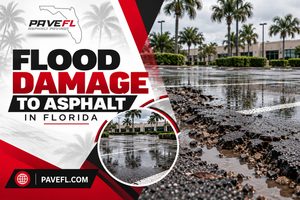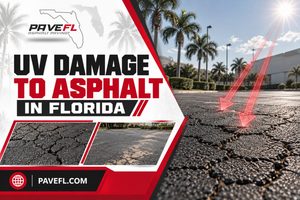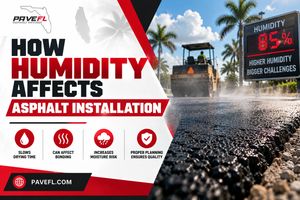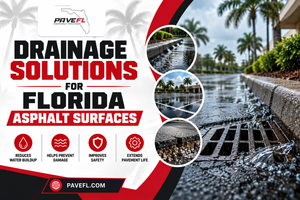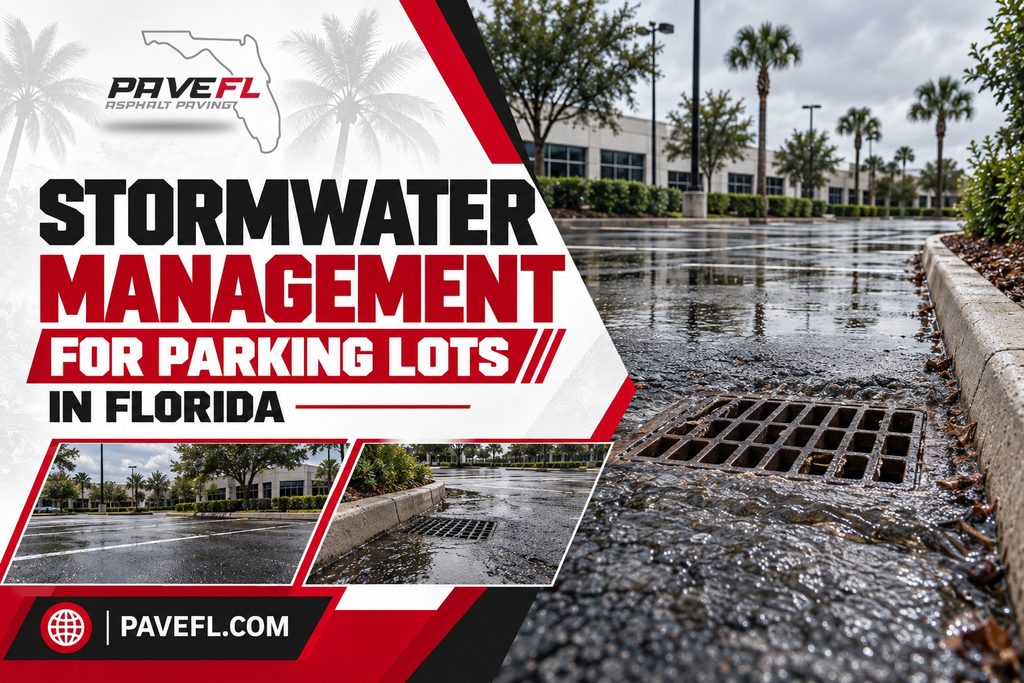
How can property owners improve parking lot drainage in Florida? Effective stormwater management starts with proper grading, suitable drainage inlets, clear water-flow paths, and a system designed to handle local rainfall and site conditions. Because asphalt and other paved surfaces prevent much of the rainwater from soaking directly into the ground, parking lots need a reliable way to collect, convey, store, and manage runoff. Without effective planning, standing water can contribute to pavement deterioration, flooding, erosion, and water pollution.
Florida’s frequent heavy rain, tropical weather, and intense downpours make drainage a critical consideration for commercial properties. Water that collects around parking spaces, entrances, or building foundations can disrupt daily operations and place stress on the pavement. Runoff can also carry sediment, litter, oil, and other pollutants toward storm drains and nearby waterways. The Florida Department of Environmental Protection identifies paved streets, parking lots, and rooftops as common impervious surfaces that generate stormwater runoff.
For property owners, effective stormwater management is about more than moving water off the asphalt as quickly as possible. A well-planned system should also manage runoff volume, reduce pollution, protect surrounding properties, and help preserve the parking lot’s structural condition.
1. Why Stormwater Management Matters for Florida Parking Lots
Parking lots cover substantial areas with asphalt, concrete, and other relatively impermeable materials. When rain falls on these surfaces, less water enters the ground directly, and more must be managed through an appropriate drainage system.
In Florida, intense rainfall can reveal weaknesses in a parking lot’s slope, drainage inlets, low areas, and runoff routes. If the existing system cannot accommodate the water reaching it, puddles and flooding may develop.
Effective stormwater management helps address several important concerns.
Protecting pavement condition: Standing water can enter cracks and reach the underlying pavement layers. When base materials become weakened or the asphalt deteriorates, potholes, settlement, and additional cracking may follow.
Reducing localized flooding: Properly planned grading and drainage infrastructure help move runoff toward designated collection, storage, treatment, or discharge areas.
Protecting buildings and adjacent properties: Water should not be directed toward building entrances, foundations, neighboring land, or pedestrian areas in ways that create hazards or damage.
Limiting water pollution: Runoff from parking lots may collect oil residues, sediment, litter, and other pollutants from vehicles and everyday activity. Suitable treatment measures can help reduce the amount carried into surrounding waters.
Maintaining safe access: Excessive ponding can inconvenience drivers and pedestrians, obscure pavement defects, and affect accessible routes or parking spaces.
A drainage plan should consider these outcomes together rather than focusing only on the visible puddles after a storm.
2. How Florida’s Climate Affects Parking Lot Drainage
Stormwater planning needs to reflect the conditions of the property, including rainfall patterns, soil characteristics, groundwater levels, and the way surrounding land directs water.
Heavy rainfall and sudden downpours
A drainage system may perform adequately during ordinary rainfall but struggle during an intense storm. The amount of runoff depends on factors such as rainfall intensity, the area being drained, the amount of impervious surface, and the capacity of the collection and storage system.
Designers need to assess the relevant rainfall criteria and the consequences of water exceeding the system’s intended capacity.
Tropical storms and hurricanes
Tropical weather can deliver substantial rainfall over a short period or across several days. Debris carried by strong winds may also block catch basins, grates, and surface drainage paths.
Parking lot drainage should therefore include practical maintenance access and consideration of where excess water will travel during larger storms. No system should be assumed capable of eliminating all flooding under every possible weather event.
High groundwater and variable soil conditions
In some parts of Florida, groundwater levels or soil conditions can limit how effectively water infiltrates into the ground. This matters when considering rain gardens, infiltration trenches, or permeable pavement.
An infiltration-based system should not be selected simply because it seems environmentally beneficial. Site-specific assessments must establish whether the soil, groundwater conditions, available space, and applicable requirements make it suitable.
Heat, humidity, and pavement deterioration
Florida’s heat and humidity also affect pavement maintenance. Existing cracks, damaged joints, and deteriorating asphalt can become pathways for moisture.
Drainage management and pavement maintenance should be considered together so that water does not repeatedly collect in areas where the surface or supporting foundation is already vulnerable.
3. Start With a Site and Drainage Assessment
Before adding drains or changing pavement slopes, property owners should understand how water currently moves across the lot.
A professional assessment should consider the parking lot’s overall shape, existing drainage infrastructure, surrounding ground elevations, nearby buildings, pavement condition, and intended use.
Important questions include:
- Where does rainwater collect during and after a storm?
- Which areas drain toward existing inlets?
- Are drainage grates blocked, damaged, or positioned too high relative to the surrounding surface?
- Does water move toward building entrances or neighboring properties?
- Are cracks, depressions, or settled areas contributing to ponding?
- Where does collected stormwater go after entering the drainage system?
- Are existing storage or treatment facilities maintained and functioning as intended?
The assessment should also establish whether the drainage problem comes from surface grading, blocked infrastructure, an undersized system, a damaged pipe, settlement, or another cause.
These issues can look similar from the surface but require different solutions. Installing an additional drain, for example, may not solve a persistent problem if the receiving pipe or downstream system lacks capacity.
4. Proper Grading Helps Direct Stormwater
Grading determines the elevation and shape of the pavement and therefore influences how water travels across the lot.
A parking area should be designed with suitable slopes that guide water toward intended collection points without creating unsafe or inconvenient walking and driving surfaces. The correct grades depend on the project design, drainage requirements, accessibility considerations, and site conditions.
Preventing low spots
Depressions in the pavement can hold water even when the rest of the lot drains properly. These low spots may result from settlement, poor construction, pavement deformation, or changes in the surrounding ground.
If the low area is localized, correcting the surface may be sufficient. If settlement continues or the underlying base has weakened, the supporting materials may also need attention.
Coordinating drainage with parking layout
Parking spaces, driving aisles, pedestrian routes, loading areas, and accessible parking spaces must be considered together when planning surface slopes.
Grading should direct runoff toward suitable collection locations while maintaining functional access and avoiding unintended water accumulation in critical areas.
Avoiding harmful runoff patterns
Water should not be diverted in a way that causes erosion, floods neighboring property, or concentrates flow at an unsuitable outlet. The drainage plan must account for where the water will travel after leaving the paved surface.
5. Drainage Inlets, Catch Basins, and Conveyance Systems
Drainage inlets and catch basins collect surface runoff and direct it into a conveyance system. Depending on the site, water may then travel through pipes, channels, or other infrastructure toward a designated treatment, storage, or discharge point.
These components must work as a complete system. A well-positioned inlet is not enough if its grate becomes blocked or the downstream pipe cannot carry the incoming water.
Place collection points where runoff accumulates
Inlets are typically located according to the drainage design, including the contours of the site and the amount of runoff expected to reach each location.
Low areas, changes in slope, and drainage channels need particular attention. The appropriate number and size of collection structures depend on engineering calculations and site requirements rather than a universal spacing rule.
Keep grates and catch basins clear
Leaves, plastic packaging, litter, sediment, and other debris can restrict the entry of water. This can cause ponding even when the wider drainage system remains functional.
Routine inspections should include cleaning accessible grates and checking for visible damage or signs of blockage.
Check the complete flow path
If an inlet appears clear but water still drains slowly, the issue may be farther downstream. Pipes, channels, discharge points, and associated structures may require inspection by qualified personnel.
Maintenance should address the complete flow path, not just the surface grate.
6. Retention and Detention Systems Help Manage Runoff
Parking lot drainage sometimes requires more than collecting water and moving it through pipes. Storage and treatment facilities can help manage runoff volume and water quality.
The appropriate arrangement depends on the site’s design, available space, soil and groundwater conditions, surrounding land, and regulatory requirements.
Retention systems
Retention systems are designed to retain stormwater for a specified purpose, such as infiltration or other forms of storage and treatment, depending on the system design.
Their ability to manage water depends on the engineered design and the conditions at the site. Infiltration-based approaches may be unsuitable without adequate supporting soil conditions and consideration of groundwater levels.
Detention systems
Detention systems temporarily store water and release it at a controlled rate. Examples can include designed storage ponds or other engineered facilities that regulate runoff during storms.
Detention can help manage the rate at which water leaves a site, but it does not necessarily eliminate runoff or flooding. The system needs appropriate capacity, a suitable outlet, and ongoing maintenance.
Why the difference matters
Retention and detention are not interchangeable labels for every stormwater feature. Designers should determine the performance required of the system and select the arrangement that meets the applicable water-quality and water-quantity requirements.
Florida’s Environmental Resource Permitting framework includes stormwater design and performance requirements. The applicable water management district’s guidance should be checked when a project requires a permit.
7. Green Infrastructure for Parking Lot Stormwater
Green infrastructure uses vegetation, soil, and specially designed surfaces or landscape features to help capture, slow, filter, or infiltrate runoff.
Where site conditions allow, these approaches can complement conventional drainage structures.
Rain gardens and bioretention areas
A rain garden or bioretention area is a landscaped depression designed to receive runoff. Engineered soil and vegetation help filter the water, while the design provides for appropriate storage, infiltration, or underdrainage.
Within a parking lot, these features may be placed in landscaped islands or along the perimeter. Their location, planting, capacity, and overflow provisions should be planned as part of the drainage system.
Bioswales and vegetated channels
Bioswales use vegetation and a designed flow path to help convey and treat runoff. They can slow water and allow certain pollutants to settle or be filtered, depending on their design.
Their suitability depends on site space, slopes, soil, expected flows, and maintenance requirements.
Permeable pavement
Permeable pavement allows water to pass through the surface into an underlying stone storage layer, where it may infiltrate into suitable soil or be collected by an underdrain.
It is not appropriate for every parking lot. Traffic loads, groundwater conditions, soil infiltration, clogging risks, maintenance, and site requirements should be evaluated before choosing this option.
The U.S. Environmental Protection Agency describes permeable pavements, rain gardens, and bioswales as stormwater management options that can be incorporated into suitable parking lot designs.
Green infrastructure should be selected for its ability to meet the project’s needs, rather than added as a decorative feature without a functioning drainage role.
8. Reduce Pollution in Parking Lot Runoff
Stormwater from paved areas can carry contaminants accumulated between rainfall events. These may include sediment, litter, residues from vehicles, and other materials associated with daily property use.
A complete stormwater strategy considers both the quantity of runoff and its potential effect on water quality.
Control litter and sediment
Regular sweeping and litter removal can reduce the material available to wash into drainage inlets. Construction-related sediment should also be managed so it does not enter the stormwater system.
Inspect oil and sediment controls
Some sites may need treatment structures designed to capture sediment, debris, or oil and grease before runoff leaves the property. The appropriate configuration depends on the site’s uses, risks, design standards, and permit requirements.
Maintain landscaped treatment areas
Rain gardens, swales, and other vegetated systems can lose effectiveness if they accumulate excessive sediment, develop erosion, become clogged, or are not maintained.
Inspection and maintenance should follow the design requirements for the particular system.
Avoid improper disposal
Oil, chemicals, paint, and other pollutants should not be washed into parking lot drains. Storm drains may discharge to waterways or connect to systems where the pollutants can affect the environment.
Florida’s NPDES stormwater program addresses discharges associated with covered construction, industrial, and municipal stormwater sources. Whether a particular activity needs permit coverage depends on its circumstances and applicable requirements.
9. How Pavement Design and Drainage Work Together
Stormwater management is most effective when it is integrated into the parking lot design from the beginning.
The pavement slope, asphalt surface, base preparation, drainage inlets, landscaped areas, and stormwater facilities all influence one another. A new asphalt layer cannot solve every drainage problem, particularly when the issue comes from incorrect grading, a blocked outlet, or an unstable foundation.
For properties planning Parking Lot Paving in South Florida, drainage should be considered alongside the pavement layout, base conditions, traffic routes, and areas where water will be collected and managed. This integrated approach helps ensure that the finished surface works as part of the site’s broader stormwater plan. Pave FL’s service page also identifies grading, drainage planning, low-spot correction, and base preparation as important elements of parking lot projects.
When existing pavement may need correction
A parking lot with standing water may need a localized correction, changes to the surface profile, inlet maintenance, or a more extensive drainage upgrade. The remedy depends on why the ponding occurs.
If the pavement is cracked or deteriorated, those defects should be assessed along with the drainage issue. Water repeatedly entering damaged pavement can contribute to further deterioration of the supporting layers.
Why surface work alone may not be enough
A visually smooth surface does not guarantee that the drainage system is functioning correctly. The lot still needs appropriate slopes, working collection points, and a reliable route for runoff.
Stormwater planning should therefore continue through construction and into the property’s maintenance program.
10. A Practical Stormwater Inspection Checklist
A regular inspection routine can help property managers identify developing drainage problems before the next major storm.
| Inspection area | What to check | Why it matters |
|---|---|---|
| Pavement surface | Puddles, depressions, cracks, and settlement | May indicate grading or pavement problems |
| Inlets and grates | Debris, blockage, visible damage | Blockages can restrict runoff entry |
| Catch basins | Sediment buildup and maintenance needs | Accumulated material can reduce function |
| Pipes and outlets | Signs of obstruction, erosion, or unusual discharge | Problems can occur beyond the visible surface |
| Landscaped areas | Erosion, clogged soil surfaces, unhealthy vegetation | Green infrastructure needs to remain functional |
| Retention or detention facilities | Sediment, vegetation problems, damaged structures, and outlet conditions | Storage and treatment capacity depend on the designed system |
| Building edges | Water collecting near entrances or walls | May indicate an undesirable runoff path |
| Parking spaces and accessible routes | Ponding or unsafe surface conditions | Standing water can affect usability and access |
| After major storms | New ponding, erosion, or changed flow patterns | Reveals problems that may not appear during dry weather |
The inspection schedule should reflect the property, the system’s maintenance requirements, and how frequently heavy rain or debris affects the site. Some drainage structures may require professional inspection or cleaning.
11. Warning Signs That Parking Lot Drainage Needs Attention
Some problems are easy to recognize, while others become apparent only during or after rainfall.
Water remains for an unusually long time: Persistent ponding may point to poor grading, a blocked inlet, insufficient capacity, or an underlying depression.
Potholes appear in recurring wet areas: Moisture exposure and deterioration can combine to weaken pavement. The cause of the water accumulation should be investigated along with the asphalt damage.
Water flows toward buildings or adjacent properties: Runoff paths may need to be reassessed to prevent unwanted accumulation or damage.
Erosion develops near outlets or landscaped areas: Concentrated flow may be moving too quickly or entering an area that is not designed to handle it.
Grates repeatedly become blocked: The site may need more frequent maintenance or a review of how debris reaches the drainage system.
Flooding occurs despite clean inlets: The problem may involve system capacity, downstream restrictions, inadequate grading, or another design issue.
Property managers should document the location, timing, and extent of the problem. If the issue persists, a qualified drainage professional can evaluate whether the system is functioning according to its design.
12. Florida Stormwater Regulations and Permitting
Stormwater requirements depend on the project location, scope, environmental conditions, and the kind of drainage work being proposed. A parking lot upgrade may need to comply with local drainage rules and, in some cases, state or water management district permitting requirements.
Florida’s Environmental Resource Permitting program uses district-specific applicant handbooks for relevant permitted stormwater systems. These documents set out design and performance methods used to address water quality and quantity.
For property owners, practical steps include:
- Determine whether the project changes the site’s grading, drainage discharge, storage capacity, or impervious area.
- Confirm applicable city or county drainage requirements.
- Check whether Environmental Resource Permit requirements apply.
- Determine whether stormwater discharge permits or construction-related controls are required for the activity.
- Preserve drainage access and follow required inspection and maintenance provisions.
A contractor should not assume that every parking lot project has the same permitting requirements. New construction, substantial redevelopment, resurfacing, and localized repairs can have different implications depending on what changes at the site.
For major drainage redesigns, property owners should work with appropriately qualified design professionals and the relevant permitting authority.
13. Planning Stormwater Management for New or Existing Lots
A new parking lot offers an opportunity to coordinate the pavement design with drainage before construction begins. The project team can assess how much impervious surface is proposed, identify suitable runoff routes, and plan any required storage or treatment features.
For an existing site, the starting point is different. The goal is to find out why the current system is not functioning as intended and determine which elements need maintenance, repair, or redesign.
Asphalt Paving in South Florida should be coordinated with drainage planning so that the finished pavement, supporting base, surface slopes, and collection points work together. Selecting suitable materials matters, but the overall design must also accommodate local rainfall, traffic, and site-specific conditions.
Property owners should compare possible solutions based on their ability to address the actual problem, comply with applicable requirements, and remain practical to maintain.
A drainage improvement that cannot be accessed for cleaning or inspection may be difficult to keep effective over time. Maintenance access should therefore be considered during planning, not after construction is complete.
Frequently Asked Questions About Parking Lot Drainage in Florida
Why is parking lot drainage important in Florida?
Florida parking lots need to manage heavy rainfall, surface runoff, and pollutants carried by water. Effective drainage helps reduce standing water, protect pavement, limit erosion, and manage runoff before it reaches surrounding properties or waterways.
What causes standing water in an asphalt parking lot?
Common causes include poor grading, depressions, blocked inlets, damaged drainage pipes, and insufficient system capacity. Settlement or pavement deterioration may also contribute. The specific cause should be identified before deciding on a repair.
Can poor drainage damage asphalt?
Yes. Water can enter cracks and reach supporting pavement layers. If the base becomes weakened or the surface deteriorates, cracking, settlement, and potholes may develop or worsen.
Are retention ponds and detention ponds the same?
No. Retention systems are designed to retain stormwater for a specified purpose, while detention systems temporarily store runoff and release it at a controlled rate. Their designs and functions vary, so the appropriate system depends on the project’s requirements.
Can permeable pavement solve parking lot drainage problems?
Permeable pavement can help manage runoff when site and design conditions are suitable. Soil infiltration, groundwater levels, traffic, clogging, maintenance, and any required underdrainage must be considered. It is not the right choice for every site.
How often should parking lot drains be inspected?
The appropriate schedule depends on the drainage design, local conditions, debris levels, and maintenance requirements. Inlets should be checked regularly and after significant storms when safe and practical. Systems that repeatedly clog may require more frequent attention.
Does every parking lot drainage project need a permit?
Not every project has the same requirements. Whether permits or stormwater discharge coverage are needed depends on the scope of work, the site, and the applicable local, district, and state rules. Confirm the requirements before starting drainage construction or making significant site changes.
Can resurfacing fix standing water?
Not automatically. If ponding comes from a surface depression, an appropriate grading correction may help. If the cause is a blocked drain, downstream restriction, or unstable base, additional work may be required. The drainage cause should be established before choosing a pavement treatment.
Conclusion: Build a Parking Lot Drainage Plan That Works With Florida’s Weather
Effective stormwater management is essential for parking lots in Florida because paved surfaces generate runoff during rainfall, and poor drainage can contribute to standing water, pavement deterioration, erosion, and water pollution. A successful plan combines suitable grading, functioning inlets, clear conveyance routes, appropriate storage or treatment measures, and regular maintenance.
The right solution depends on the property’s layout, soils, groundwater conditions, drainage infrastructure, traffic requirements, and applicable regulations. For existing lots, identifying the source of ponding is the first step toward selecting an appropriate correction. For new projects, integrating drainage with pavement design from the start helps avoid costly and disruptive problems later.
Pave FL works with property owners and managers across Miami-Dade, Broward, and Palm Beach counties on parking lot paving and pavement improvement projects. If your property has standing water, drainage-related pavement damage, or a planned parking lot project that needs drainage considerations, contact Pave FL at 786-708-8017 to discuss the site and request a free estimate.