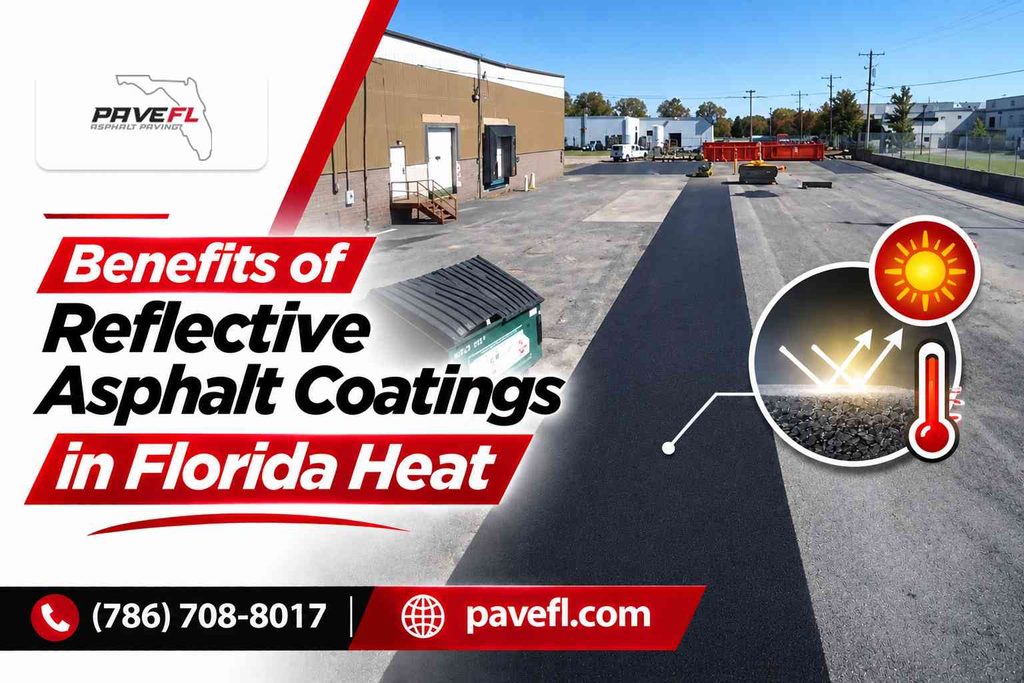
Have you noticed how hot an asphalt driveway or parking lot becomes after hours of direct sunlight? In Florida, dark pavement can absorb significant solar energy, making its surface much hotter than the surrounding air.
This is where reflective asphalt coatings can make a difference.
The benefits of reflective asphalt coatings in Florida heat go beyond changing the appearance of a paved surface. These specialized treatments are designed to reflect more incoming sunlight instead of allowing the pavement to absorb as much solar energy.
For homeowners, commercial property owners, and property managers, this can offer an additional approach to managing heat exposure on suitable asphalt surfaces.
Florida’s combination of strong sunlight, high temperatures, and frequent rainfall creates ongoing challenges for pavement maintenance. Traditional asphalt can gradually experience surface aging, oxidation, and heat-related stress.
A properly selected reflective coating may help reduce some of these effects while improving the performance of exposed pavement surfaces.
At Pave FL, we understand the importance of choosing suitable pavement protection for South Florida’s climate. From residential driveways to commercial parking areas, evaluating the surface condition and selecting appropriate maintenance treatments are important steps toward maintaining asphalt.
What Are Reflective Asphalt Coatings?
Reflective asphalt coatings are specialized surface treatments designed to increase the amount of sunlight reflected by conventional asphalt pavement.
Traditional asphalt has a dark surface that absorbs much of the solar radiation reaching it. This absorbed energy contributes to higher pavement temperatures during sunny weather.
Reflective coatings use specially formulated materials and pigments to change how the surface interacts with sunlight.
One important property is called solar reflectance, which describes how much incoming sunlight a surface reflects.
A related term is albedo. It represents the proportion of incoming solar energy reflected by a material. A higher albedo generally means less solar energy is absorbed by the surface.
The U.S. Environmental Protection Agency (EPA) recognizes reflective coatings as one of several technologies used to create cooler pavements. Other approaches include reflective aggregates, modified pavement materials, and permeable surfaces.
Unlike conventional dark asphalt sealers, reflective treatments are generally designed to increase solar reflectance rather than simply restore a black finish.
This makes them an interesting option for selected paved areas exposed to intense sunlight.
7 Major Benefits of Reflective Asphalt Coatings in Florida Heat
Reflective pavement treatments offer several potential advantages when the correct product is selected and applied to a suitable surface.
Their effectiveness depends on the coating formulation, pavement condition, surrounding environment, and maintenance requirements.
1. Helps Reduce Asphalt Surface Temperatures
One of the main benefits of reflective asphalt coatings in Florida heat is their ability to reduce the amount of solar energy absorbed by the pavement.
Conventional dark asphalt absorbs sunlight throughout the day. As the surface temperature increases, the pavement stores heat and gradually releases it into the surrounding environment.
A reflective coating changes this process by reflecting a greater portion of incoming solar radiation.
This can help keep the treated pavement surface cooler under comparable sunlight conditions.
For properties with extensive exposed asphalt, such as commercial parking lots and residential driveways, managing surface temperature may improve comfort around the paved area.
However, the actual temperature reduction depends on the coating’s reflectance, color, application quality, and environmental conditions.
2. Helps Reduce Heat-Related Pavement Stress
High pavement temperatures can affect asphalt performance.
Asphalt binder is temperature-sensitive. When pavement becomes very hot, the binder can soften, making the surface more susceptible to deformation under repeated vehicle loads.
This is particularly important in areas where vehicles frequently stop, turn, accelerate, or remain parked.
Reflective coatings may help reduce surface heat absorption, which can contribute to lower thermal stress on suitable pavement surfaces.
However, coatings are not a substitute for proper asphalt mixture selection, adequate pavement thickness, or a stable foundation.
Rutting and deformation can also result from poor compaction, excessive loading, and weak supporting layers.
A reflective treatment should therefore be considered one part of a broader pavement maintenance strategy.
3. May Help Slow Surface Aging
Prolonged exposure to sunlight, oxygen, and heat contributes to the aging of asphalt binder.
Over time, the binder can become harder and less flexible. This may increase the pavement’s vulnerability to cracking and surface deterioration.
Certain reflective coating systems are designed to reduce the amount of solar energy absorbed by the surface. Depending on their formulation, they may also provide a protective barrier against environmental exposure.
These properties can help support pavement preservation when the existing asphalt is in suitable condition.
Still, the coating does not reverse advanced oxidation or restore the original flexibility of severely aged asphalt.
Regular inspection and appropriate maintenance remain important for long-term pavement performance.
4. Can Improve Comfort Around Paved Areas
Large asphalt surfaces can contribute to uncomfortable outdoor conditions during Florida’s hot weather.
This is particularly noticeable in exposed parking lots, shared residential spaces, walkways, and other areas where people spend time outdoors.
A reflective pavement treatment may help reduce the surface temperature of selected areas, which can improve comfort near the treated pavement.
Cooler pavement surfaces can also contribute to urban heat mitigation by reducing the amount of heat stored in exposed paved areas.
However, a cooler pavement does not automatically mean a significant reduction in surrounding air temperature.
The overall effect depends on the size of the treated area, nearby buildings, vegetation, wind conditions, and the amount of sunlight reflected into the surroundings.
5. Supports Better Management of Large Asphalt Areas
Commercial properties often contain extensive paved surfaces that receive direct sunlight for much of the day.
Shopping centers, office complexes, community parking lots, and private access roads may experience considerable heat exposure.
Reflective treatments can be considered for suitable areas where reducing solar heat absorption is a priority.
They may be particularly useful when property managers want to explore surface-temperature management without completely replacing the existing asphalt.
However, traffic volume, vehicle turning, braking, and pedestrian movement should be considered before choosing a coating.
The coating must provide suitable surface durability and traction for its intended application.
6. May Support Asphalt Preservation
Pavement maintenance is not only about repairing visible damage. It also involves managing environmental exposure that contributes to deterioration over time.
A suitable reflective coating may help reduce heat-related stress and provide additional surface protection, depending on its formulation.
When used as part of a planned maintenance program, it can complement crack repair, cleaning, drainage management, and other pavement care practices.
The goal is to maintain asphalt that is still structurally sound rather than waiting until major deterioration requires extensive repairs.
7. Can Improve the Appearance of Selected Paved Areas
Reflective asphalt coatings are available in different formulations and finishes.
Some treatments create lighter-colored surfaces, while others use specially designed pigments to achieve higher solar reflectance without relying entirely on a white appearance.
This gives property owners additional choices when considering the appearance of selected paved areas.
For commercial properties, residential communities, and shared outdoor spaces, a suitable finish may help create a more consistent appearance while supporting heat management.
However, product color and reflectance should be selected together. A lighter surface is not automatically the best choice for every property.
Reflective Asphalt Coating vs. Traditional Asphalt Sealcoating
One of the most important things to understand before selecting a coating is the difference between reflective treatments and conventional sealcoating.
Although both are applied to asphalt surfaces, their main purposes are different.
Traditional asphalt sealcoating is generally used to protect suitable pavement against UV exposure, moisture, oil, and surface contaminants. It also restores the dark appearance of aging asphalt.
Reflective coatings are specifically formulated to increase solar reflectance and help reduce heat absorption.
| Comparison Factor | Reflective Asphalt Coating | Traditional Asphalt Sealcoating |
|---|---|---|
| Main purpose | Reflects more sunlight and helps reduce surface heat absorption. | Provides a protective layer against environmental exposure. |
| Solar reflectance | Designed to increase solar reflectance. | Typically maintains or restores a darker asphalt appearance. |
| Surface appearance | May create a lighter or specially formulated finish. | Generally restores a dark black finish. |
| Heat management | Helps reduce solar heat absorption when properly designed. | Not necessarily designed to lower pavement temperatures. |
| UV protection | Depends on the coating formulation. | Helps protect suitable asphalt against UV exposure. |
| Moisture protection | Depends on the product and its application. | Helps reduce water penetration into suitable pavement surfaces. |
| Maintenance | May require cleaning, inspection, and reapplication as performance declines. | Requires periodic inspection and reapplication based on pavement condition. |
Both treatments can have a place in asphalt maintenance, but they should not be considered interchangeable.
Pave FL’s Driveway Seal Coating in South Florida service uses asphalt emulsion sealer and is designed to protect the surface and restore a darker appearance.
Pave FL also discusses lighter-colored and reflective protective treatments where appropriate in its guide to How Temperature Impacts Asphalt Paving Quality in South Florida.
The specific product should always be confirmed before deciding which treatment is suitable for your pavement.
How Do Reflective Coatings Work in Florida’s Hot Climate?
The main purpose of a reflective coating is to change how the pavement surface responds to incoming sunlight.
Conventional asphalt absorbs a large proportion of solar energy because of its dark color and relatively low solar reflectance.
Reflective treatments use pigments and specialized coating materials to increase the amount of sunlight reflected away from the pavement.
The process can be understood through three basic stages.
Stage 1: Sunlight reaches the pavement.
The treated asphalt receives direct and indirect solar radiation throughout the day.
Stage 2: The coating reflects more solar energy.
Instead of allowing as much incoming energy to be absorbed, the reflective surface sends a larger proportion of it back into the surrounding environment.
Stage 3: The pavement absorbs less heat.
With less solar energy absorbed, the surface may remain cooler than conventional dark asphalt under similar weather conditions.
The U.S. EPA identifies cool pavement technologies as useful options for reducing heat absorption in developed areas.
Its guidance also emphasizes that cool pavement technologies include several different approaches, and reflective coatings are only one part of this category.
You can learn more from the EPA’s guide: Using Cool Pavements to Reduce Heat Islands.
Where Can Reflective Asphalt Coatings Be Useful in Florida?
Not every paved surface requires a reflective treatment. The best applications are generally areas where solar exposure and surface temperature are important considerations.
Residential Driveways
Residential driveways often remain exposed to direct sunlight throughout the day.
In South Florida, this can make the surface uncomfortable to walk on and contribute to heat exposure around garages and outdoor areas.
For homeowners interested in Residential Paving in South Florida, reflective coatings may be worth considering as part of a broader pavement maintenance discussion.
The treatment should be suitable for the existing asphalt, driveway traffic, and surrounding property layout.
You can explore Pave FL’s Residential Paving in South Florida services for driveway installation, asphalt replacement, and residential pavement improvements.
Commercial Parking Lots
Large parking lots are particularly interesting applications for cool pavement technologies because they contain extensive exposed asphalt areas.
A properly selected reflective coating may help reduce surface heat absorption and improve conditions around sections of the property where people park or walk.
However, parking lots experience vehicle turning, tire friction, oil exposure, and regular traffic.
The coating must be suitable for those conditions and provide adequate skid resistance.
Private Roads and Community Access Areas
Private roads and residential community access areas may also benefit from selected reflective pavement applications.
However, traffic speed, surface friction, line markings, and the surrounding environment should be considered carefully.
For property owners planning Road Paving in South Florida, reflective treatments may be one additional option to evaluate when considering long-term surface performance.
They should not replace proper pavement design, suitable asphalt mixtures, or structural maintenance.
Commercial Walkways and Outdoor Areas
Certain pedestrian areas and shared outdoor spaces may benefit from cooler pavement surfaces.
Examples include walkways, outdoor gathering areas, and selected paved spaces around buildings.
The selected coating should be designed for pedestrian use and provide suitable traction, particularly during wet conditions.
Important Factors to Consider Before Applying Reflective Asphalt Coatings
Reflective coatings can offer useful benefits, but choosing the wrong product or applying it to unsuitable asphalt may create additional problems.
Before proceeding, property owners should review several important factors.
1. Existing Pavement Condition
The asphalt should be structurally sound before a reflective coating is applied.
Deep potholes, severe cracking, settlement, and failed pavement layers should be addressed first.
A surface treatment cannot repair a damaged base or restore an unstable pavement foundation.
2. Solar Reflectance Performance
Different products have different levels of solar reflectance.
Instead of selecting a coating based only on color, check the manufacturer’s technical information.
Important details include:
- Solar reflectance.
- Thermal emittance.
- Surface temperature performance.
- UV resistance.
- Expected durability.
- Application requirements.
A product with a suitable appearance but poor reflectance may not provide the intended cooling benefit.
3. Skid Resistance and Traction
Surface safety should always be a priority.
Some reflective coatings can change pavement texture and reduce skid resistance if the product is not properly formulated for the intended use.
This matters especially in Florida, where frequent rainfall can leave paved surfaces wet.
Choose a coating with appropriate friction characteristics and confirm that its performance is suitable for vehicle or pedestrian traffic.
4. Glare and Reflected Heat
Increasing solar reflectance can reduce pavement heat absorption, but some reflected energy may affect nearby surfaces.
Very bright coatings can create uncomfortable glare or increase reflected radiant heat toward surrounding buildings and pedestrian spaces.
The layout, coating color, orientation, and surrounding structures should therefore be considered before selecting a treatment.
A moderate reflectance level may be more appropriate than choosing the brightest possible finish.
5. Durability and Maintenance
Reflective performance can decline as the coating is exposed to tires, dirt, UV radiation, moisture, and environmental wear.
A 2024 systematic review of heat-reflective pavement coatings identified abrasion, soiling, and weathering as important factors that can reduce coating reflectance and cooling performance.
This means property owners should consider maintenance needs when evaluating a reflective treatment.
Regular inspection, suitable cleaning, and timely maintenance can help identify when the coating needs attention.
Limitations of Reflective Asphalt Coatings
Reflective treatments are not a universal solution for every asphalt surface.
Understanding their limitations helps property owners avoid unrealistic expectations.
| Limitation | Why It Matters | What to Consider |
|---|---|---|
| Performance varies by product | Not every reflective coating provides the same cooling effect. | Review technical specifications and test information. |
| Surface wear | Tires and environmental exposure can reduce coating effectiveness. | Plan periodic inspections and maintenance. |
| Glare | Highly reflective finishes may affect nearby drivers or pedestrians. | Select a suitable reflectance level and finish. |
| Skid resistance | Some coatings may reduce surface friction. | Confirm suitability for the intended traffic. |
| Existing pavement damage | Surface coatings cannot correct structural problems. | Repair the pavement before application. |
| Environmental exposure | Dirt, moisture, and UV exposure can change coating performance. | Follow product-specific cleaning and maintenance guidance. |
Reflective coatings should be viewed as specialized surface treatments rather than permanent solutions to pavement deterioration.
Their performance depends on product quality, surface preparation, application conditions, and ongoing care.
Reflective Coatings vs. Asphalt Resurfacing: Which Should You Choose?
A reflective coating and asphalt resurfacing solve different pavement problems.
A reflective treatment is intended to change the surface’s solar reflectance and help manage heat absorption.
Asphalt resurfacing involves placing a new asphalt layer over an existing pavement that still has a structurally sound foundation.
If your asphalt is structurally sound but receives intense sunlight, a suitable reflective treatment may be worth evaluating.
However, if the pavement has widespread surface deterioration, significant cracking, or other defects, resurfacing or repair may be more appropriate.
If you are considering Asphalt Resurfacing in South Florida, inspect the existing surface and supporting base before deciding whether an overlay is suitable.
Pave FL offers Asphalt Resurfacing in South Florida for residential and commercial properties.
Choosing between a protective coating and resurfacing should depend on the actual condition of the pavement, not simply the amount of sunlight it receives.
How to Maintain Reflective Asphalt Coatings in Florida
Proper maintenance is necessary to preserve the appearance and performance of coated asphalt.
Florida’s weather exposes paved surfaces to sunlight, rain, humidity, and frequent vehicle traffic. These conditions can gradually affect reflective treatments.
Here are some practical maintenance considerations.
Inspect the surface regularly. Look for peeling, fading, worn areas, or changes in texture.
Keep the surface clean. Dirt and debris can cover reflective pigments and reduce the effectiveness of the coating.
Monitor traffic-related wear. Entrances, turning areas, and parking spaces may experience greater abrasion than less-used sections.
Check drainage conditions. Water should not repeatedly collect on the treated pavement.
Follow product-specific maintenance instructions. Different reflective coatings have different cleaning, curing, and reapplication requirements.
Arrange professional assessments when necessary. Peeling, loss of traction, or widespread deterioration should be evaluated before applying another coating.
A maintenance plan should reflect the coating’s actual condition and the manufacturer’s recommendations rather than relying on a fixed reapplication schedule.
How Pave FL Helps Protect Asphalt in South Florida’s Heat
Maintaining asphalt in South Florida requires attention to more than surface appearance.
Intense sunlight, high pavement temperatures, rainfall, and regular traffic can affect the condition of driveways, parking lots, and private roads.
Pave FL provides asphalt paving and maintenance solutions across South Florida, including:
- Residential asphalt paving.
- Driveway installation and replacement.
- Asphalt sealcoating.
- Asphalt repairs and crack treatment.
- Asphalt resurfacing.
- Parking lot paving.
- Private road paving.
Our approach focuses on evaluating the existing pavement, understanding the property’s requirements, and considering appropriate protective measures.
Pave FL’s existing guidance on How Florida Heat Impacts Asphalt Pavement also discusses lighter-colored and reflective coating options where suitable for the project.
Not every property needs a specialized reflective treatment. Some asphalt surfaces may be better suited to conventional sealcoating, while others may require crack repairs, resurfacing, or more extensive pavement work.
For property owners interested in reflective options, the appropriate product and application should be confirmed based on the surface condition and intended use.
You can also explore our Driveway Seal Coating in South Florida service to understand how conventional asphalt protection can help maintain suitable residential pavement.
Frequently Asked Questions About Reflective Asphalt Coatings
1. What are reflective asphalt coatings?
Reflective asphalt coatings are specialized surface treatments designed to increase solar reflectance. They help reflect more sunlight away from the pavement, reducing the amount of solar energy absorbed by the surface.
2. Do reflective asphalt coatings reduce pavement temperature?
Yes, suitable reflective coatings can reduce pavement surface temperatures under comparable sunlight conditions. The actual result depends on the coating formulation, solar reflectance, surface condition, and environmental exposure.
3. Are reflective coatings the same as regular asphalt sealcoating?
No. Conventional sealcoating generally protects suitable asphalt against UV exposure, moisture, and surface contaminants while restoring a darker appearance. Reflective coatings are specifically designed to increase solar reflectance and help manage surface heat.
4. Can reflective coatings help asphalt last longer in Florida?
They may help reduce heat-related stress when the product is suitable for the pavement. However, pavement lifespan also depends on material quality, foundation stability, traffic, drainage, installation, and regular maintenance. A reflective coating cannot guarantee a specific increase in service life.
5. Are reflective asphalt coatings suitable for residential driveways?
They can be suitable for selected residential applications when the coating is designed for driveway traffic and provides adequate surface friction. The existing pavement should also be structurally sound before application.
6. Can reflective coatings be applied to existing asphalt?
Yes, certain reflective products are designed for existing asphalt surfaces. However, the pavement must be properly prepared, and cracks, potholes, or major defects should be addressed before application.
7. Do reflective coatings require regular maintenance?
Yes. Sunlight, tire abrasion, dirt, and moisture can gradually affect reflectance and coating durability. Regular inspections and product-specific maintenance help maintain performance.
8. Does Pave FL provide asphalt protection services in South Florida?
Pave FL provides driveway sealcoating, asphalt repair, resurfacing, and residential and commercial paving services across South Florida. Specialized reflective coating availability and product suitability should be confirmed for the individual project.
Final Thoughts: Are Reflective Asphalt Coatings Right for Your Florida Property?
Florida’s intense sunlight and high temperatures create ongoing challenges for asphalt pavement. Reflective coatings offer an additional way to manage solar heat absorption and potentially improve conditions around selected paved areas.
From reducing surface heat to supporting pavement preservation, the benefits of reflective asphalt coatings can make them worth considering for suitable residential and commercial applications.
However, the right treatment depends on more than reflectance alone. Existing pavement condition, surface traction, glare, coating durability, and maintenance requirements should all be considered before application.
Traditional sealcoating, reflective treatments, asphalt repairs, and resurfacing each serve different purposes. Understanding these differences helps property owners choose a solution that matches their actual pavement needs.
At Pave FL, customer satisfaction begins with understanding your property’s condition and providing clear guidance about the available paving and maintenance options.
We focus on responsive communication, careful project planning, professional workmanship, and solutions suited to South Florida’s climate.
From discussing your concerns and evaluating your asphalt to explaining suitable protective treatments and completing the necessary paving work, our goal is to keep you informed and supported throughout the process.
We want every homeowner and property manager to feel confident in their decisions and completely satisfied with the service they receive.
Looking for better protection for your asphalt in Florida’s heat? Visit Pave FL to discuss your pavement condition and explore the right maintenance solution for your property.