How Much Does It Cost to Pave a Residential Driveway in Florida in 2026? Planning a new driveway but unsure how much the installation will cost? Understanding the residential driveway paving cost in Florida in 2026 can help you prepare your budget and choose the right paving solution for your property.
Driveway paving costs vary depending on several factors. The total area, selected material, existing ground conditions, labor, and amount of preparation required can all influence the final estimate.
For homeowners in South Florida, these considerations are especially important. The local climate, frequent rainfall, soil conditions, and drainage requirements can affect how a driveway needs to be constructed.
A small residential driveway with a stable foundation may require less preparation than a larger property with uneven ground or an existing damaged surface.
At Pave FL, we provide customized residential paving solutions throughout South Florida. Whether you are planning a new asphalt driveway, replacing an older surface, or considering a different paving material, understanding the project costs can help you make a more informed decision.
This guide explains the main cost components, typical 2026 pricing benchmarks, and the factors that can influence your driveway paving estimate.
Average Residential Driveway Paving Cost in Florida (2026)
The average cost of paving a residential driveway depends on the material and type of installation.
Asphalt is a popular option for homeowners looking for a smooth and practical driveway surface. However, a new installation, complete replacement, and resurfacing project involve different amounts of preparation and materials.
For general 2026 planning, published cost estimates provide the following reference ranges.
| Asphalt Driveway Project | Estimated Cost Per Square Foot | Project Details |
|---|---|---|
| New asphalt driveway | $7–$13 | Includes standard installation and labor in the published national benchmark. |
| Existing driveway replacement | $8–$15 | Includes removal of the existing asphalt and new installation. |
| Asphalt overlay or resurfacing | $3–$7 | Suitable when the existing pavement foundation is structurally sound. |
| Full-depth reconstruction | $8–$12 | A Florida-focused estimate for projects involving more extensive foundation work. |
These figures are general planning estimates, not fixed prices. The first three ranges are based on published 2026 national project data, while the full-depth range comes from a separate Florida-focused estimating guide. Their project scopes and pricing methods differ, so they should not be treated as directly interchangeable.
South Florida homeowners should request a property-specific estimate before making a final budget decision.
Residential Asphalt Driveway Cost by Size
Driveway size is one of the most direct factors affecting the total paving cost. A larger driveway requires more asphalt, additional preparation, and potentially more labor and equipment time.
The following examples use the $7–$13 per-square-foot national benchmark for new asphalt driveway installation.
| Driveway Size | Approximate Area | Estimated Installation Range |
|---|---|---|
| 20 ft × 20 ft | 400 sq. ft. | $2,800–$5,200 |
| 20 ft × 30 ft | 600 sq. ft. | $4,200–$7,800 |
| 20 ft × 40 ft | 800 sq. ft. | $5,600–$10,400 |
| 25 ft × 40 ft | 1,000 sq. ft. | $7,000–$13,000 |
These are illustrative calculations, not South Florida contractor quotations. Actual project costs may differ based on site preparation, material specifications, access, and local conditions.
Why Does Driveway Size Matter?
A longer or wider driveway requires more paving material and increases the area that must be prepared and compacted.
However, size alone does not determine the final price. A relatively small driveway with poor soil conditions may require more preparation than a larger driveway with a stable base.
The layout also matters. Curved driveways, irregular shapes, wider entrances, and additional parking areas can make construction more complex.
Before calculating your budget, measure the actual paved area rather than estimating it based only on the number of vehicles you plan to accommodate.
Cost Breakdown: What Goes Into Residential Driveway Paving?
Understanding the individual parts of a paving project makes it easier to compare estimates and identify where the money goes.
A professional driveway installation generally involves several stages.
1. Asphalt Materials
Materials are a major part of asphalt driveway installation.
The total material requirement depends on the driveway’s dimensions, the selected asphalt mixture, and the planned pavement thickness.
The asphalt must also be suitable for the property’s intended use and local weather conditions.
For example, a driveway designed for regular passenger vehicles may have different material requirements from an access area expected to support heavier vehicles.
Choosing suitable materials is important because a low initial material price does not necessarily provide the best long-term value.
2. Labor and Equipment
Driveway paving requires experienced workers and specialized equipment.
Labor involves preparing the site, handling materials, spreading the asphalt, and compacting the finished surface.
Equipment may include excavation machinery, paving equipment, rollers, and trucks for transporting materials.
The project size, site accessibility, installation method, and amount of preparation required can influence these expenses.
For narrow or difficult-to-access residential properties, the installation process may require additional time and equipment coordination.
3. Site Preparation and Excavation
Before installing a new asphalt driveway, the existing ground must be suitable for construction.
Depending on the property, preparation may include clearing vegetation, removing unsuitable soil, excavating existing pavement, leveling the area, and preparing the foundation.
If the ground has soft spots or uneven sections, additional work may be required to create a stable base.
Site preparation is an important part of the total driveway paving cost in Florida because the finished asphalt depends on the condition of the supporting layers.
4. Base Material and Compaction
The base provides structural support beneath the asphalt.
It helps distribute vehicle loads and creates a stable platform for the finished pavement. The required material and thickness depend on soil conditions, expected traffic, and project specifications.
Proper grading and compaction are essential. A poorly prepared base may contribute to settlement, cracking, and uneven pavement later.
For homeowners planning residential asphalt paving, this is one of the areas worth discussing carefully when reviewing a contractor’s estimate.
5. Grading and Drainage
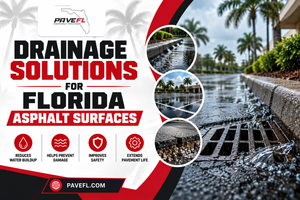
Florida receives frequent rainfall, making drainage an important part of residential driveway construction.
The surface should direct rainwater appropriately instead of allowing it to collect near the garage, foundation, or neighboring property.
Depending on the site, the work may involve adjusting surface elevations, correcting slopes, or integrating suitable drainage features.
A driveway with complicated grading or existing water-management problems may require additional preparation.
6. Removal and Disposal of Old Pavement
A complete driveway replacement generally involves removing the existing surface before installing new asphalt.
This may require breaking up the old material, loading it onto trucks, transporting it, and arranging appropriate disposal or recycling.
The amount of existing pavement, its thickness, accessibility, and disposal requirements can all affect the project estimate.
For this reason, replacing an old driveway usually involves a different scope of work from installing asphalt over an existing stable surface.
7. Edge Treatments and Finishing
Finishing details also influence residential driveway paving costs.
Depending on the design, a project may include:
- Clean asphalt edges.
- Driveway widening or extensions.
- Concrete aprons or transitions.
- Decorative borders.
- Connections to existing walkways or parking areas.
- Final grading around the paved surface.
These details help the finished driveway fit the property’s layout and intended use.
What Factors Affect Driveway Paving Costs in South Florida?
Two homeowners may request similar-sized driveways and still receive different estimates.
This happens because every property has different site conditions and construction requirements.
Here are some of the main factors that influence the cost of residential driveway paving in South Florida.
1. Type of Paving Material
The material you choose affects both the installation process and the overall project budget.
Asphalt, concrete, and paver stones have different material requirements, construction methods, and finishing options.
Asphalt is often selected for its smooth surface and practical installation. Concrete provides another option for homeowners who prefer a different finish, while paver stones offer decorative design possibilities.
Pave FL provides residential paving solutions that include asphalt driveways, concrete work, gravel services, and paver stone decorations.
The right option depends on your property’s requirements, preferred appearance, and intended use.
2. Existing Ground Conditions
The condition of the soil beneath the driveway can significantly affect preparation requirements.
A property with stable, well-compacted ground may need less excavation and base correction.
In contrast, soft areas, uneven soil, existing settlement, or moisture-related problems may require additional work before paving begins.
South Florida properties can have different soil and groundwater conditions depending on their location. This is why a site evaluation is more useful than relying on a standard price per square foot alone.
3. Driveway Thickness
Pavement thickness influences the amount of asphalt and supporting material needed for installation.
The appropriate thickness depends on expected vehicle loads, the condition of the foundation, and the project’s design requirements.
A driveway intended for regular passenger vehicles may have different structural requirements from one that regularly accommodates heavier vehicles.
Reducing the specified thickness simply to lower the initial estimate may affect pavement performance.
4. Property Accessibility
The location and accessibility of the driveway can influence the time and equipment required.
For example, a wide entrance with convenient equipment access may be easier to prepare than a narrow driveway surrounded by landscaping, structures, or limited working space.
Long driveways and properties with complicated layouts may also require additional transportation and installation coordination.
5. Drainage Requirements
Poor drainage can create additional construction requirements.
If water regularly collects on the property, the driveway may need grading adjustments or other drainage-related work.
These improvements should be considered during the initial planning process instead of waiting until after the asphalt has been installed.
6. Location Within South Florida
Residential paving estimates may vary across Miami-Dade, Broward, and Palm Beach counties.
Local labor availability, material transportation, site accessibility, permitting requirements, and project complexity can all influence the final price.
Even homes within the same city may have different paving requirements based on property layout and ground conditions.
This is why homeowners should request an estimate based on their specific property rather than relying entirely on broad regional averages.
New Asphalt Installation vs. Asphalt Resurfacing: Which Costs Less?
Not every driveway needs complete replacement.
Sometimes the existing pavement remains stable, and a new asphalt layer may restore its appearance and usability without requiring full reconstruction.
Understanding the difference between installation, replacement, and resurfacing can help you choose the appropriate service.
New Asphalt Driveway Installation
A new driveway installation involves preparing the site and creating a paved surface where one does not currently exist.
The work may include clearing, excavation, base preparation, grading, asphalt placement, and compaction.
This option is appropriate when creating a new driveway or developing a new paved area.
Complete Driveway Replacement
Replacement involves removing existing damaged pavement and installing a new surface.
The process requires additional demolition and disposal work compared with a straightforward new installation.
It may be necessary when the existing driveway has extensive deterioration or when its supporting structure cannot provide adequate stability.
Asphalt Resurfacing in South Florida
Asphalt resurfacing is generally less extensive than complete replacement because it uses the existing pavement as the foundation for a new asphalt layer.
However, resurfacing is only appropriate when the underlying base remains structurally sound.
It may be suitable for driveways with surface-level cracks, fading, and limited deterioration. Significant settlement, widespread structural cracks, or a failed base may require more extensive work.
If you are considering asphalt resurfacing in South Florida, the condition of the existing pavement should be evaluated first.
Pave FL offers Asphalt Resurfacing in South Florida for residential and commercial properties.
Asphalt vs. Concrete Driveway: What Should Homeowners Consider?
Material selection can influence the initial installation budget, maintenance needs, and overall appearance of your property.
Both asphalt and concrete are used for residential driveways, but they have different characteristics.
| Comparison Factor | Asphalt Driveway | Concrete Driveway |
|---|---|---|
| Appearance | Smooth, dark surface | Available in different finishes and textures |
| Installation | Asphalt placement and mechanical compaction | Formwork, pouring, finishing, and curing |
| Maintenance | May require crack repair and protective maintenance | May require joint care and crack repairs |
| Design flexibility | Primarily traditional dark pavement appearance | More options for decorative finishes |
| Cost considerations | Depends on material, thickness, and preparation | Depends on concrete mix, reinforcement, finishing, and preparation |
| Best suited to | Homeowners seeking a practical paved surface | Homeowners looking for a different appearance or specific concrete applications |
There is no single material that is best for every property.
The decision should consider the driveway’s intended use, soil conditions, drainage, desired appearance, and long-term maintenance preferences.
Pave FL also provides Concrete Contractors in South Florida and Concrete Paving in South Florida for residential and commercial projects.
How to Prepare a Realistic Driveway Paving Budget
Planning your budget becomes easier when you understand the full scope of the work.
Instead of focusing only on the initial asphalt installation price, consider the complete project.
Start by measuring the driveway’s length and width. Multiply those measurements to calculate the approximate square footage.
Next, identify whether you need a new driveway, a complete replacement, or resurfacing.
Then consider whether the existing ground requires excavation, additional base material, grading, or drainage improvements.
Your estimate should clearly explain the following:
- Total driveway area.
- Selected paving material.
- Planned pavement thickness.
- Base preparation requirements.
- Existing pavement removal, if needed.
- Asphalt material and installation labor.
- Grading and drainage work.
- Edge treatments and finishing.
- Applicable permit or approval requirements.
- Cleanup and final project details.
A detailed estimate makes it easier to compare project scopes instead of comparing prices without understanding what each contractor includes.
Common Budgeting Mistakes to Avoid
Homeowners sometimes focus too heavily on the lowest initial price without reviewing the work included in the estimate.
This can create problems when important construction details are overlooked.
Choosing a contractor based only on price: A lower estimate may exclude necessary preparation, material specifications, or finishing work.
Ignoring foundation preparation: Installing asphalt over an unsuitable base can lead to premature pavement problems.
Underestimating driveway size: Small measurement errors can affect the estimated material requirements and total project budget.
Forgetting removal costs: Replacing existing asphalt involves additional work that may not be included in a standard new-installation estimate.
Ignoring drainage: Poor grading and water accumulation can create maintenance problems after installation.
Overlooking project details: Ask whether the estimate includes excavation, base preparation, asphalt placement, compaction, and cleanup.
A complete estimate helps homeowners understand what they are paying for and what to expect from the finished project.
How Pave FL Helps Homeowners Plan Residential Driveway Paving
Choosing a paving service involves more than comparing a few numbers. Homeowners also need to understand the scope of work, material options, and preparation required for their properties.
Pave FL provides residential paving services throughout South Florida, including:
- New asphalt driveway installation.
- Asphalt replacement.
- Driveway resurfacing and recapping.
- Walk paths and parking pads.
- Gravel and loose-fill paving.
- Paver stone decorations.
Our team understands the importance of evaluating driveway layouts, ground conditions, grading, and drainage before starting a project.
Whether you need a new driveway or want to improve an existing paved surface, Pave FL focuses on providing solutions suited to your property’s requirements.
You can explore our Residential Paving in South Florida services to learn more about the available options.
Frequently Asked Questions About Residential Driveway Paving Costs in Florida
1. How much does a residential asphalt driveway cost in Florida in 2026?
Published 2026 national estimates place a new asphalt driveway at approximately $7–$13 per square foot installed. However, the actual cost in South Florida depends on driveway size, site preparation, material requirements, and accessibility.
2. Is asphalt cheaper than concrete for a residential driveway?
Asphalt often has a lower initial installation cost than concrete in many markets. However, the actual price depends on the materials, project design, foundation preparation, and finishing requirements. Homeowners should compare complete project estimates rather than material prices alone.
3. What is the average size of a residential driveway?
Residential driveway sizes vary according to the property layout and the number of vehicles. A 400–800 square-foot area can be used as an illustrative planning range for many common driveway layouts, but actual dimensions should be measured on-site.
4. What makes driveway paving more expensive in South Florida?
Additional excavation, unstable ground, drainage improvements, old pavement removal, difficult equipment access, and custom finishing can increase the project scope and final estimate.
5. Is asphalt resurfacing less expensive than a complete driveway replacement?
Generally, yes. Resurfacing can cost less because it does not require removing the entire existing driveway. However, it is suitable only when the underlying pavement foundation remains stable.
6. Does driveway size affect asphalt installation costs?
Yes. Larger driveways require more materials and usually involve more installation work. However, the final cost also depends on preparation, thickness, site access, and other construction requirements.
7. Does Pave FL provide residential driveway paving estimates?
Yes. Pave FL offers customized residential paving estimates in South Florida. The team evaluates property conditions, project requirements, and the paving services needed to help homeowners understand their options.
8. What should be included in a residential driveway paving estimate?
A detailed estimate should identify the driveway area, materials, pavement thickness, site preparation, base work, labor, equipment, removal requirements, grading, drainage, and finishing details where applicable.
Final Thoughts: Plan Your Driveway Paving Budget With Confidence
The residential driveway paving cost in Florida in 2026 depends on more than the size of the paved area. Material selection, labor, site preparation, pavement thickness, drainage, and existing ground conditions all influence the final project estimate.
For homeowners in South Florida, understanding these factors makes it easier to compare paving options and prepare a realistic budget.
Whether you are planning a new asphalt driveway, replacing an old surface, or considering asphalt resurfacing in South Florida, choosing the right scope of work is essential.
At Pave FL, customer satisfaction begins with understanding your needs and providing clear information about the available paving solutions. We focus on responsive communication, careful project planning, quality materials, and professional workmanship.
From discussing your driveway requirements and evaluating your property to preparing a customized estimate and completing the paving work, our goal is to keep you informed and supported throughout the process.
We want every homeowner to understand the work being performed, feel confident about their decisions, and remain satisfied with the service they receive.
Planning a residential driveway paving project in South Florida? Visit Pave FL to discuss your project and request a customized estimate for your property.