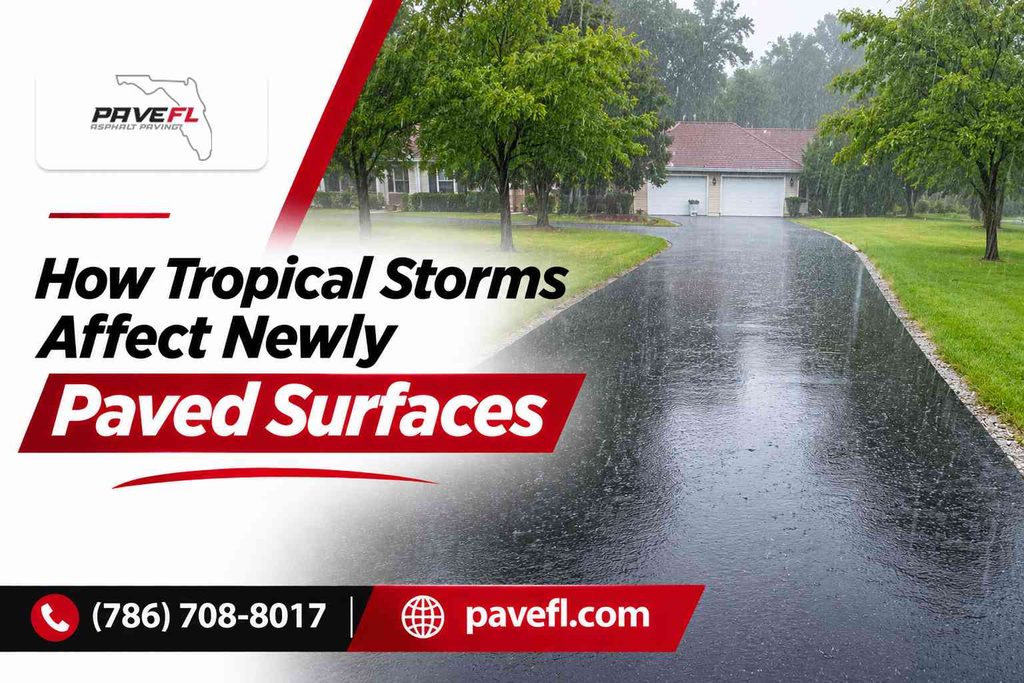
Can a Tropical Storm Damage Your Newly Paved Driveway or Parking Lot? Imagine installing a brand-new asphalt driveway, only to see a tropical storm approach a few days later. Heavy rainfall, strong winds, and possible flooding can raise concerns about whether the new pavement will remain in good condition.
Understanding how tropical storms affect newly paved surfaces is important for Florida homeowners, commercial property owners, and property managers. The timing of the storm, the condition of the pavement, and the quality of installation all influence the potential impact.
A properly prepared and compacted asphalt surface can withstand normal rainfall once it has cooled. However, heavy flooding, fast-moving runoff, soil erosion, and water entering vulnerable pavement areas can create problems.
The situation is different when a storm arrives during asphalt installation or shortly after placement. Rain can cool the asphalt mixture too quickly, interrupt compaction, and interfere with proper bonding.
At Pave FL, we understand the importance of planning paving projects around South Florida’s changing weather conditions. Whether you are installing a residential driveway, resurfacing a parking lot, or improving a private road, proper preparation and weather-aware scheduling help support better pavement performance.
Why Are Tropical Storms a Concern for Newly Paved Surfaces in Florida?
Florida regularly experiences tropical weather systems that can bring intense rainfall, strong winds, and inland flooding.
According to the National Hurricane Center, tropical cyclones can produce widespread heavy rainfall and destructive flooding. The amount of rainfall depends on factors such as storm size, movement, and local geography. National Hurricane Center: Tropical Cyclone Hazards
For newly paved properties, these weather conditions deserve special attention because pavement installation involves several stages.
The asphalt must be placed on a suitable surface, spread at the required thickness, and compacted before the mixture cools too much.
After installation, the pavement also needs protection from unnecessary traffic and other stresses while it cools.
Several tropical storm conditions can affect this process:
- Heavy rainfall: Can interrupt paving operations and interfere with asphalt compaction.
- Flooding: Can affect the supporting soil and surrounding pavement structure.
- Strong winds: May carry branches, sand, and debris onto active construction areas.
- Surface runoff: Can wash away loose soil near newly paved edges.
- Groundwater changes: May affect already vulnerable foundation conditions.
- Restricted access: Storm-related conditions may prevent construction teams from completing inspections or maintenance.
These risks are not the same for every project. A recently installed driveway with a stable foundation may respond differently from a large commercial parking lot with drainage limitations.
How Tropical Storms Affect Newly Paved Asphalt
The effects of a tropical storm depend heavily on when the storm arrives.
A storm during active installation presents different concerns from one that occurs after the asphalt has cooled and opened to traffic.
1. Heavy Rain Can Interrupt Fresh Asphalt Installation
One of the biggest concerns is rainfall during asphalt placement.
Hot Mix Asphalt must be placed and compacted while the mixture remains within a suitable temperature range. Rain can cool the material faster and reduce the time available for proper compaction.
Water on the underlying surface can also interfere with bonding between pavement layers.
If rainwater collects in low areas, placing asphalt over standing water can create additional problems, including moisture-related separation between the binder and aggregate.
Florida Department of Transportation specifications for applicable paving projects prohibit placing asphalt mixtures while rain is falling or when water is present on the surface being covered. The Asphalt Institute also explains how rain-related cooling can make proper compaction more difficult.
This is why experienced paving professionals monitor weather conditions throughout the installation process rather than relying only on the morning forecast.
2. Floodwater Can Affect the Pavement Foundation
Asphalt pavement depends on a stable foundation.
The surface layer, aggregate base, and supporting soil work together to carry vehicle loads. If floodwater remains around a newly constructed driveway or parking lot, it may saturate vulnerable supporting materials.
In some situations, moving water can also remove soil from around pavement edges.
When the foundation loses support, the surface may develop depressions, settlement, or cracking.
This is particularly important for properties with recently disturbed soil, newly placed fill, or areas that already have drainage problems.
3. Surface Runoff Can Erode Newly Prepared Edges
The edges of a newly paved driveway or road need suitable support.
During a tropical storm, fast-moving runoff may travel alongside the pavement and carry away loose soil or aggregate.
This can leave sections of the asphalt edge unsupported.
Property owners may later notice crumbling edges, gaps beside the pavement, or uneven transitions between asphalt and surrounding ground.
Proper edge preparation and suitable grading help reduce this risk.
4. Strong Winds Can Carry Debris Across New Pavement
Tropical storms can produce strong winds that move branches, leaves, landscaping materials, and unsecured objects.
These materials can collect on newly paved surfaces and block nearby drainage paths.
During active construction, blowing sand and debris can also contaminate prepared surfaces or interfere with bonding between pavement layers.
Once the asphalt has cooled, wind alone is unlikely to damage a properly constructed surface. However, falling branches or heavy objects can create localized physical damage.
Keeping the surrounding work area clear and securing loose materials before severe weather arrives can help reduce avoidable problems.
5. Standing Water Can Reveal Drainage Problems
A newly paved surface should have suitable grading to direct water toward appropriate drainage locations.
However, a tropical storm may produce more rainfall than the property’s drainage arrangements can handle.
If water repeatedly collects on the pavement, it may indicate low spots, blocked drainage features, or inadequate surface slopes.
Standing water also makes it harder to identify developing defects immediately after a storm.
Once conditions are safe, checking how water moves across the new pavement can help identify areas that need further attention.
What Happens When a Tropical Storm Arrives at Different Stages of Paving?
The timing of a storm is one of the most important factors when evaluating potential pavement damage.
| Project Stage | Main Storm-Related Risk | Recommended Response |
|---|---|---|
| Before asphalt installation | Saturated ground and unsuitable paving conditions | Evaluate the site and wait for suitable preparation conditions. |
| During asphalt placement | Rapid cooling, poor compaction, and moisture-related bonding problems | Stop or adjust paving operations according to site conditions and specifications. |
| Immediately after placement | Unnecessary traffic, water movement, and potential surface disturbance while asphalt is hot | Follow the contractor’s access restrictions and installation guidance. |
| After asphalt has cooled | Flooding, erosion, and problems associated with poor drainage | Monitor water movement and inspect the pavement after the storm. |
| After major flooding | Soil movement, settlement, cracks, and damaged pavement edges | Arrange an assessment if visible problems appear. |
This comparison highlights an important point: newly installed asphalt does not remain equally vulnerable throughout every stage of the project.
Once the asphalt has cooled and been properly compacted, ordinary rainfall should not automatically cause damage. The bigger concerns are flooding, water intrusion through defects, erosion, and problems within the supporting foundation.
Does Rain Damage Asphalt Immediately After Installation?
Not necessarily.
Unlike concrete, asphalt does not depend on a long chemical curing process to develop its initial hardness. Hot Mix Asphalt becomes workable during placement and gradually stiffens as it cools.
However, this does not mean a freshly paved driveway should immediately receive unrestricted traffic or be exposed to avoidable stresses.
During the early period after installation, the asphalt can remain more sensitive to sharp turns, stationary steering, heavy loads, and hot-weather surface pressure.
Pave FL’s FAQ recommends allowing a few hours before walking on a new driveway and generally waiting 24–48 hours before driving on it. Actual instructions should follow the contractor’s guidance and the conditions of the specific project. Pave FL Paving FAQ
If a tropical storm is approaching during this period, homeowners should contact their paving contractor to discuss access restrictions and any necessary precautions.
The important distinction is between a properly cooled pavement exposed to rain and asphalt that is still being placed or compacted under unsuitable wet conditions.
How Tropical Storms Affect Newly Paved Concrete Surfaces
Although asphalt is a common choice for residential driveways and roads, concrete is also used for sidewalks, parking areas, entrances, and other paved spaces.
Fresh concrete responds differently to rainfall because it undergoes a chemical hydration and curing process.
If heavy rain reaches newly placed concrete before the surface has set sufficiently, it can affect the finish by washing away cement paste, leaving indentations, or creating uneven surface texture.
For concrete pavement, preparation should include suitable weather monitoring and protection against unexpected rainfall.
Some important considerations include:
- Scheduling concrete placement around suitable weather conditions.
- Keeping protective coverings available when rain is possible.
- Avoiding surface finishing during active rainfall.
- Following the specified curing procedure.
- Protecting the fresh surface from premature traffic.
A U.S. Federal Highway Administration field reference for concrete pavement construction recommends having suitable protective coverings available to protect fresh concrete from sudden rainfall.
For projects involving concrete entrances, sidewalks, or paved areas, Pave FL provides Concrete Paving in South Florida and Concrete Contractors in South Florida.
The protection and curing requirements should be appropriate for the selected material rather than applying asphalt installation practices to concrete.
Warning Signs of Tropical Storm Damage on Newly Paved Surfaces
After a tropical storm passes, inspect the pavement once the area is safe to access.
Some problems may become visible immediately, while others may develop over the following days as water-affected areas experience vehicle traffic.
Pay attention to these warning signs.
| Warning Sign | Possible Cause | What to Check |
|---|---|---|
| New cracks | Surface stress or movement beneath the pavement | Check whether the cracks are isolated or widespread. |
| Sunken areas | Possible settlement or weakened supporting soil | Inspect the surrounding surface and foundation. |
| Crumbling asphalt edges | Soil erosion or inadequate edge support | Check for missing soil and exposed base material. |
| Loose aggregate | Surface deterioration or installation-related problems | Assess the affected section. |
| Standing water | Low spots or inadequate drainage | Identify where runoff collects. |
| New potholes | Surface or structural pavement failure | Determine whether the damage extends into the base. |
| Uneven concrete finish | Possible rainfall damage during early setting | Check for surface erosion or irregular texture. |
Not every visible change indicates permanent pavement failure.
For example, some water discoloration may disappear as the surface dries. However, new cracks, settlement, and damaged edges should be evaluated rather than ignored.
How to Protect Newly Paved Surfaces Before a Tropical Storm
The best protection begins before the storm arrives.
When a tropical system is approaching, completing a new paving project should never take priority over suitable construction conditions and safety.
Here are some practical considerations for residential and commercial property owners.
1. Monitor Weather Conditions Before Scheduling Paving
Check local forecasts and tropical weather alerts when planning a new driveway, private road, or parking lot.
A sunny morning does not guarantee a full day of suitable paving conditions.
Professional scheduling should consider rainfall chances, wind conditions, surface moisture, and the time required to complete proper compaction.
If a storm is expected during the planned work period, discuss postponement with the paving contractor.
2. Make Sure the Foundation Is Properly Prepared
A suitable foundation is important for long-term pavement performance.
Before installation, the subgrade and aggregate base should be prepared and compacted according to the project’s requirements.
A stable foundation helps distribute traffic loads and reduces the likelihood of settlement when the surrounding ground becomes wet.
3. Review Surface Grading and Drainage
New pavement should direct water toward appropriate drainage locations.
Before construction is complete, review the driveway or parking lot elevations and check for potential low spots.
Pay particular attention to areas near garages, building entrances, sidewalks, and pavement edges.
Correcting these conditions during construction is generally more practical than addressing persistent ponding after installation.
4. Protect the Construction Area From Debris
Before a tropical storm approaches, secure loose materials and clear accessible drainage paths.
Branches, landscaping materials, and construction debris can block drainage features and interfere with runoff movement.
The paving work area should also be left in a safe condition when operations are suspended.
5. Follow the Contractor’s Traffic Restrictions
A new asphalt surface needs time to cool and become suitable for normal vehicle use.
Avoid opening the driveway or parking area earlier than recommended.
During the early period, stationary steering, sharp turns, and concentrated heavy loads can mark or deform a warm asphalt surface.
Always follow the project-specific instructions for reopening the area.
What Should You Do If a Tropical Storm Hits Shortly After Paving?
Sometimes weather conditions change unexpectedly after a project is completed.
If a tropical storm occurs shortly after installation, there is no need to assume that the entire pavement has been damaged.
Instead, focus on safety and the condition of the new surface.
Step 1: Wait Until the Area Is Safe
Do not inspect flooded roads, unstable ground, or areas affected by dangerous weather.
Wait until conditions improve and follow local safety instructions.
Step 2: Check for Standing Water
Once access is safe, look for water collecting across the pavement.
Pay attention to low areas and locations where water appears to move toward the garage, building, or surrounding property.
Step 3: Inspect Pavement Edges
Check for washed-out soil, exposed aggregate, or gaps along the driveway or road edges.
Water erosion can affect the supporting ground even when the asphalt surface initially appears intact.
Step 4: Look for New Surface Changes
Compare the pavement with its appearance before the storm.
Check for cracks, depressions, loose material, potholes, and other unusual changes.
Photographs can help document visible damage and support later discussions about repairs.
Step 5: Contact a Paving Professional if Problems Appear
If you notice settlement, significant cracking, loose asphalt, or repeated water accumulation, arrange an assessment.
A professional can help determine whether the issue involves the surface, supporting foundation, or drainage conditions.
Avoid simply covering damaged sections with fresh asphalt before identifying the cause.
How Long Should You Wait Before Using Newly Paved Asphalt After a Storm?
The appropriate reopening time depends on when the pavement was installed, how well it has cooled, and whether the storm affected its surface or foundation.
For a new residential driveway, Pave FL’s general guidance is to wait approximately 24–48 hours before driving on the asphalt.
However, this should not be treated as a universal guarantee.
A storm may create additional concerns if it causes flooding, erosion, or visible pavement movement.
Before allowing normal vehicle traffic, consider:
- Whether the asphalt has cooled sufficiently.
- Whether the surface remains smooth and stable.
- Whether standing water has receded.
- Whether the pavement edges remain supported.
- Whether new cracks or depressions are visible.
- Whether the contractor has cleared the area for normal use.
If flooding has affected the surrounding ground, an additional assessment may be necessary.
The priority is to protect the new pavement and avoid unnecessary traffic over potentially weakened areas.
Residential Driveways, Parking Lots, and Private Roads: Different Storm Risks
Tropical storms can affect different paved properties in different ways.
The pavement structure, traffic volume, drainage layout, and surrounding ground influence the type of risk involved.
Residential Asphalt Driveways
New residential driveways may experience issues such as standing water, erosion near edges, or damage caused by premature vehicle traffic.
For homeowners planning Residential Paving in South Florida, suitable grading and foundation preparation are important considerations before installation.
Pave FL provides Residential Paving in South Florida, including new asphalt driveway installation, replacement, repairs, and resurfacing.
Commercial Parking Lots
Commercial parking areas often have larger paved surfaces and multiple drainage locations.
Heavy rainfall can expose problems around parking spaces, entrances, low areas, and loading zones.
For newly paved parking lots, drainage performance and proper pavement compaction are important from the beginning.
Pave FL offers Parking Lot Paving in South Florida for new construction, repairs, resurfacing, and related paving improvements.
Private Roads and Community Access Areas
Private roads may experience repeated traffic from passenger vehicles, delivery trucks, maintenance vehicles, and emergency services.
After a tropical storm, inspect pavement edges, road shoulders, low areas, and sections that may have experienced flooding.
For property owners planning Road Paving in South Florida, the pavement structure should account for expected traffic and local site conditions.
Pave FL provides Road Paving in South Florida for residential communities, private roads, and commercial developments.
Concrete Areas Around Asphalt
Some paving projects contain both asphalt and concrete surfaces.
During a storm, the risks can differ depending on the material and installation stage.
New concrete may require additional protection during its initial setting and curing period, while asphalt performance depends heavily on proper placement, compaction, and cooling.
For mixed paving projects, each surface should receive the appropriate construction and maintenance attention.
When Should You Consider Asphalt Repair or Resurfacing After a Tropical Storm?
A tropical storm does not automatically mean a newly paved driveway or road needs replacement.
The correct solution depends on the type and extent of damage.
When Is Asphalt Repair Appropriate?
Localized repairs may be suitable when damage is limited to a specific area and the surrounding pavement foundation remains stable.
Examples include isolated potholes, damaged edges, or suitable small sections of deteriorated asphalt.
Pave FL offers Asphalt Repair in South Florida for pavement problems that require targeted attention.
When Is Asphalt Resurfacing a Better Option?
If a paved surface has widespread surface deterioration but its supporting base remains stable, resurfacing may be appropriate.
This process involves preparing the existing surface and placing a new asphalt layer over it.
However, resurfacing cannot reliably correct an unstable foundation or severe settlement.
If you are considering Asphalt Resurfacing in South Florida, the condition of the existing pavement should be evaluated before selecting an overlay.
Pave FL provides Asphalt Resurfacing in South Florida for residential and commercial properties.
How Pave FL Supports New Paving Projects in South Florida
Planning a paving project in Florida requires attention to more than the surface material.
Weather conditions, installation timing, foundation preparation, and drainage all influence how a newly paved area performs.
Pave FL provides residential and commercial paving services across South Florida, including:
- New asphalt driveway installation.
- Asphalt replacement.
- Commercial parking lot paving.
- Private road construction and resurfacing.
- Asphalt repair and pothole patching.
- Milling and paving.
- Concrete paving services.
- Pavement marking and line striping.
Our approach focuses on understanding the property, identifying relevant site conditions, and planning the paving work according to the project’s requirements.
For new residential and commercial surfaces, proper preparation, appropriate material selection, and careful installation are important considerations.
We also understand that tropical weather can affect project scheduling. Paving work should proceed when site and weather conditions allow the necessary preparation, placement, and compaction.
The goal is to provide a reliable paving experience while helping property owners understand the work involved and the appropriate next steps.
Frequently Asked Questions About Tropical Storms and Newly Paved Surfaces
1. Can a tropical storm damage a newly paved asphalt driveway?
Yes, under certain conditions. Heavy flooding, soil erosion, poor drainage, and pavement installation during unsuitable weather can create problems. However, ordinary rainfall does not automatically damage properly installed and cooled asphalt.
2. Can asphalt be installed during a tropical storm?
No. Paving should not proceed during heavy rainfall, flooding, or unsuitable surface conditions. Rain can cool the asphalt mixture, interfere with compaction, and affect bonding. The work should be scheduled for an appropriate weather window.
3. What happens if it rains immediately after asphalt paving?
The effect depends on whether the asphalt has been properly placed and compacted and how much cooling has occurred. Rain during active placement is a major concern. After the surface has cooled, normal rainfall is generally less concerning, although flooding and poor drainage can still create problems.
4. How long should I wait before driving on newly paved asphalt?
Pave FL generally recommends waiting 24–48 hours before driving on a newly paved driveway. Weather, pavement conditions, and project-specific instructions may change the recommended waiting period.
5. Can flooding cause a newly paved driveway to sink?
Flooding can contribute to settlement when water affects weak supporting soil or washes away material around the pavement. The actual risk depends on foundation preparation, drainage, and flood conditions.
6. Does a newly paved concrete surface need protection from tropical storm rain?
Yes. Fresh concrete can be affected by heavy rainfall before it sets sufficiently. Rain may damage its surface finish or wash away cement paste. Appropriate protective coverings and proper curing procedures are important.
7. Should I resurface asphalt after a tropical storm?
Not necessarily. First, determine whether the damage affects only the surface or extends into the foundation. Localized repairs may be sufficient in some cases, while extensive structural damage may require more work.
8. Can Pave FL help repair storm-damaged asphalt?
Yes. Pave FL offers asphalt repair, pothole patching, resurfacing, and replacement services for residential and commercial pavement in South Florida. The appropriate solution depends on the condition and extent of the damage.
Final Thoughts: Protect Your Newly Paved Surface From Tropical Storm Damage
Tropical storms can create challenges for newly paved surfaces in Florida, especially when heavy rainfall arrives during installation or before the surrounding site is properly prepared.
For asphalt, proper placement, adequate compaction, suitable grading, and stable foundation support are essential. For concrete, protection during the early setting and curing stages requires a different approach.
Once the pavement is properly installed and asphalt has cooled, ordinary rain should not automatically be a cause for concern. Flooding, erosion, standing water, and underlying foundation problems deserve greater attention.
At Pave FL, customer satisfaction begins with understanding your property’s needs and providing clear guidance throughout the paving process. We focus on responsive communication, careful project planning, professional workmanship, and paving solutions suited to your property’s requirements.
From discussing your project and evaluating site conditions to scheduling the work, completing installation, and providing guidance on caring for the finished surface, our goal is to keep you informed and supported at every stage.
We want every homeowner and property manager to feel confident in their paving decisions and completely satisfied with the service they receive.
Planning a new driveway, parking lot, or private road before Florida’s storm season? Visit Pave FL to discuss your paving needs and explore the right solution for your property.