Planning a new asphalt driveway? Are you wondering how thick the pavement should be to handle Florida’s heat, rainfall, and everyday vehicle traffic?
Choosing the correct thickness is important for building a stable and durable driveway. A pavement that is too thin for its intended use may develop cracks, depressions, or uneven areas. However, adding more asphalt does not automatically guarantee better performance.
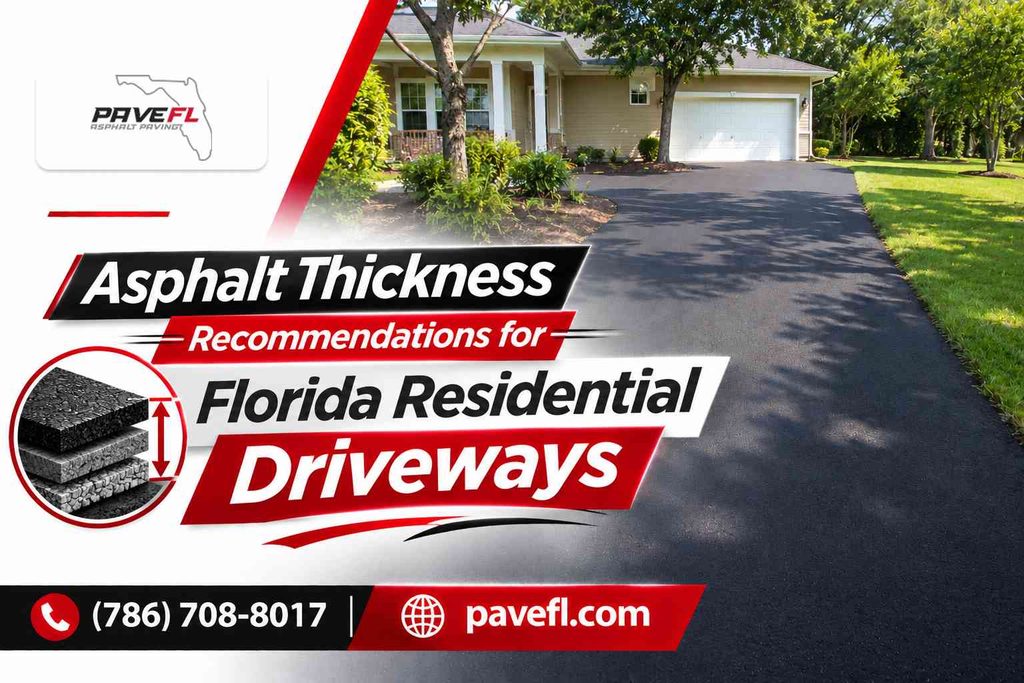
For many typical residential driveways, approximately 2 inches of compacted asphalt over a properly prepared 4–6-inch aggregate base is a common construction approach. Some projects may require approximately 2.5 inches or a different pavement design depending on soil conditions and vehicle loads.
At Pave FL, we understand that a durable driveway starts with more than a smooth asphalt surface. Proper foundation preparation, suitable materials, and correct pavement thickness all contribute to long-term performance.
Recommended Asphalt Thickness for Florida Driveways
The right asphalt thickness depends on how your driveway will be used. A standard residential driveway has different requirements from one that regularly accommodates heavier vehicles.
Here is a general reference for common residential applications.
| Driveway Application | Compacted Asphalt Thickness | Aggregate Base |
|---|---|---|
| Standard residential driveway | Around 2 inches | Around 4–6 inches |
| Driveway with heavier vehicle use | Around 2.5 inches may be suitable | Based on site conditions |
| Driveway with weak soil | Determined by project assessment | May require additional preparation |
| Heavy vehicle access | Project-specific pavement design | Designed for expected loads |
These measurements are general planning guidelines, not fixed requirements for every Florida property. The final design should consider soil stability, drainage, traffic, and the quality of the supporting base.
Why Does Asphalt Thickness Matter?
Asphalt thickness affects how well a driveway handles repeated vehicle loads and changing weather conditions.
The pavement surface and supporting layers work together to distribute pressure. When these layers are properly designed, they help reduce unnecessary movement and surface stress.
Here are three important benefits of selecting suitable thickness.
Better vehicle support: Proper pavement thickness helps distribute the weight of cars, SUVs, and other vehicles across the driveway structure.
Reduced cracking and deformation: A suitable pavement structure helps reduce stress that may contribute to premature cracking and uneven surfaces.
Improved pavement durability: Correct thickness, combined with proper compaction and drainage, supports better long-term performance.
However, thickness alone cannot correct a weak foundation. The entire pavement structure must be prepared correctly.
Understanding the Layers of an Asphalt Driveway
A residential asphalt driveway generally consists of three important layers.
1. Prepared Subgrade
The subgrade is the natural soil beneath the driveway. It supports everything installed above it.
Before paving begins, unsuitable materials, vegetation, and weak soil areas should be addressed. The ground should also be graded and compacted according to the project requirements.
Florida properties often contain sandy soil and varying moisture conditions. These factors should be considered during preparation.
2. Aggregate Base
The aggregate base sits between the subgrade and asphalt surface. It provides additional support and helps distribute vehicle loads.
For many South Florida residential projects, a compacted 4–6-inch aggregate base is a common starting point.
Proper grading and compaction are important. A poorly prepared base can contribute to settlement even when the asphalt thickness is suitable.
3. Asphalt Surface
The asphalt layer provides the finished driving surface.
For many standard residential applications, approximately 2 inches of compacted asphalt is commonly used. Properties with heavier vehicle use may require additional thickness based on the pavement design.
The final thickness should always be measured after compaction, not before the asphalt is rolled.
4 Factors That Affect Residential Asphalt Thickness
Not every driveway needs the same pavement structure. Several conditions can influence the recommended thickness.
1. Vehicle Weight and Traffic
Driveways used mainly by passenger vehicles generally have different requirements from those that regularly accommodate delivery trucks, RVs, or heavier vehicles.
Repeated traffic also matters. A driveway used by several vehicles every day may need different structural consideration from one with occasional use.
2. Soil Conditions
The condition of the supporting soil has a major influence on pavement performance.
Loose sandy soil, poorly compacted fill, and unstable ground may require additional preparation. Simply adding more asphalt over weak soil may not solve the problem.
3. Florida’s Weather
High temperatures can affect asphalt binder, while heavy rainfall can expose weaknesses in the pavement foundation.
Proper material selection, compaction, grading, and drainage should all be considered when planning residential paving in South Florida.
4. Base Preparation
A stable aggregate base provides the support needed for the finished asphalt surface.
Its thickness and material should match the site’s soil conditions and expected traffic. Proper compaction is just as important as choosing the right base material.
New Asphalt Installation vs. Asphalt Resurfacing
A new driveway installation and an asphalt resurfacing project require different considerations.
| Project Type | What Is Involved | Main Consideration |
|---|---|---|
| New driveway installation | Subgrade preparation, aggregate base, and new asphalt | Entire pavement structure must be suitable. |
| Complete replacement | Removing old pavement and rebuilding the surface | Existing foundation may need correction. |
| Asphalt resurfacing | Adding a new asphalt layer over existing pavement | Existing base must remain structurally sound. |
If your existing driveway has moderate surface wear but a stable foundation, resurfacing may be an appropriate option.
However, extensive settlement, deep cracks, and base failure may require more extensive repairs before an overlay can be considered.
Pave FL provides Residential Paving in South Florida and Asphalt Resurfacing in South Florida for homeowners considering new driveways, replacement, and pavement improvements.
Common Asphalt Thickness Mistakes to Avoid
A few construction mistakes can affect the performance of an otherwise suitable asphalt mixture.
- Choosing insufficient thickness: The pavement may not provide adequate support for its intended traffic.
- Ignoring base preparation: Weak or poorly compacted soil can lead to settlement.
- Overlooking drainage: Standing water may affect the pavement and supporting layers.
- Using the same design for every property: Driveways have different soil conditions and traffic requirements.
- Measuring loose asphalt instead of compacted asphalt: The final compacted thickness is what matters.
Paying attention to these details before installation can help prevent avoidable pavement problems.
Frequently Asked Questions
1. How thick should an asphalt driveway be in Florida?
Around 2 inches of compacted asphalt over a properly prepared 4–6-inch aggregate base is a common approach for many residential driveways. Heavier use or difficult soil conditions may require a different design.
2. Is 2 inches of asphalt enough for a residential driveway?
It can be suitable when the foundation is stable and the driveway is designed for regular passenger vehicles. However, site conditions and expected traffic should guide the final specification.
3. Is 2.5 inches of asphalt better than 2 inches?
A 2.5-inch compacted layer may provide additional support for certain applications. However, more thickness does not automatically solve foundation problems.
4. How thick should the base be under an asphalt driveway?
A compacted 4–6-inch aggregate base is a common reference for many residential projects in South Florida. Additional preparation may be needed depending on soil and traffic conditions.
5. Does Florida’s heat affect asphalt thickness?
Yes, temperature should be considered during pavement design. However, heat resistance also depends on the asphalt mixture, binder, compaction, and foundation—not just thickness.
6. Does asphalt resurfacing require the same thickness as a new driveway?
No. Resurfacing uses the existing pavement as a supporting structure. The overlay thickness depends on the condition of the existing asphalt and the project requirements.
7. Can Pave FL help determine the right driveway thickness?
Yes. Pave FL provides residential asphalt paving, driveway installation, replacement, and resurfacing services throughout South Florida. The appropriate approach depends on your property’s condition and intended use.
Final Thoughts: Choose the Right Thickness for a Stronger Driveway
Choosing the correct asphalt thickness is an important step toward building a durable residential driveway in Florida.
For many standard properties, approximately 2 inches of compacted asphalt over a properly prepared 4–6-inch aggregate base provides a useful starting point. However, soil conditions, vehicle weight, drainage, and foundation preparation should always influence the final design.
At Pave FL, customer satisfaction begins with understanding your property’s needs and explaining the available paving options clearly. We focus on careful project planning, professional workmanship, and responsive communication throughout the process.
From discussing your driveway requirements to evaluating the project and completing the paving work, our goal is to keep you informed and supported at every stage. We want you to feel confident in your decisions and completely satisfied with the service you receive.
Planning a new asphalt driveway in South Florida? Visit Pave FL to discuss your residential paving needs and explore the right solution for your property.