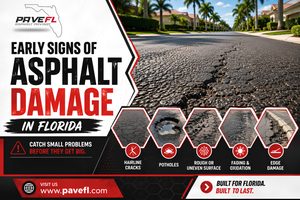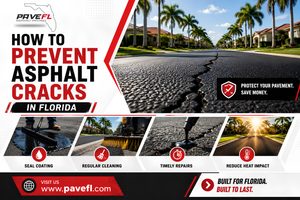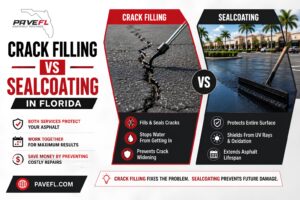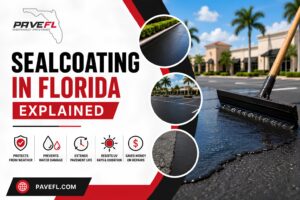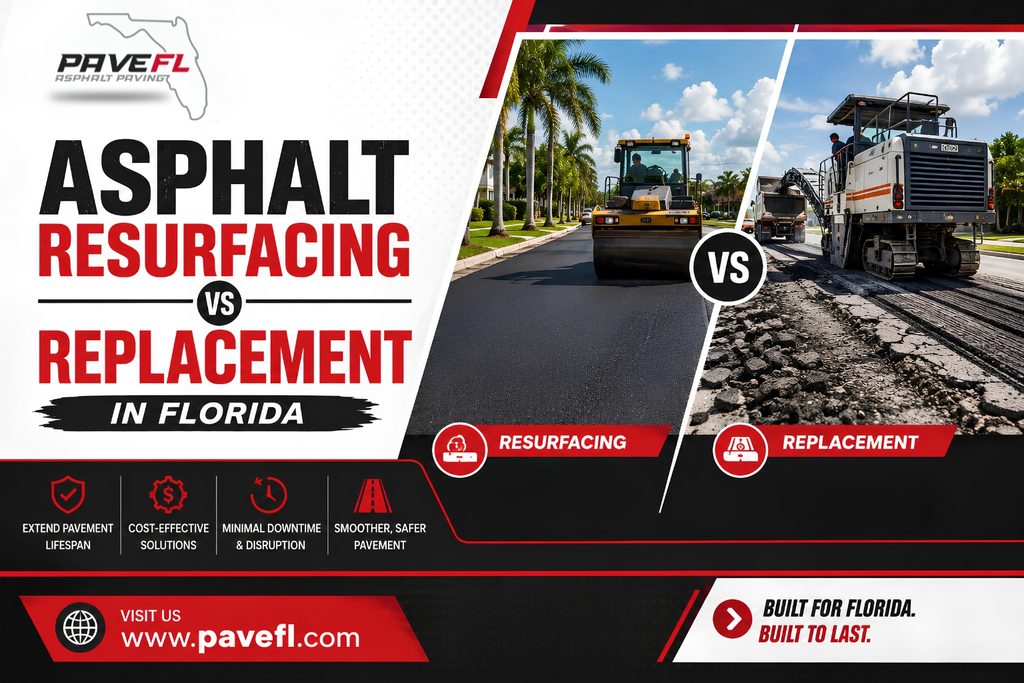
Is asphalt resurfacing better than replacing your pavement? Not always and the right choice depends primarily on what is happening beneath the asphalt. If an existing pavement surface is worn, faded, moderately cracked, or showing other surface-level problems while its foundation remains stable, asphalt resurfacing Florida property owners can use may provide an effective way to restore smoothness and appearance. However, if the pavement has widespread structural failure, severe drainage problems, deep settlement, or a weakened base, complete replacement may be the more appropriate solution. Pave FL explains that resurfacing works best when the existing pavement is structurally sound, while deeper foundation problems generally require more extensive reconstruction.
Florida pavement faces year-round environmental stress. Intense heat and UV exposure can accelerate oxidation, while heavy rainfall and humidity can contribute to moisture intrusion and base deterioration. Because of these conditions, property owners should not make the resurfacing-versus-replacement decision based solely on how the surface looks. A professional evaluation should consider the asphalt, base, drainage, grading, traffic demands, and extent of existing damage.
Understanding Asphalt Resurfacing
Asphalt resurfacing, also called an asphalt overlay, involves placing a new layer of hot-mix asphalt over an existing pavement surface.
Before the new asphalt is installed, the existing pavement is prepared. Depending on its condition, preparation may include repairing potholes and cracks, grinding or milling selected areas, correcting surface problems, and applying a tack coat to help the new asphalt bond properly.
Pave FL describes resurfacing as an appropriate solution for pavement with surface-level deterioration when the underlying base remains stable. It can restore smoothness, improve appearance, and extend pavement service life without removing the entire pavement structure.
Resurfacing may be appropriate when:
- Cracking is primarily superficial.
- The pavement foundation remains stable.
- Drainage is functioning correctly.
- There are isolated potholes rather than widespread structural failures.
- The pavement has become faded or weathered.
- The surface is rough but remains structurally sound.
- Previous maintenance has kept deeper deterioration under control.
The important point is that an overlay does not repair a failing foundation. It renews the pavement surface. If the underlying problems remain unresolved, those problems can eventually appear through the new asphalt.
Understanding Full Asphalt Replacement
Full asphalt replacement takes a more comprehensive approach.
Instead of placing new asphalt over the existing pavement, the deteriorated asphalt is removed. Contractors then inspect and address the underlying base before installing new pavement.
This approach is designed for situations where the existing pavement has reached a point where surface treatment or resurfacing cannot provide an appropriate long-term solution.
Pave FL’s residential and commercial paving services include tear-out and replacement, particularly where worn surfaces need to be completely rebuilt.
Replacement may be necessary when:
- Widespread alligator cracking is present.
- The pavement is sinking or severely uneven.
- Deep potholes continue returning.
- The base has shifted or collapsed.
- Drainage problems are causing structural deterioration.
- Previous repairs repeatedly fail.
- The asphalt has extensive deformation.
- The existing pavement structure is no longer reliable.
Full replacement takes longer and involves more construction, but it provides an opportunity to address problems beneath the visible asphalt instead of covering them.
Asphalt Resurfacing vs. Replacement: Key Differences
| Factor | Asphalt Resurfacing | Full Replacement |
|---|---|---|
| Existing asphalt | Remains in place | Removed |
| New asphalt | Installed over existing pavement | Installed over prepared/rebuilt base |
| Best suited for | Surface-level deterioration | Structural deterioration |
| Base repairs | Limited | Can be addressed comprehensively |
| Drainage correction | Limited | More extensive correction possible |
| Project disruption | Generally lower | Generally greater |
| Surface appearance | Significantly improved | Like-new pavement |
| Best application | Sound foundation | Failed or severely weakened pavement |
The central difference is simple: resurfacing primarily renews the pavement surface, while replacement rebuilds the pavement system.
Why Florida’s Climate Matters
Choosing between these two solutions requires special consideration of Florida’s climate.
Florida pavement experiences environmental conditions that can accelerate deterioration.
Intense Heat and UV Exposure
Strong sunlight causes asphalt binders to oxidize over time. As asphalt oxidizes, it gradually becomes harder and more brittle.
This can contribute to:
- Surface fading
- Loss of flexibility
- Increased cracking
- Surface raveling
- General pavement aging
A new overlay can protect and refresh an existing structurally sound surface, but it cannot reverse significant structural deterioration beneath the pavement.
Heavy Rainfall
Water is another major concern.
When cracks develop, rainfall can enter the pavement structure. If drainage is inadequate, moisture can remain around or beneath the pavement and weaken supporting materials.
Over time, this can lead to:
- Settlement
- Potholes
- Base erosion
- Cracking
- Uneven surfaces
This is why Pave FL emphasizes evaluating drainage and base stability before recommending resurfacing.
When Is Resurfacing the Better Choice?
Resurfacing is often appropriate when the pavement has surface deterioration but a sound foundation.
For example, imagine a parking lot that has become faded and rough after years of Florida sunshine. It has some cracks and isolated pavement defects, but the pavement remains level, drains properly, and does not have widespread structural failures.
In that situation, an overlay may provide the appropriate restoration.
Typical resurfacing candidates include:
- Aging residential driveways
- Worn commercial parking lots
- Private roads with stable foundations
- Pavement with moderate surface cracking
- Asphalt affected primarily by oxidation
- Surfaces with isolated pothole damage
Pave FL’s resurfacing process can include pothole filling, crack sealing, surface grinding, milling where necessary, tack-coat application, overlay installation, compaction, and striping for parking lots.
When Is Replacement the Better Choice?
Replacement becomes more appropriate when the pavement’s underlying structure is failing.
A new layer of asphalt cannot permanently correct a collapsed or severely weakened base.
For example, if a driveway has significant settlement because the supporting materi al has shifted or eroded, simply covering it with new asphalt does not address the cause of the movement.
Similarly, a parking lot with widespread alligator cracking and recurring potholes may require deeper rehabilitation.
Warning signs include:
- Extensive interconnected cracking
- Major depressions
- Repeated pavement settlement
- Severe pothole development
- Failed previous patches
- Persistent water problems
- Weak or unstable base
- Significant pavement deformation
Pave FL specifically notes that extensive base damage, widespread deformation, and persistent drainage problems can indicate that full replacement is a better solution than resurfacing.
The Importance of Base Stability
The condition of the base is arguably the most important factor in the decision.
The asphalt surface is only one component of a pavement system. Beneath it are supporting layers that distribute vehicle loads and help maintain stability.
If those layers remain strong, resurfacing can be an effective way to restore the upper pavement.
If those layers are damaged, unstable, or saturated, placing another asphalt layer over them may only hide the problem temporarily.
A professional evaluation should consider:
- Surface condition – How extensive are cracks, potholes, and raveling?
- Base stability – Is the supporting structure firm?
- Drainage – Does water move away effectively?
- Settlement – Are sections sinking or shifting?
- Traffic – What types of vehicles use the pavement?
- Previous repairs – Have patches repeatedly failed?
- Pavement age – How long has the existing surface been in service?
Pave FL states that its paving projects begin with an assessment of pavement condition, base stability, drainage, traffic, and existing damage before selecting the appropriate paving approach.
Resurfacing Does Not Mean Skipping Preparation
One common misconception is that resurfacing simply means putting new asphalt over old asphalt.
Professional resurfacing requires significant preparation.
Step 1: Inspection
The pavement is examined to determine whether an overlay is appropriate.
Step 2: Cleaning
Dirt, loose material, vegetation, and other contaminants are removed.
Step 3: Repairs
Cracks, potholes, weak areas, and other defects are addressed before the overlay.
Step 4: Milling or Grinding
Where necessary, portions of the existing pavement can be milled to correct elevations and prepare the surface.
Step 5: Tack Coat
A tack coat may be applied to promote bonding between the existing pavement and new asphalt.
Step 6: Asphalt Installation
Fresh hot-mix asphalt is placed and distributed across the prepared surface.
Step 7: Compaction
The new pavement is compacted to establish the required density and finish.
Pave FL describes these preparation and installation steps as part of its South Florida resurfacing process.
What Happens During Full Replacement?
Full replacement is a more extensive process because the existing pavement is removed.
A typical project can involve:
Existing Pavement Removal
Damaged asphalt is removed so contractors can access the underlying structure.
Base Evaluation
The supporting material is inspected for instability, erosion, saturation, or other problems.
Base Preparation
Weak areas can be repaired and the surface properly graded and compacted.
Drainage Corrections
If drainage contributed to pavement failure, corrections can be incorporated into the project.
New Asphalt Installation
Fresh asphalt is installed over the properly prepared foundation.
Final Compaction and Finishing
The new pavement is compacted and finished to create a smooth, stable surface.
This approach provides a major advantage when underlying problems are responsible for the pavement’s deterioration because those issues can be addressed rather than concealed. Pave FL offers full-depth asphalt replacement and asphalt removal and replacement as part of its paving services.
How Drainage Can Change the Decision
Drainage should never be overlooked when evaluating pavement.
A surface may appear suitable for resurfacing, but if water repeatedly collects underneath or around it, the new asphalt can eventually experience the same problems.
Signs of drainage trouble include:
- Persistent standing water
- Depressed pavement areas
- Water flowing toward structures
- Eroded pavement edges
- Recurring potholes in the same location
- Cracking concentrated around low areas
Pave FL provides drainage correction and low-spot repair as part of its asphalt repair services because addressing water movement can be critical to preventing recurring pavement damage.
Resurfacing for Residential Driveways
Homeowners often consider resurfacing when their driveway still has a stable foundation but has developed an aged or worn surface.
Typical signs include:
- Gray or faded asphalt
- Moderate cracking
- Minor potholes
- Surface roughness
- General weathering
- Reduced curb appeal
Pave FL describes resurfacing as an option for homeowners whose driveway base remains in good condition. Its residential services include recap/resurfacing as well as complete tear-out and replacement when needed.
A professional assessment is important because two driveways can look similar from the surface while having very different conditions underneath.
Resurfacing for Parking Lots
Commercial parking lots experience additional stresses from:
- Frequent vehicle movements
- Turning traffic
- Delivery vehicles
- Heavy loads
- Constant exposure to weather
- High pedestrian activity
Pave FL provides parking lot resurfacing, repair, milling and overlay, grading, drainage correction, striping, and full-depth replacement services.
For a parking lot, the decision should consider not only pavement condition but also traffic patterns, drainage, accessibility requirements, and how construction will affect property operations.
How to Prevent the Need for Early Replacement
Regardless of whether a property receives resurfacing or replacement, ongoing maintenance remains important.
Property owners can help protect asphalt by:
- Repairing cracks promptly
- Addressing potholes early
- Keeping drainage systems clear
- Removing vegetation from pavement edges
- Maintaining appropriate grading
- Scheduling periodic inspections
- Using sealcoating where appropriate
- Monitoring areas with recurring water accumulation
Pave FL emphasizes preventative maintenance and timely repairs as important strategies for extending pavement life in South Florida’s demanding climate.
Common Mistakes Property Owners Should Avoid
Choosing Resurfacing Based Only on Appearance
A pavement can look acceptable while having serious underlying problems. Always evaluate structural condition before selecting an overlay.
Covering Drainage Problems
If water is responsible for pavement deterioration, simply adding asphalt does not solve the underlying issue.
Ignoring Recurring Potholes
A pothole that repeatedly returns in the same location may indicate a deeper structural or drainage problem.
Skipping Surface Preparation
An overlay needs a properly prepared surface to achieve reliable bonding and performance.
Waiting Until the Pavement Completely Fails
Regular inspections can identify deterioration earlier, when more restoration options may remain available.
A Simple Decision Guide
| What You See | Likely Consideration |
|---|---|
| Faded asphalt | Resurfacing may be appropriate |
| Moderate surface cracking | Evaluate for resurfacing |
| Isolated potholes | Repair, then evaluate |
| Stable pavement with rough surface | Resurfacing may work |
| Widespread alligator cracking | Consider replacement |
| Severe settlement | Replacement may be needed |
| Recurring deep potholes | Investigate underlying structure |
| Persistent drainage failure | Correct drainage before resurfacing |
| Collapsed base | Full replacement |
| Multiple failed repairs | Professional structural evaluation |
This table is a starting point—not a substitute for an on-site pavement assessment.
Why Professional Evaluation Matters
The biggest mistake is assuming that every damaged pavement surface needs the same treatment.
Professional contractors can distinguish between surface deterioration and structural deterioration.
That distinction determines whether an overlay is appropriate or whether the pavement needs to be removed and rebuilt.
A proper assessment should look beyond the visible asphalt and evaluate:
- Base condition
- Drainage
- Grading
- Cracking patterns
- Settlement
- Traffic loads
- Previous repairs
- Overall pavement performance
Pave FL follows this evaluation-based approach, assessing pavement condition and underlying factors before recommending resurfacing, repair, or replacement.
Why Choose Pave FL for Asphalt Resurfacing or Replacement?
At Pave FL, we understand that Florida pavement requires solutions designed around the local climate and the actual condition of the property.
Our team provides both resurfacing and replacement services, allowing us to recommend the appropriate approach rather than treating every pavement problem the same way.
Our services include:
- Asphalt resurfacing
- Asphalt overlays
- Full asphalt replacement
- Parking lot resurfacing
- Driveway resurfacing
- Asphalt repair
- Milling and paving
- Pothole repair
- Crack repair
- Drainage correction
- Parking lot striping
- Residential and commercial paving
Pave FL has more than 15 years of local paving experience and serves Miami-Dade, Broward, and Palm Beach counties. The company states that it is fully licensed and insured and uses professional equipment and quality asphalt materials for its projects.
Whether your pavement needs a new surface or a complete rebuild, our professionals can inspect the existing condition, identify underlying concerns, and recommend the appropriate solution for your property.
Final Thoughts
Choosing between asphalt resurfacing Florida property owners can use and full pavement replacement should never be based simply on how old or unattractive the asphalt looks. The most important consideration is the condition of the pavement foundation.
If the existing base is stable and the deterioration is primarily on the surface, resurfacing can restore smoothness, appearance, and pavement performance. If the foundation is failing, drainage problems are severe, or structural deterioration is widespread, replacement may provide the more appropriate long-term solution.
Florida’s heat, UV exposure, heavy rainfall, humidity, and year-round traffic make professional pavement evaluation particularly important. By identifying the actual cause of deterioration before work begins, property owners can choose a restoration method that supports better long-term performance.
Pave FL can evaluate your existing pavement and determine whether resurfacing, repair, or complete replacement is the right solution. Our professional paving team works with residential and commercial property owners throughout South Florida to restore damaged asphalt, improve drainage and pavement performance, and create durable surfaces built for Florida’s demanding conditions.