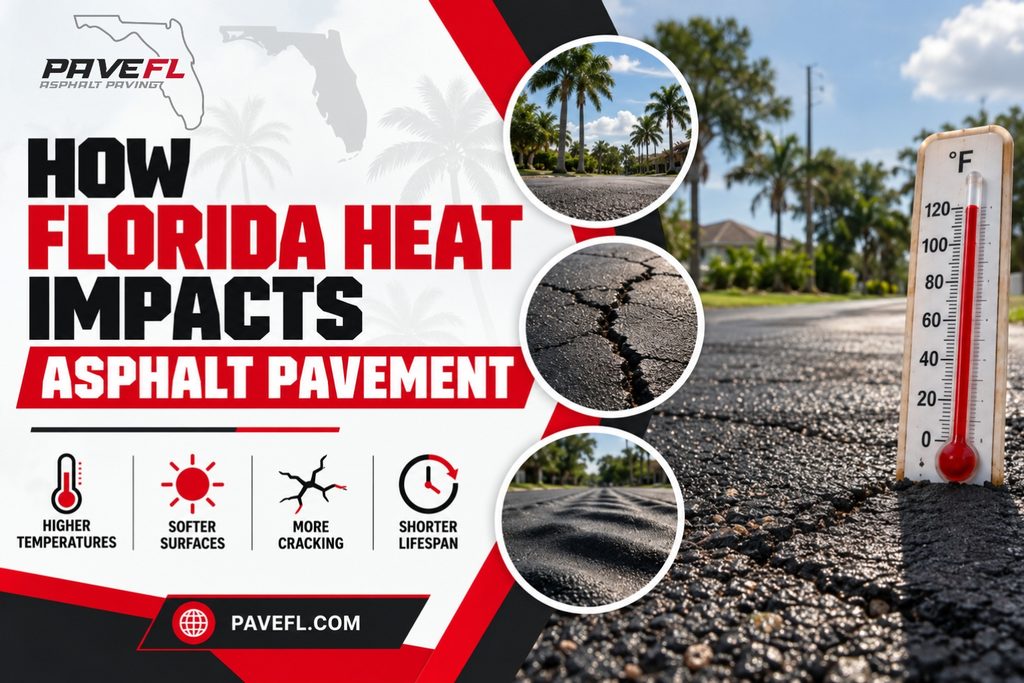
How Does Florida Heat Impact Asphalt Pavement? Florida’s hot climate can place significant stress on asphalt pavement. Long periods of strong sunlight, high pavement temperatures, heavy traffic, and seasonal rainfall can all affect how asphalt performs over time.
One of the most important effects of heat is that asphalt can become softer and more susceptible to deformation when pavement temperatures rise. Under repeated vehicle loads, this can contribute to rutting, depressions, and other surface changes. Research into asphalt pavement behavior shows that higher pavement temperatures can increase deformation under repeated loading.
For Florida property owners, understanding asphalt heat Florida conditions is important because pavement is exposed to heat throughout much of the year. A parking lot, driveway, private road, or commercial pavement may experience thousands of cycles of heating and cooling during its service life.
The good news is that heat-related deterioration can often be managed through appropriate pavement design, quality installation, drainage, regular inspections, and timely maintenance.
1. Florida Asphalt Can Become Extremely Hot
The temperature of asphalt pavement is not necessarily the same as the temperature shown in a weather forecast.
Dark pavement absorbs solar energy throughout the day. When the sun is strong, the pavement surface can become considerably hotter than the surrounding air.
This matters because asphalt is a temperature-sensitive material.
As temperatures increase, asphalt binder can become softer. When the pavement is subjected to repeated vehicle loading while it is hot, the surface may be more susceptible to permanent deformation.
This is particularly important in Florida because properties can experience:
- Long periods of direct sunlight
- High summer temperatures
- Warm nights
- Heavy vehicle traffic
- Frequent braking and acceleration
- Repeated seasonal heat exposure
Therefore, pavement performance should be considered over the entire life of the asphalt rather than based on how the surface looks on a particular day.
2. Heat Can Increase the Risk of Asphalt Rutting
Rutting is one of the most noticeable forms of pavement deformation associated with high temperatures and repeated traffic.
A rut is a depression that develops along a vehicle’s wheel path. Instead of remaining flat, the asphalt gradually becomes lower in areas that receive repeated loading.
Heat can make this problem more noticeable because asphalt becomes more susceptible to deformation as its temperature increases.
However, heat is not necessarily the only cause.
Rutting can also be associated with:
- Heavy traffic
- Poor pavement structure
- Inadequate compaction
- Weak underlying layers
- Moisture-related problems
- Unsuitable materials
- Insufficient pavement thickness
Research on pavement deformation shows that rutting can involve both the asphalt layer and underlying pavement layers.
This is why simply repairing the visible rut may not always solve the underlying problem.
3. Heavy Traffic Makes Heat-Related Problems More Important
Heat becomes particularly important when it is combined with repeated vehicle loading.
Consider a commercial parking lot.
During a hot afternoon, delivery trucks may repeatedly enter and leave the property. Vehicles may stop, accelerate, turn, and travel through the same areas.
Those repeated loads can place substantial stress on pavement that is already softened by high temperatures.
The same principle applies to:
- Truck entrances
- Loading zones
- Drive-through lanes
- Parking lot entrances
- Distribution areas
- Commercial driveways
- Frequently used private roads
Areas that experience both high temperatures and heavy traffic deserve particular attention during pavement inspections.
4. Vehicle Turning Can Put Additional Stress on Hot Asphalt
Straight-line traffic is not the only concern.
Turning vehicles can place different types of forces on the pavement surface.
For example, a heavy truck turning sharply in a parking lot can place significant stress on the asphalt near the turning area.
When the pavement is hot, the asphalt can be more susceptible to movement under these repeated forces.
Over time, this may contribute to:
- Surface deformation
- Shoving
- Rutting
- Uneven areas
- Cracking around damaged sections
This is one reason commercial pavement should be evaluated according to how the property is actually used.
5. Heat Can Contribute to Long-Term Asphalt Aging
Florida heat affects asphalt not only during individual hot days but also through long-term exposure.
Asphalt contains a binder that helps hold the aggregate together. With repeated exposure to heat, oxygen, sunlight, and environmental conditions, the binder can gradually age.
As asphalt ages, its characteristics can change.
An older pavement may become:
- Less flexible
- More susceptible to cracking
- More brittle
- More vulnerable to surface deterioration
This does not mean every older Florida pavement will automatically fail. Pavement performance depends on its materials, construction, traffic, drainage, maintenance history, and environmental exposure.
However, long-term heat exposure is an important part of the overall aging process.
6. Heat Can Affect Asphalt Flexibility
Fresh asphalt generally has a different level of flexibility than older, weathered pavement.
Over time, environmental exposure can change the properties of the asphalt binder.
A pavement that has aged significantly may have less ability to accommodate certain movements and stresses.
This can make existing defects more important.
For example, a small crack that is ignored may eventually become wider and allow additional water into the pavement.
That water can then contribute to deterioration of supporting materials, especially when drainage is poor.
7. Florida Heat and Rain Can Work Together
Florida’s pavement does not experience heat in isolation.
The state also receives substantial rainfall, particularly during its wet season.
That creates a combination of environmental stresses:
Heat → softening and aging
Rain → moisture exposure
Traffic → repeated loading
When these factors occur together, pavement deterioration can accelerate.
Moisture can affect supporting pavement layers, while high temperatures can increase asphalt’s susceptibility to deformation. Research on pavement behavior shows that underlying layers can contribute significantly to surface rutting when their strength or stiffness is reduced.
This is why drainage is an important part of Florida asphalt maintenance.
8. Poor Drainage Can Make Asphalt Problems Worse
Water that remains on or around pavement can create additional problems.
If a property has poor drainage, rainfall may collect around the pavement instead of moving away efficiently.
Persistent moisture can contribute to:
- Weak supporting layers
- Edge deterioration
- Settlement
- Potholes
- Cracking
- Rutting
- Repeated pavement failures
A hot climate does not eliminate moisture-related pavement problems.
In fact, Florida property owners need to think about both heat and water when evaluating asphalt.
Good pavement management should therefore consider:
- Surface slope
- Drainage
- Pavement edges
- Cracks
- Low areas
- Soil conditions
- Traffic patterns
9. Heat Can Make Existing Pavement Problems More Noticeable
A pavement surface that already has problems may become more vulnerable during periods of extreme heat.
For example, an asphalt surface with:
- Existing rutting
- Poorly repaired areas
- Weak pavement sections
- Previous settlement
- Heavy traffic
- Drainage problems
may perform differently from a properly constructed and maintained pavement.
This is why property owners should not wait until a pavement problem becomes severe before investigating it.
Regular inspections can identify changes while they are still manageable.
10. Asphalt Thickness Matters
The thickness and overall structure of asphalt pavement should be appropriate for the property’s expected use.
A residential driveway does not experience the same loading as a commercial parking lot or a heavy-truck access area.
For example:
Residential driveway
Primarily passenger vehicles may use the surface.
Commercial parking lot
The pavement may experience frequent vehicle movements throughout the day.
Heavy-traffic area
Trucks and other heavy vehicles may repeatedly load the pavement.
The pavement structure should therefore be selected according to expected traffic and site conditions.
Heat resistance cannot be separated from the overall pavement design.
11. Asphalt Material Selection Is Important
Not all asphalt mixtures behave identically.
The properties of the asphalt binder and mixture influence how pavement responds to temperature and traffic.
High-temperature pavement performance is an important consideration in asphalt mixture selection because rutting resistance depends partly on how the material behaves under elevated temperatures.
Florida pavement research has specifically evaluated asphalt mixtures and binders for performance under Florida traffic and climate conditions.
For property owners, the important point is simple:
The asphalt mixture should be appropriate for the pavement’s expected conditions.
That includes considering:
- Climate
- Traffic
- Pavement thickness
- Site use
- Drainage
- Existing pavement conditions
12. Proper Compaction Helps Pavement Performance
Installation quality can have a major influence on how asphalt performs later.
Compaction helps establish the desired density of the asphalt mixture.
If asphalt is not properly compacted, the finished pavement may have characteristics that make it more vulnerable to deterioration.
Construction quality and pavement density are therefore important considerations when installing asphalt in Florida.
A quality paving project should pay attention to:
- Proper surface preparation
- Suitable materials
- Correct placement
- Appropriate compaction
- Proper drainage
- Final surface condition
These steps help create a pavement system that is better prepared for Florida’s demanding climate.
13. Heat Can Affect Different Areas Differently
Not every part of a property experiences the same conditions.
A shaded driveway may have different surface temperatures from a large parking lot exposed to direct sunlight all day.
Similarly, pavement beneath trees, beside buildings, and in open areas may experience different heating patterns.
However, shaded pavement should not automatically be considered problem-free.
Traffic and drainage can still affect pavement performance.
The best approach is to evaluate pavement according to its:
- Location
- Use
- Traffic
- Drainage
- Age
- Surface condition
- Previous maintenance
14. Parking Lots Can Be Particularly Vulnerable
Commercial parking lots can experience a combination of heat and repeated traffic.
Certain areas typically receive more stress than others.
Parking lot entrances
Vehicles frequently brake and accelerate.
Drive lanes
Repeated wheel loading occurs throughout the day.
Loading zones
Heavy vehicles can place significant loads on the pavement.
Turning areas
Vehicles may apply additional forces while turning.
Exit lanes
Repeated traffic can create concentrated loading.
These areas should be inspected regularly for early signs of deformation.
15. What Does Heat-Related Asphalt Damage Look Like?
Property owners should know what to look for.
Some common signs include:
Wheel-path depressions
Grooves appear where vehicle tires repeatedly travel.
Uneven pavement
The surface becomes visibly distorted.
Shoving
Asphalt appears to move or push toward another area.
Cracks around deformed sections
Cracking can develop as pavement deterioration progresses.
Recurring potholes
A repaired pothole repeatedly returns.
Standing water
Depressed pavement collects rainfall.
Surface deterioration
The pavement begins losing its smooth, consistent appearance.
Not every one of these problems is caused by heat. A professional evaluation may be necessary to determine the actual cause.
16. How Can Property Owners Protect Asphalt From Florida Heat?
Property owners cannot control the weather, but they can control how pavement is managed.
Some practical steps include:
- Inspect asphalt regularly
- Repair significant cracks
- Address potholes promptly
- Maintain drainage
- Monitor high-traffic areas
- Watch for rutting
- Avoid ignoring recurring pavement problems
- Maintain pavement before deterioration becomes extensive
- Consider professional evaluation when problems continue
Preventive maintenance can help property owners identify pavement problems before they become larger repair projects.
17. Sealcoating Can Help Protect the Surface
Sealcoating is commonly used as part of asphalt maintenance.
It creates a protective surface treatment that can help reduce exposure to environmental elements and improve the appearance of asphalt.
However, sealcoating is not a solution for structural pavement failure.
If pavement already has:
- Deep potholes
- Major rutting
- Significant settlement
- Structural cracking
- Weak underlying layers
those conditions should be evaluated before considering surface treatments.
Maintenance should always match the condition of the pavement.
18. Why Crack Repair Matters in Florida
Cracks should not simply be viewed as cosmetic imperfections.
Open cracks can allow water to move into the pavement system.
Once water reaches vulnerable pavement layers, traffic and environmental exposure can contribute to additional deterioration.
Therefore, addressing appropriate cracks can be an important part of long-term pavement maintenance.
This is especially relevant in Florida, where high temperatures and heavy rainfall can both affect asphalt.
19. How PaveFL Can Help With Heat-Affected Asphalt
PaveFL can help Florida property owners evaluate asphalt surfaces that are showing signs of heat-related deterioration.
Depending on the pavement’s condition, the appropriate solution may involve:
- Asphalt repair
- Crack treatment
- Resurfacing
- New asphalt installation
- Drainage-related improvements
- Preventive maintenance
The right solution depends on the actual condition of the pavement.
For example, a pavement surface with minor deterioration may require maintenance, while extensive rutting or structural failure may require a more comprehensive repair strategy.
PaveFL can help property owners understand the condition of their pavement and determine what type of paving work is appropriate for the property.
20. When Should You Consider Professional Asphalt Evaluation?
Property owners should consider professional evaluation when they notice:
- Deep wheel-path ruts
- Significant surface deformation
- Repeated potholes
- Extensive cracking
- Persistent standing water
- Failed patches
- Pavement settlement
- Damage concentrated in heavy-traffic areas
- Problems that return after previous repairs
Recurring deterioration can indicate that the visible surface problem is connected to a deeper pavement or drainage issue.
Instead of repeatedly treating the symptom, the underlying condition should be evaluated.
Florida Heat and Asphalt: Problem vs. Solution
| Heat-Related Challenge | What It Can Lead To | Appropriate Response |
|---|---|---|
| High pavement temperature | Increased asphalt softness | Proper pavement design |
| Heavy traffic | Rutting and deformation | Evaluate pavement structure |
| Repeated turning | Surface movement | Monitor high-stress areas |
| Long-term heat exposure | Asphalt aging | Preventive maintenance |
| Open cracks | Moisture infiltration | Appropriate crack treatment |
| Poor drainage | Weak supporting layers | Address water movement |
| Inadequate compaction | Reduced pavement performance | Quality installation |
| Recurring potholes | Progressive deterioration | Determine underlying cause |
| Thin or weak pavement | Faster deformation | Evaluate structural needs |
How Florida Property Owners Can Build a Better Asphalt Maintenance Routine
A simple maintenance routine can help identify problems earlier.
Inspect the surface
Walk or drive across the property periodically and look for new pavement changes.
Watch wheel paths
Look for grooves or depressions in frequently used areas.
Check drainage
Make sure water is not repeatedly collecting in the same location.
Monitor cracks
Small cracks should not be ignored indefinitely.
Pay attention to heavy-traffic areas
Loading zones and entrances may deteriorate faster than lightly used sections.
Document recurring problems
If the same location repeatedly fails, record the location and type of damage.
Schedule professional evaluation
When pavement deterioration becomes widespread or repeatedly returns, professional assessment can help identify the appropriate next step.
Why Florida Heat Should Be Considered Before Installing Asphalt
The best time to think about Florida heat is before asphalt installation—not after pavement starts failing.
A paving project should consider the property’s expected use, traffic, pavement structure, drainage, materials, and environmental exposure.
Good planning can help reduce the likelihood that pavement will be overwhelmed by its intended use.
For a new asphalt paving service Florida project, property owners should consider the complete pavement system rather than focusing only on the visible asphalt surface.
That means thinking about:
- Base preparation
- Asphalt thickness
- Material selection
- Drainage
- Traffic
- Compaction
- Site grading
- Long-term maintenance
Why Maintenance Is Important in Florida’s Climate
Florida asphalt experiences repeated environmental stress throughout the year.
A pavement surface may go through:
Intense sunlight → high surface temperatures → traffic loading → cooling → rainfall → drying → repeated heating
This cycle occurs again and again.
Over time, small defects can become larger problems if they are not addressed.
Maintenance is therefore not simply about making asphalt look better.
It can help property owners:
- Identify deterioration early
- Maintain drainage
- Address cracks
- Reduce surface deterioration
- Monitor high-stress areas
- Plan future repairs
- Avoid unnecessary emergency work
Final Thoughts
Understanding asphalt heat Florida conditions is important for anyone responsible for a driveway, parking lot, commercial property, or other asphalt surface.
Florida’s high temperatures can make asphalt more susceptible to deformation under repeated traffic, while long-term environmental exposure can contribute to aging. At the same time, heat is only one part of the picture. Traffic, pavement structure, drainage, materials, compaction, and maintenance all influence how asphalt performs.
Rutting is particularly important to watch because permanent deformation can occur in both asphalt and underlying pavement layers.
The most effective approach is to treat pavement as a complete system. Proper installation, suitable materials, good drainage, regular inspection, and timely maintenance can all contribute to better long-term performance.
PaveFL can help property owners evaluate their asphalt needs and choose appropriate paving or maintenance solutions based on the actual condition and use of the pavement.
For property owners planning an asphalt paving service Florida project, considering Florida’s heat from the beginning can help create a pavement system that is better suited to its environment, traffic demands, and long-term maintenance needs.