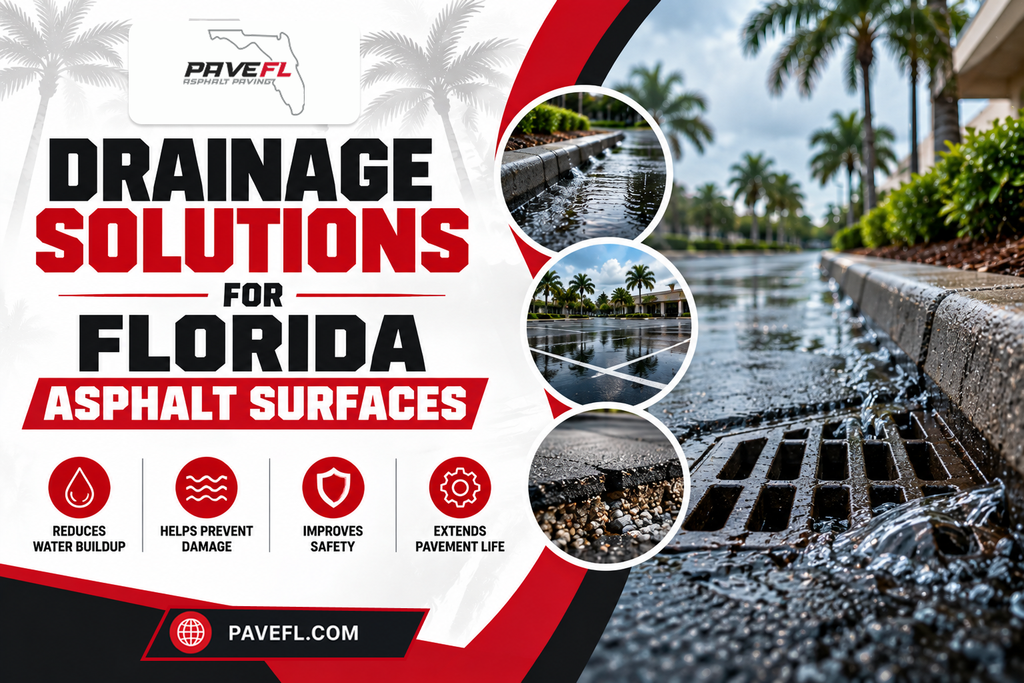
Why Is Proper Drainage Important for Florida Asphalt? Florida asphalt pavement has to handle intense rainfall, tropical storms, high humidity, and frequent periods of heavy runoff. When water cannot move away from an asphalt surface efficiently, it can collect on top of the pavement or enter cracks and other defects. Over time, excess moisture can weaken pavement materials and the supporting layers beneath the surface.
Excess moisture can reduce pavement performance, particularly when it combines with heavy traffic and moisture-sensitive materials. It also identifies surface infiltration through cracks, edges, and other defects as a major source of water entering pavement systems.
For Florida properties, effective asphalt drainage Florida solutions should therefore address both surface runoff and water that could enter or remain within the pavement structure.
1. Start With Proper Pavement Grading
One of the basic principles of pavement drainage is giving water a path to leave the surface.
Proper grading allows rainwater to flow toward appropriate drainage points instead of remaining in low areas. Adequate cross slopes and longitudinal slopes as important ways to encourage rapid surface runoff and reduce moisture entering pavement systems.
During a new paving project, grading should be considered before the asphalt is installed.
Poor grading can create:
- Low spots
- Standing water
- Uneven runoff
- Water near pavement edges
- Repeated wet areas
If an existing pavement surface consistently holds water, the issue may require more than a simple surface repair.
2. Maintain Appropriate Pavement Slopes
Pavement slope works together with grading to move water away from the surface.
Paving Services in Miami, FL guidance addresses drainage design as part of Florida’s transportation infrastructure, including hydrologic, hydraulic, stormwater-management, and coastal-engineering considerations.
For asphalt surfaces, the objective is to prevent rainfall from remaining on the pavement longer than necessary.
This becomes especially important during Florida’s heavy rainfall events.
3. Keep Drainage Inlets Clear
A properly designed drainage system cannot function effectively if its openings are blocked.
Leaves, dirt, sediment, grass, trash, and other debris can obstruct drainage inlets and prevent water from leaving the pavement efficiently.
Drainage-maintenance guidance recommends inspecting for blocked drains, accumulated debris, erosion channels, damaged drainage structures, and other conditions that can interfere with proper water movement.
Property owners should inspect drainage points regularly, particularly before periods of heavy rainfall.
4. Address Standing Water Quickly
Standing water is one of the easiest drainage problems to recognize.
If water remains on an asphalt surface long after rainfall has stopped, investigate why.
Possible causes include:
- Insufficient slope
- Pavement settlement
- Clogged drainage
- Poor grading
- Uneven pavement
- Drainage-system limitations
Water remaining on pavement can create safety concerns, while rutting and drainage deficiencies can contribute to thicker water films on the pavement surface.
Persistent ponding should therefore be treated as a pavement-management issue rather than simply a cosmetic concern.
5. Keep Asphalt Cracks Properly Maintained
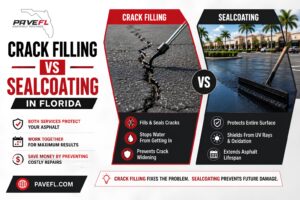
Cracks can become entry points for water.
Surface cracks, joints, pavement edges, and other discontinuities as pathways through which moisture can enter a pavement structure.
Asphalt maintenance should therefore include identifying suitable cracks for sealing or other appropriate treatments.
The goal is to reduce opportunities for water to move below the asphalt surface.
6. Protect Pavement Edges
Pavement edges can be particularly vulnerable to water infiltration and erosion.
Water moving along an edge can affect surrounding soil and supporting pavement materials, especially when the edge is already damaged or poorly supported.
Pavement edges and shoulder areas can provide pathways for moisture to enter pavement structures and that drainage systems may be used to remove infiltrated water.
Inspect pavement edges for:
- Crumbling asphalt
- Exposed base material
- Eroded soil
- Edge settlement
- Water channels
- Vegetation growth
Addressing these conditions can help protect the pavement structure.
7. Use Appropriate Surface Drainage Features
Depending on the property, surface drainage may involve features such as:
- Swales
- Gutters
- Ditches
- Catch basins
- Drainage inlets
- Channels
- Properly graded pavement
The right solution depends on the property’s layout, rainfall patterns, existing drainage infrastructure, and local requirements.
FDOT maintains current drainage manuals and design guidance for Florida transportation infrastructure, reflecting the importance of site-specific drainage design.
8. Consider Subsurface Drainage Where Needed
Some water problems cannot be solved at the pavement surface alone.
Identifies underdrains, edge drains, permeable bases, and other subsurface drainage features as methods for removing water that enters a pavement structure.
These systems may be particularly relevant when pavement is exposed to persistent moisture or when site conditions make subsurface water difficult to control.
For an existing pavement, the appropriate drainage improvement depends on the pavement structure and the source of the water.
9. Prevent Water From Reaching the Pavement
Good drainage does not always mean collecting water after it reaches the pavement.
Another strategy is to control runoff before it enters vulnerable areas.
Durface-water management is an important part of pavement protection and notes that intercepting and transporting water before it reaches critical areas can help reduce infiltration.
Depending on the site, this may involve:
- Proper grading
- Drainage swales
- Berms
- Ditches
- Gutters
- Controlled runoff paths
10. Maintain Drainage Systems After Installation
Drainage requires ongoing maintenance.
Even a well-designed system can become less effective if sediment, vegetation, debris, or other materials restrict water movement.
Maintaining drainage helps prevent erosion, subbase saturation, and damage to roadway structures.
A maintenance routine should include checking drainage features before and after periods of heavy rain.
Common Florida Asphalt Drainage Problems
| Drainage Problem | Potential Pavement Effect |
|---|---|
| Standing water | Prolonged moisture exposure |
| Blocked drains | Water accumulation |
| Poor grading | Persistent low spots |
| Insufficient slope | Slow surface runoff |
| Open cracks | Water infiltration |
| Damaged pavement edges | Moisture and erosion |
| Poor subsurface drainage | Saturated supporting layers |
| Eroded surrounding soil | Loss of edge support |
| Clogged ditches | Restricted runoff |
| Repeated ponding | Possible underlying drainage problem |
These conditions can occur individually or together. A pavement surface that repeatedly experiences several of them may require a more comprehensive drainage evaluation.
How Does Poor Drainage Damage Asphalt?
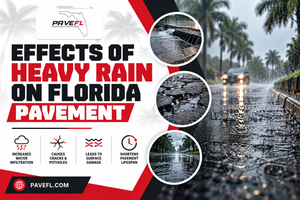
Water can affect asphalt in several ways.
When moisture enters the pavement structure, it can reduce the stiffness of supporting materials and contribute to deterioration. Excessive moisture can reduce the stiffness of aggregate base, subbase, and subgrade materials, while saturation can also affect asphalt and other pavement layers.
The process can look like this:
Heavy rainfall → water infiltration → saturated pavement layers → reduced support → traffic loading → cracking, rutting, or potholes
This is why drainage should be considered part of pavement durability.
How Florida Rainfall Changes Drainage Requirements
Florida’s frequent heavy rainfall means pavement drainage needs to handle significant amounts of water during short periods.
Paving Services in Miami, FL provides guidance for hydrologic and hydraulic design, stormwater management, and coastal engineering throughout Florida.
Property owners should consider the property’s specific conditions, including:
- Surface area
- Existing slopes
- Drainage outlets
- Surrounding grades
- Soil conditions
- Flood exposure
- Traffic
- Existing pavement condition
A drainage solution that works for one property may not be appropriate for another.
Drainage for Residential Asphalt
Residential driveways may have fewer vehicles than commercial parking lots, but drainage remains important.
Homeowners should look for water collecting:
- Along driveway edges
- Near garage entrances
- At the bottom of slopes
- Around cracks
- Near landscaping
- Where the driveway meets the street
If water repeatedly collects in one location, the driveway may have a grading or drainage issue.
Drainage for Commercial Parking Lots
Commercial pavement can face more demanding conditions because of larger paved areas, higher traffic, and heavier vehicles.
Parking lot drainage should account for:
- Vehicle circulation
- Parking-space layout
- Loading areas
- Drainage inlets
- Pavement slopes
- Stormwater flow
- Low points
Poor drainage in a busy parking lot can become both a pavement-maintenance and site-management concern.
How Can Property Owners Improve Asphalt Drainage?
A practical approach is to inspect the pavement and drainage system together.
Step 1: Identify where water collects
After rainfall, observe the locations where water remains longest.
Step 2: Check drainage points
Look for clogged or damaged drains, gutters, ditches, and channels.
Step 3: Inspect the pavement
Look for cracks, potholes, depressions, rutting, and deteriorating edges.
Step 4: Determine whether the problem is surface or structural
A surface defect may require maintenance, while settlement or recurring ponding may indicate a deeper problem.
Step 5: Choose an appropriate solution
Depending on the condition, the solution could involve drainage maintenance, crack treatment, localized asphalt repair, grading adjustments, resurfacing, or broader pavement work.
When Should Professional Drainage Evaluation Be Considered?
Professional evaluation is especially useful when:
- Water repeatedly pools in the same location
- Potholes keep returning
- Pavement continues settling
- Drainage problems affect a large area
- Asphalt edges are eroding
- Cracks are expanding despite maintenance
- Water appears to be entering the pavement structure
- Existing drainage features are damaged
Recurring problems often indicate that the visible pavement damage is not the only issue.
Why Drainage Should Be Planned Before Asphalt Installation
Drainage is easier to incorporate during new pavement construction than to correct after pavement has already failed. Pavement drainage can involve surface slopes, moisture-resistant materials, underdrains, edge drains, permeable bases, and other design features depending on project conditions.
This makes drainage planning an important part of an asphalt paving service Florida property owners may need for new construction or major pavement rehabilitation.
Proper planning can help coordinate:
- Grading
- Pavement slopes
- Base preparation
- Drainage outlets
- Surface water flow
- Pavement thickness
- Traffic requirements
Asphalt Maintenance and Drainage Go Together
Drainage should not be treated as a separate issue from asphalt maintenance.
A crack can allow water to enter. Water can weaken supporting materials. Traffic can then accelerate deterioration.
Similarly, a clogged drain can cause water to remain on the surface, while a depression can create a new location for water to collect.
Maintaining the pavement and drainage system together provides a more complete approach to protecting the asphalt.
How PaveFL Can Help
PaveFL can help Florida property owners address asphalt conditions where pavement performance and drainage need to be considered together. Professional assessment can help identify whether a property needs localized repair, resurfacing, new pavement, or other improvements.
For property owners planning an asphalt paving service Florida project, drainage should be considered alongside pavement materials, site grading, traffic requirements, and long-term maintenance.
Final Thoughts
Effective asphalt drainage Florida solutions are essential because water is one of the major factors that can reduce pavement performance. PaveFL explains that excess moisture can enter through cracks, edges, and other surface defects and can reduce the performance of pavement layers when moisture levels become excessive.
The most effective approach is not simply to remove water after it collects. Good pavement drainage begins with proper grading and slopes, continues with functional surface and subsurface drainage features, and depends on regular maintenance of cracks, pavement edges, drains, and runoff paths.
For Florida properties, drainage planning should be considered from the beginning of a paving project and monitored throughout the pavement’s service life. With appropriate design, maintenance, and timely repairs, property owners can reduce unnecessary moisture exposure and help their asphalt perform more reliably through Florida’s heavy rainfall conditions.