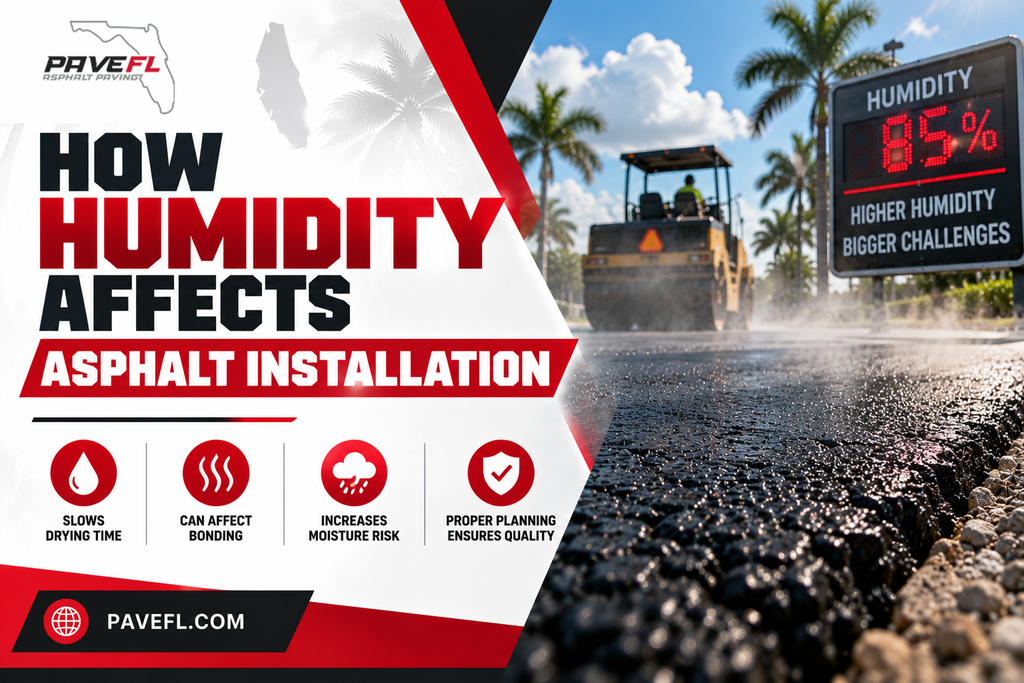
How Does Humidity Affect Asphalt Installation in Florida? Florida’s humid climate creates another important consideration for asphalt installation. While temperature and rainfall often receive the most attention, moisture in the air and on the pavement surface can also influence paving conditions.
High humidity by itself does not automatically prevent asphalt installation. The bigger concern is surface moisture, rain, drying conditions, and how environmental conditions affect the time available for proper placement and compaction. Asphalt paving quality depends on controlling these factors during installation. Asphalt mixtures need to remain within an appropriate temperature range long enough to be properly compacted, while moisture on the surface can interfere with bonding.
For Florida property owners, understanding asphalt humidity Florida conditions can help explain why professional paving requires careful scheduling and preparation.
PaveFL can help property owners plan asphalt projects around site conditions and weather so the pavement receives the preparation, placement, and compaction needed for reliable long-term performance.
1. What Is Humidity and Why Does It Matter?
Humidity refers to the amount of water vapor present in the air.
Florida commonly experiences humid conditions, particularly during warmer and wetter periods. High humidity means the air contains substantial moisture, but it is important to distinguish humidity in the air from liquid water on the pavement.
Those are not the same thing.
A humid day does not automatically mean asphalt cannot be installed.
Instead, paving professionals need to evaluate the complete set of conditions, including:
- Air temperature
- Pavement temperature
- Asphalt mixture temperature
- Surface moisture
- Recent rainfall
- Weather forecast
- Wind
- Site conditions
- Time available for compaction
The condition of the pavement surface is especially important because asphalt needs a suitable, dry surface for proper placement.
2. Humidity and Surface Moisture Are Different
One of the most important points for Florida property owners is that high relative humidity does not necessarily mean the asphalt surface is wet.
However, humid conditions can occur alongside:
- Dew
- Recent rainfall
- Condensation
- Damp pavement
- Slow evaporation
This is why a paving professional should inspect the actual surface rather than relying only on the humidity percentage shown in a weather forecast.
When moisture is present on the surface, it can interfere with the asphalt’s ability to properly bond with the underlying surface. Asphalt application guidance notes that high humidity can contribute to an invisible moisture film, while rain or a wet surface requires paving operations to be suspended until the pavement is dry.
3. Moisture Can Interfere With Asphalt Bonding
A strong bond between the new asphalt and the prepared surface is an important part of successful paving.
If water is present where asphalt is supposed to adhere, the bond may be compromised.
This is particularly important when:
- The pavement was recently exposed to rain
- Dew has formed overnight
- The surface has not dried completely
- Drainage problems leave wet areas
- The base or underlying surface remains damp
The goal is to place asphalt on a properly prepared and suitable surface—not simply wait until the top appears visually dry.
4. Rain Is a Bigger Concern Than Humidity Alone
It is useful to separate humidity from rainfall.
Humidity: moisture in the air.
Rain: liquid water directly contacting the pavement.
Rain is generally much more disruptive to asphalt installation because asphalt should not be placed on a wet surface.
Paving guidance states that asphalt application should be suspended during rain and that pavement should be allowed to dry before operations resume.
This is particularly relevant in Florida, where a sunny morning can sometimes be followed by a sudden afternoon shower.
Professional scheduling therefore needs to consider the weather throughout the paving window—not only the conditions at the beginning of the project.
5. Humidity Can Influence How Quickly Conditions Change
Florida weather can change quickly.
A surface may be dry in the morning and become wet later because of:
- Rain
- Condensation
- Dew
- Changing cloud cover
- Increased moisture
- Storm activity
This means paving schedules should leave enough flexibility to respond to changing conditions.
Rather than simply asking, “Is today hot enough?”, professionals need to consider:
Is the surface dry?
Will rain interfere with the work?
Will the asphalt remain within its appropriate compaction range?
Is there enough time to complete placement and compaction properly?
6. Asphalt Temperature Is Critical During Installation
Humidity is only one environmental factor.
The temperature of the asphalt mixture is extremely important because asphalt binder becomes less workable as it cools.
When asphalt is hot, the binder allows the aggregate particles to move during compaction. As the mixture cools, the binder becomes stiffer and eventually the mixture becomes much harder to compact effectively.
This creates a limited window for proper compaction.
The paving team needs to coordinate:
- Delivery
- Placement
- Rolling
- Compaction
- Traffic control
so the asphalt reaches the required density before it becomes too cool.
7. Why Proper Compaction Matters
Compaction is one of the most important steps in asphalt installation.
Proper compaction helps:
- Reduce air voids
- Improve pavement strength
- Reduce permeability
- Improve durability
- Reduce susceptibility to moisture damage
- Reduce permanent deformation
Asphalt paving guidance identifies adequate compaction as a major factor in pavement performance.
This is one reason environmental conditions matter.
If the asphalt cools too quickly or paving operations are interrupted, the contractor may have less opportunity to achieve the required density.
8. Does High Humidity Always Slow Asphalt Cooling?
Humidity can influence heat transfer and moisture conditions around a newly placed surface, but humidity should not be treated as the only factor controlling asphalt cooling.
The rate at which an asphalt mat cools depends on several conditions, including:
- Mix temperature
- Air temperature
- Pavement temperature
- Layer thickness
- Wind
- Sun exposure
- Surface conditions
- Environmental conditions
Asphalt paving guidance notes that environmental conditions can influence the time available for compaction, while mixture temperature remains a central factor.
For Florida projects, professionals should therefore evaluate the entire weather situation rather than assuming that humidity alone determines installation success.
9. Humidity Can Be More Important When Combined With Rain
High humidity becomes more relevant when it occurs with wet weather.
For example:
High humidity + recent rain + damp surface
creates a very different paving situation from:
High humidity + dry surface + stable weather
The first situation may require additional drying time or a change in the work schedule.
The second may be suitable for paving depending on the remaining project conditions.
This distinction is important because Florida’s humid climate does not mean asphalt paving has to stop every time humidity is high.
10. Morning Conditions Require Attention
Morning can present unique conditions for asphalt installation.
After an overnight period of high humidity, the pavement surface may have moisture from dew or condensation.
The air may be warm, but the surface itself can still be damp.
Before paving begins, the surface should be evaluated to make sure it is suitable for asphalt placement.
This is particularly important when:
- Temperatures dropped overnight
- The property is near water
- The area receives limited sunlight
- Rain occurred the previous evening
- Humidity remained high overnight
A dry-looking area should still be checked carefully when conditions suggest surface moisture may be present.
11. Humidity and Florida’s Rainy Season
Florida’s humid conditions often overlap with periods of frequent rainfall.
That combination creates additional scheduling challenges.
A paving project may need to account for:
- Afternoon thunderstorms
- Sudden showers
- Wet pavement
- Longer drying periods
- Changing surface conditions
- Weather interruptions
The objective is not simply to find the hottest day.
Instead, the goal is to find a suitable paving window in which the surface can remain dry and the asphalt can be properly placed and compacted.
12. Humidity Can Affect Asphalt Maintenance Work Too
Humidity is not relevant only to brand-new asphalt installation.
It can also matter when performing certain maintenance treatments.
Surface treatments and other applications may have their own requirements concerning:
- Surface dryness
- Temperature
- Humidity
- Rain
- Drying time
The specific material and application method determine the appropriate conditions.
Therefore, property owners should avoid assuming that every asphalt treatment can be applied under the same weather conditions.
13. Moisture Below the Surface Can Also Matter
A pavement surface may appear dry while moisture remains beneath it.
This can happen after:
- Heavy rainfall
- Flooding
- Poor drainage
- Prolonged wet conditions
- Water accumulation beneath pavement
Moisture in the pavement foundation can influence pavement performance over time.
Research on pavement moisture emphasizes preventing susceptible pavement layers from becoming saturated and removing water that enters the pavement system.
For a new paving project, site preparation and drainage therefore deserve attention before asphalt is placed.
14. Drainage Is Important Before Asphalt Installation
Good drainage helps prevent water from remaining around the pavement structure.
Before paving, property owners should consider:
- Site grading
- Surface slope
- Drainage paths
- Low areas
- Existing water accumulation
- Soil conditions
- Pavement edges
If a property has a persistent drainage problem, simply installing a new asphalt surface may not address the underlying cause.
Water management should be considered as part of the overall pavement system.
15. Humidity and Asphalt Installation Mistakes
Poor weather planning can contribute to installation problems.
Examples include:
Paving over a damp surface
Moisture can interfere with bonding.
Ignoring the weather forecast
Unexpected rain can interrupt placement.
Starting before the surface is ready
Dew or recent rainfall can leave moisture on the pavement.
Delaying compaction
Asphalt becomes less workable as it cools.
Treating every weather condition the same
Temperature, humidity, wind, rain, and surface moisture can interact differently from project to project.
Professional planning helps reduce these avoidable risks.
16. Why the Base Must Be Properly Prepared
Asphalt does not perform independently of the material beneath it.
A properly prepared base helps distribute traffic loads and provides a stable foundation for the asphalt layer.
Before installation, the paving process may need to address:
- Existing weak areas
- Soft spots
- Drainage issues
- Improper grading
- Unstable base material
- Settlement
Moisture management is particularly important because saturated supporting layers can lose stiffness and affect pavement performance.
17. Humidity Does Not Replace the Need for Proper Weather Monitoring
A common misunderstanding is that humidity percentage alone determines whether asphalt can be installed.
It does not.
A paving professional should consider multiple measurements and observations.
| Condition | Why It Matters |
|---|---|
| Air temperature | Influences environmental conditions |
| Asphalt temperature | Determines workability |
| Surface temperature | Helps assess installation conditions |
| Humidity | Indicates moisture conditions in the air |
| Surface moisture | Can interfere with bonding |
| Rain | Can interrupt installation |
| Wind | Can affect cooling |
| Forecast | Helps plan the paving window |
| Base condition | Influences pavement support |
This broader approach is more useful than relying on a single weather number.
18. How Florida Heat and Humidity Work Together
Florida asphalt installation is influenced by both heat and humidity.
High temperatures can keep asphalt workable for longer, while environmental conditions influence how quickly the pavement cools.
At the same time, excessive heat can create other concerns, particularly for pavement that remains soft under traffic.
This means paving professionals need to balance:
Enough heat for workability
with
Enough cooling and compaction control for proper pavement performance.
The mixture’s specific requirements determine the appropriate temperature range, so paving decisions should be based on the actual asphalt mixture rather than a universal temperature rule.
19. Why Timing Matters for Florida Asphalt Installation
Choosing the right paving window can make installation easier.
A suitable period generally needs:
- Dry pavement
- Appropriate temperatures
- Stable weather
- Enough time for placement
- Enough time for compaction
- Minimal risk of immediate rainfall
This is particularly important in Florida because weather can change rapidly.
A professional paving team can monitor conditions and adjust the work schedule when necessary.
20. How PaveFL Can Help With Humid-Weather Asphalt Projects
PaveFL can help Florida property owners plan asphalt installation around the site’s condition and environmental factors.
Depending on the project, this can include evaluating:
- Existing pavement
- Base preparation
- Drainage
- Surface moisture
- Weather conditions
- Traffic requirements
- Asphalt installation needs
- Maintenance requirements
PaveFL can also help property owners understand why a project may need to be scheduled around rainfall and suitable surface conditions rather than simply selecting a date based on convenience.
The goal is to give the new pavement a properly prepared foundation and suitable installation conditions.
21. What Property Owners Should Ask Before Asphalt Installation
If you are planning a new asphalt project in Florida, consider asking:
Is the surface completely ready?
The existing area should be properly prepared before asphalt placement.
Is drainage adequate?
Water should have an appropriate path away from the pavement.
What are the expected weather conditions?
Rain and wet surfaces can interfere with paving.
How will compaction be managed?
The asphalt must be compacted while it remains within its appropriate temperature range.
Is the project being scheduled around Florida weather?
A good paving schedule should account for changing conditions.
What maintenance will the pavement need afterward?
Long-term maintenance can help protect the investment.
22. Can Asphalt Be Installed on a Humid Day?
Yes, high humidity alone does not automatically make asphalt installation impossible.
The more important question is whether the actual paving conditions are suitable.
A humid day with a dry surface and stable weather can be very different from a humid day with rain, condensation, or wet pavement.
Professional paving decisions should therefore consider:
- Actual surface moisture
- Weather conditions
- Asphalt temperature
- Base condition
- Rain probability
- Available compaction time
This distinction is particularly important in Florida.
23. What Happens If Asphalt Is Installed Under Poor Conditions?
When paving conditions are unsuitable, the finished pavement may not perform as intended.
Potential concerns can include:
- Poor bonding
- Inadequate compaction
- Higher air voids
- Moisture-related deterioration
- Uneven surface
- Premature cracking
- Reduced durability
Not every problem is caused by humidity, but poor environmental conditions can contribute to installation difficulties.
This is why quality paving involves more than simply placing hot asphalt onto a prepared area.
24. Asphalt Installation Should Be Planned Around the Entire Environment
A successful Florida paving project considers the complete site.
That includes:
Weather
Is the forecast suitable?
Surface
Is it dry and properly prepared?
Base
Is the foundation stable?
Drainage
Can water move away effectively?
Material
Is the asphalt mixture appropriate?
Temperature
Can the mix be placed and compacted within the required range?
Traffic
Will the pavement receive the expected loads?
These factors work together to influence the finished pavement.
25. Long-Term Pavement Performance Starts During Installation
Maintenance is important, but pavement performance begins with installation.
Proper preparation can help reduce future problems.
A quality installation process focuses on:
- Evaluating the site
- Preparing the base
- Addressing drainage
- Selecting appropriate materials
- Placing the asphalt correctly
- Maintaining suitable temperatures
- Compacting the asphalt properly
- Allowing the pavement to reach appropriate condition before normal use
Adequate compaction is particularly important because it can improve pavement strength and reduce permeability and moisture-related deterioration.
26. Humidity and New Asphalt: What Property Owners Should Know
Property owners do not need to monitor every technical detail themselves.
Instead, the important takeaway is simple:
Humidity is one part of a much larger weather and installation picture.
Florida’s humid environment makes moisture awareness important, but the actual condition of the pavement surface, rainfall, temperature, asphalt mix, and compaction process matter greatly.
If the pavement surface is wet, paving should wait until conditions are appropriate.
If the surface is dry and the rest of the conditions are suitable, humidity alone may not prevent installation.
27. Simple Checklist for Florida Asphalt Installation
Before beginning a paving project, consider this checklist:
- Inspect the existing pavement or site
- Check drainage
- Address soft or unstable areas
- Confirm the base is properly prepared
- Check the weather forecast
- Confirm the pavement surface is dry
- Monitor asphalt temperature
- Plan the compaction process
- Allow enough time for proper installation
- Avoid paving during rain
- Monitor changing weather conditions
- Follow an appropriate post-installation traffic plan
This approach helps property owners understand why professional paving is a process rather than a single step.
28. Why PaveFL Takes Weather Conditions Seriously
Florida’s climate requires paving projects to be planned around real-world conditions.
PaveFL can help property owners evaluate when and how asphalt work should be approached based on the property’s condition, drainage, weather, and intended use.
Rather than treating humidity as an automatic reason to delay every project, the focus should be on determining whether the actual pavement and environmental conditions are suitable for quality installation.
That can help reduce avoidable problems and give the asphalt a better opportunity to achieve the required density and bond.
Final Thoughts
Understanding asphalt humidity Florida conditions is important when planning a paving project, but humidity should not be viewed in isolation. High humidity mainly becomes a concern when it occurs alongside surface moisture, rainfall, condensation, or other conditions that can interfere with asphalt placement and bonding. Asphalt installation guidance emphasizes that moisture on the surface can interfere with adhesion and that paving should be suspended during rain until the pavement has dried.
Temperature and compaction are equally important. Asphalt must remain workable long enough for proper placement and compaction, and the appropriate temperature range depends on the mixture and binder being used.
For Florida property owners, the best approach is to consider the complete installation environment: surface condition, moisture, temperature, weather, drainage, base preparation, asphalt mixture, placement, and compaction.
PaveFL can help property owners plan asphalt projects with Florida’s humid and changeable weather in mind. By evaluating site conditions and scheduling work appropriately, PaveFL can help create the foundation for a durable, properly installed pavement surface.
For a professional asphalt paving service Florida project, the objective should not simply be to find a day when the weather looks good. The goal is to choose conditions that allow the entire paving process—from preparation through compaction—to be completed correctly.