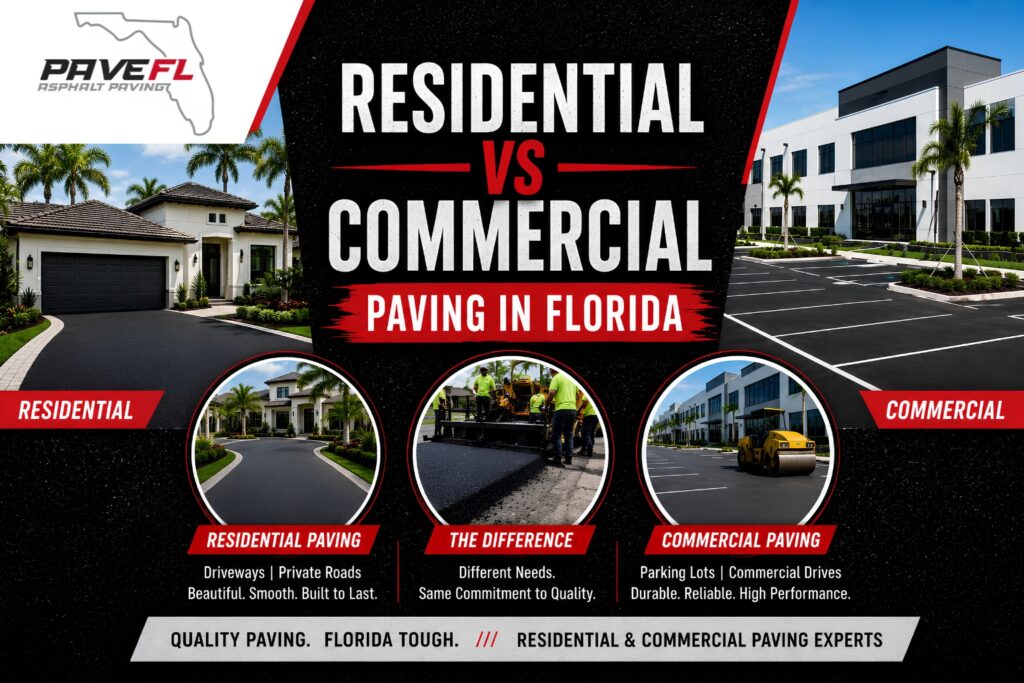
Are you planning a paving project and wondering whether residential or commercial paving is the better fit? Understanding the differences between residential vs commercial paving Florida property owners deal with is important before starting any asphalt or concrete project. While both types of paving serve the same basic purpose — creating durable, smooth, and functional surfaces — the design requirements, materials, traffic demands, regulations, and long-term maintenance needs differ significantly. Residential paving usually includes driveways, walkways, and small parking pads designed for light passenger vehicles and focused heavily on curb appeal, quick installation, and cost-efficiency. Commercial paving, on the other hand, covers parking lots, retail entrances, private roads, and industrial access areas that must withstand heavier traffic loads, larger vehicles, and stricter construction standards.
In Florida, climate plays a major role in both residential and commercial pavement performance. Intense heat, humidity, UV exposure, heavy rainfall, flooding risks, and shifting soil conditions create constant stress on paved surfaces throughout the year. Residential driveways may prioritize appearance and ease of maintenance, while commercial paving projects require stronger base preparation, thicker asphalt layers, stormwater management systems, ADA compliance, and more detailed traffic planning. Understanding these differences helps homeowners, business owners, and property managers choose the right paving approach for long-term durability, safety, and performance.
Definitions & Scope
- Residential Paving: Pavement work on private homes or small multi-family sites. Common projects include driveways, walkways, patios, and small parking pads. Typically light-duty, designed for car/light truck traffic. Scope is usually limited to the homeowner’s property lines. Often involves simple layouts and minimal permitting (aside from any municipal driveway curb cuts or HOA rules).
- Commercial Paving: Pavement for businesses, retail centers, offices, apartments, public institutions, and industrial sites. Includes large parking lots, access roads, loading zones, and plazas. Heavy-duty design for trucks, buses, and high traffic. Scope often spans multiple acres. Requires detailed planning (traffic flow, signage), regulatory compliance (ADA, fire lanes, stormwater), and often coordination with municipal or state agencies.
Typical Projects & Use-Cases
- Residential Examples: Driveway installation or replacement; asphalt patching; small back-yard patio or pathway; paved sports courts; residential street segments (in HOAs). Projects are usually under 0.25 acre. Owners care about appearance and practical longevity.
- Commercial Examples: Shopping center parking lots; office or apartment complex driveways; municipal parking garages; curb and gutter roadways; event venue lots; industrial facility aprons. Areas often exceed 0.5 acres. Projects may involve phasing to avoid closing entire parking areas and may include multiple materials (asphalt and concrete). Businesses focus on durability, code compliance, and minimizing customer disruption.
Design & Engineering Differences
- Load-Bearing Requirements: Commercial pavement is engineered for heavier, sustained loads. This means thicker base and surface layers. For example, a home driveway might use 2–3 inches of asphalt over 4–8 inches of base, whereas a commercial lot often uses 4–6 inches of asphalt over 8–12 inches of base. Residential design uses standard flexible pavement calculators; commercial designs may use FDOT or ASTM standards, especially for connections to highways.
- Subgrade and Sub-Base: Both require competent subgrade. Residential jobs often rely on the existing soil compacted to specifications. Commercial projects frequently require soil testing and engineered sub-base materials (graded aggregate, stabilized fill, geogrids) to prevent settlement under heavy use. A poorly prepared base is a top cause of failures (alligator cracking, sinkholes). Skimping on sub-base (a common DIY shortcut) will dramatically shorten life.
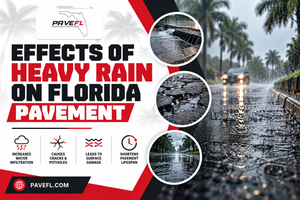
- Drainage and Grading: Proper slope is critical. All paving must slope (typically ≥¼ inch per foot) to drain water away. Standing water is destructive, especially in Florida’s rainfall. For residential jobs, simple swales or surface grade may suffice. Commercial sites need engineered drainage systems (curbs, inlets, retention/detention ponds) to meet local stormwater regulations. Precision grading equipment (laser-guided) is common in commercial projects to meet tight tolerances.
- Drainage Compliance: Commercial projects often must submit a stormwater management plan (meeting FDEP or local requirements). Permeable pavement options or underground retention might be used in high-density developments. Residential projects typically do not trigger formal stormwater permits unless they alter public right-of-way.
- Reinforcement: Residential pavements may be “asphalt over stone” with no extra reinforcement. Commercial pavements may include asphalt binder layers, rebar or wire mesh in concrete, or geogrid reinforcement beneath the base to handle heavy traffic. Heavy-duty aprons and loading docks often use full-depth concrete or a multi-course asphalt design (rock base + binder + surface).
Material Choices & Specifications
- Asphalt Mixes: Florida paving uses hot mix asphalt (HMA) from FDOT-approved plants. Residential jobs may use a standard “performance grade” binder mix, whereas commercial projects might specify polymer-modified asphalt or high-RAP mixes for durability. For instance, polymer-modified mixes resist rutting under high heat. Typical residential asphalt thickness is 2–3 inches; commercial lots use 4–6 inches. The aggregate size and gradation may also differ: larger aggregate is often used in commercial mixes for strength.
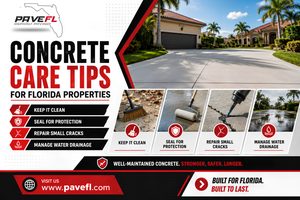
- Concrete Mixes: Concrete driveways generally use 3000–4000 psi mixes, often 4–5 inches thick for cars. Commercial slabs might use 4000+ psi or fiber-reinforced mixes, poured 6–8 inches or more, especially if trucks will pass over. Fiber or rebar reinforcement is common in industrial/commercial slabs. Admixtures (plasticizers, retarders) may be used to improve workability in Florida’s heat. Control joints at ~10 ft spacing prevent random cracks.
- Additives & Alternatives: Both sectors may use crumb rubber modifiers (Florida requires crumb rubber modifier in most asphalt pavements), anti-stripping agents to resist moisture damage, and sealants. Commercial projects sometimes incorporate specialty surfaces (e.g., golf cart paths, tennis courts). Florida encourages (and sometimes mandates) pervious or porous pavement in certain projects for stormwater, which can apply to both residential and commercial designs.
Installation Process & Timelines
- Residential: Typically fast and straightforward. After marking utilities and clearing, the crew excavates and grades the subgrade, installs base material (crushed stone) and compacts it, sets forms (for concrete), and paves. An asphalt residential driveway can often be completed in 1–2 days once prep is done. A concrete slab also takes a few days (pour plus 1 week for curing). Permits and engineering are minimal, so scheduling is flexible.
- Commercial: Longer and phased. Projects may need shutdown notices, detours, and staged work. Large parking lots might be paved in sections (phase A, B, etc.) to keep businesses open. Each phase involves subgrade testing, base compaction, placement of multiple lift layers (binder + surface), curing (for concrete), and lane/parking marking. Expect anywhere from a week for a small lot to several weeks for a complex site. Detailed scheduling must account for weather windows in Florida’s rainy season and local permit inspections.
- Quality Controls: Commercial projects often include field testing (density testing, core sampling) and certified QC procedures. Residential jobs may rely on contractor experience and visual checks.
Equipment & Crew Requirements
- Residential: Smaller equipment suffices—dump trucks, skid steers or mini-excavators for sub-base, a paving machine for asphalt, and a tandem roller. Crew size can be 3–5 people. Equipment needs are modest, reflecting smaller scale.
- Commercial: Large machinery and manpower. Commercial paving uses motor graders, large asphalt pavers, dump fleets, multiple rollers (vibratory and tandem), and laser-guided grade lasers. Crews of 10–20+ may be needed for efficiency. Traffic control personnel, safety spotters, and inspectors are often on site. The operation is more complex and continuous, demanding experienced crews.
Permitting & Regulatory Considerations in Florida
- Residential Permits: Local municipalities often require a driveway or building permit for new or expanded driveways. This ensures setbacks and connections (especially if it involves street curbs or sidewalk cuts) are to code. Florida counties may also enforce stormwater management for large area changes. However, homeowners seldom face the stringent regulations of commercial projects.
- Commercial Permits and Codes: Commercial paving must comply with:
- ADA Standards: Accessible parking spaces (width, slope ≤2%, signage) and accessible routes. Federal ADA guidelines are enforced by Florida building codes for public/commercial lots.
- Stormwater/Environmental: Projects over 0.5 acre usually need an Environmental Resource Permit (ERP) or local drainage plan (per Florida DEP/Water Management Districts) to manage runoff. Impervious area (driveways, lots) triggers retention/detention requirements. Some municipalities mandate pervious pavement or green spaces for large parking lots.
- Fire & Safety Codes: Fire lanes must be demarcated, and fire hydrant access must be maintained.
- Local Codes: City or county pavement standards (thickness, materials per local roadway specs), public right-of-way access, and plan reviews for engineering and safety.
- DOT Standards: If connecting to state roads, FDOT driveway design (FDOT FDM Ch. 214) may apply. Even private developments often mimic public standards for storm and traffic.
Maintenance Schedules & Lifecycle
- Residential: Typical asphalt driveways last 15–25 years if well-built, but unmaintained surfaces may fail sooner. Recommended maintenance: sealcoating every 2–4 years to protect against UV and moisture, and filling cracks promptly. A concrete driveway may last 30+ years with periodic cleaning and occasional sealing (to prevent stains).
- Commercial: Lifespans of 20–30 years (asphalt) or 30+ years (concrete) are expected with proper upkeep. Commercial lots require scheduled maintenance: sealcoat ~every 2–3 years, restriping every 1–2 years, and overlay/resurfacing ~10–15 years. Facility managers often implement a Pavement Management Plan with annual inspections. The Pavement Group notes regular maintenance (seal, crack-fill, overlays) extends service life for commercial properties.
Common Failure Modes & Mitigation
- Alligator Cracking (Fatigue): A web of cracks indicates base failure under repetitive loads. Fix by removing damaged asphalt and rebuilding the base and surface. Prevent by proper compaction and sufficient base thickness for expected traffic.
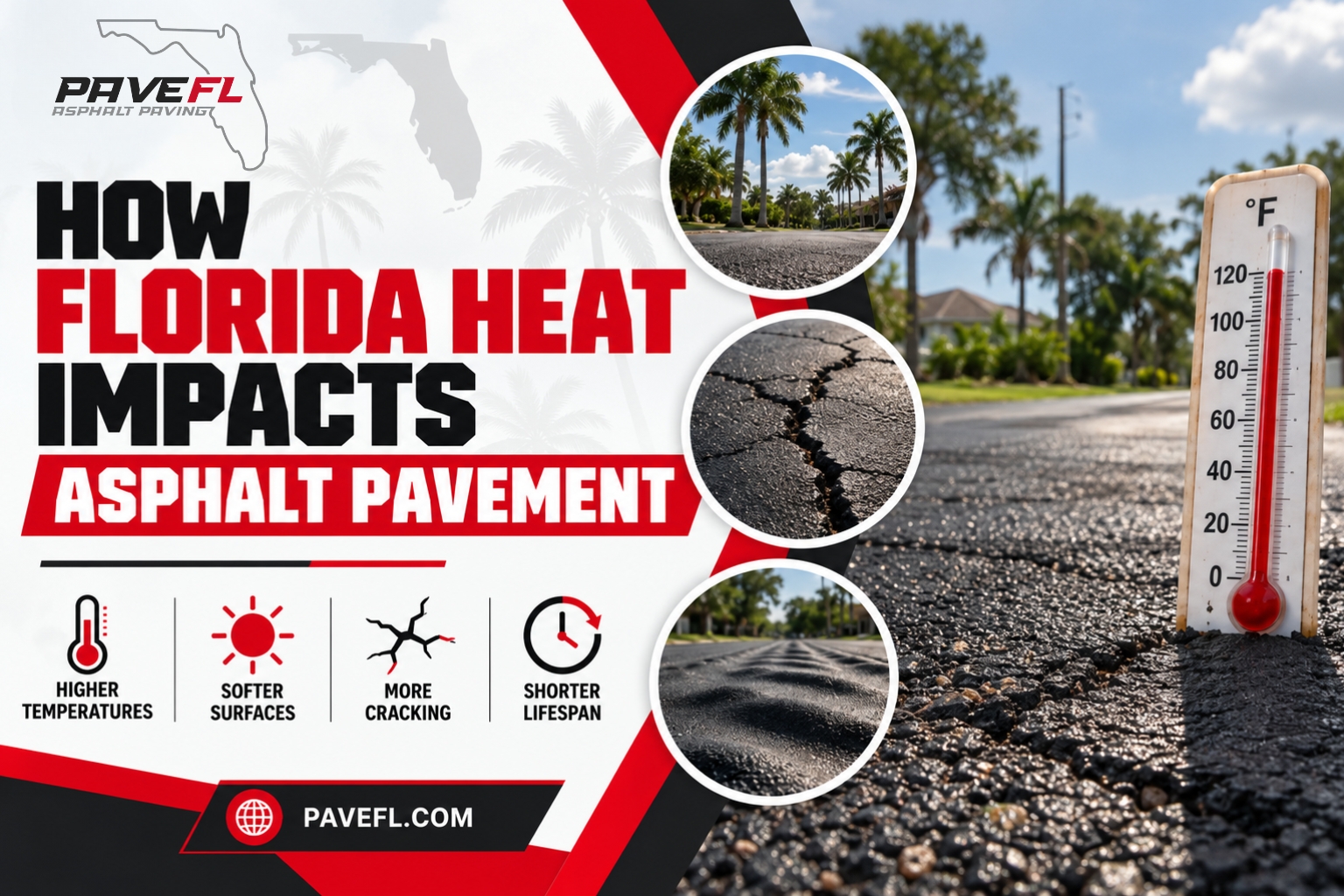
- Thermal Cracking: Even without freeze-thaw, repeated expansion/contraction in heat can crack pavements. Mitigate with joints (in concrete) or polymer additives (in asphalt) to increase flexibility.
- Rutting and Deformation: Heavy wheels can depress asphalt if binder is weak. Thicker asphalt/binder layer and reinforcing fibers help resist rutting.
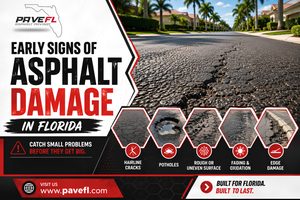
- Potholes: Caused by water infiltration and traffic. Prevent with timely crack sealing and good drainage. Repair by patching or full-depth replacement in severe cases.
- Surface Wear and Oxidation: UV and fuel spills oxidize asphalt, turning it brittle. Sealcoating restores oils and prolongs life. Concrete can spall or stain if water or oils penetrate; sealing and using air-entrained mixes can mitigate damage.
- Subsidence/Sinkage: Occurs if the subgrade was not well-compacted or if cavities form. Avoid by removing organic soil, properly compacting base, and addressing drainage.
Cost Drivers & Budget Considerations
Rather than specific prices, consider these qualitative factors:
- Area & Thickness: Larger area and thicker pavement both drive up materials and labour costs. Commercial jobs generally require more material per square foot.
- Base Prep & Demolition: Removing old pavement or unstable soil adds cost. Any excavation, hauling debris, and adding gravel base increase budget.
- Access & Logistics: Tight urban sites or ones with poor access add labor/time (shuttle loads). Working around daily operations (in commercial) may require overtime or night work.
- Regulatory Compliance: Budgeting time and money for permits, ADA features (curb cuts, ramps), stormwater design, and inspections is crucial for commercial work.
- Traffic Control & Phasing: For commercial sites, traffic diversion plans and phased construction add complexity (and cost) compared to a simple residential job.
- Materials Quality: Premium mixes (rubber-modified asphalt, high-psi concrete) cost more upfront but yield longevity. Contractors often present “good-better-best” options; investing in quality saves maintenance.
- Seasonality: Paving in extreme heat or rainy season can slow work or require special measures (cooling, curing compounds) – factor this into scheduling costs.
Contractor Selection Criteria
- Experience & Specialization: Choose a company with proven residential and commercial projects in Florida. They should know local soils (e.g. coral rock, sand), climate, and building codes.
- Credentials: Verify licensing and insurance. PaveFL, for example, highlights being “fully licensed and insured”. Licensure (state/local), A+ safety records, and bonded contractors minimize risk.
- Quality of Work: Look for reviews, references, or portfolios showing clean, straight lines and attention to drainage and grading. Reputable contractors (like PaveFL) emphasize “quality materials and proven techniques”.
- Communication & Support: A good contractor provides detailed estimates, communicates scheduling, and helps with permits. PaveFL notes “transparent and customized solutions” for each client.
- Warranty & Maintenance: Compare warranties (e.g. 1-year on work), and ask if they offer maintenance services. Ongoing relationship (sealcoating, repairs) is a plus.
Residential Best-Practice Checklist
- Obtain any required driveway permit (curb/sidewalk removal usually needs it).
- Verify property lines and sidewalk set-back (to avoid future disputes).
- Remove existing pavement/vegetation and test/compact subgrade.
- Install geotextile (weed barrier) if recommended, then 4–8 in of compacted crushed base.
- Apply asphalt or concrete to the right thickness (see material section). Use edge forms for concrete.
- Compact asphalt in lifts while hot. For concrete, finish surface (broom or stamped) and cure properly (keep moist).
- Grade edges and tie-ins to meet existing surfaces smoothly.
- Allow recommended curing/settle time before use (concrete ~7 days, asphalt ~24–48 hours).
- Schedule first sealcoat after 6–12 months (asphalt) then every 2–4 years. Inspect annually for cracks and seal or fill early.
Commercial Best-Practice Checklist
- Engage contractor early for site analysis and engineered design. Include parking counts, heavy-turn areas, ADA layout, and stormwater plan.
- Secure permits: building permit, site plan approvals, environmental (if needed), and utility cut permits. Ensure ADA stall calculations and signage meet local codes.
- Close sections in phases to allow business access. Coordinate with tenants/employees for traffic control.
- Excavate and set a robust subgrade; often perform soil compaction tests (Proctor test). Use quality base (FDOT Spec. for Type S or Granular A).
- Install drainage (inlets, pipes) and grade to drainage plan before paving. Confirm slopes meet requirements.
- Pave with multiple lifts: often a binder (1–3”) then a surface course (1–3”), compacting each. Use thick edges or curbs to reinforce perimeter.
- Line-striping: install stall lines, ADA symbols, arrows, speed bumps, and fire lanes per code. Make sure curb ramps are properly placed.
- Plan maintenance: note sealcoat schedule (2–3 years), re-striping, and full overlay timeframe. Budget these into life-cycle costs.
Comparison Table: Residential vs Commercial Paving
| Aspect | Residential | Commercial | Impact on Lifespan/Maintenance |
|---|---|---|---|
| Traffic Load | Cars, light trucks (5–10 tons). | Heavy trucks, buses, high volume (10+ tons) | Heavier loads accelerate wear; inadequate design shortens life. |
| Pavement Thickness | Thin (2–4″ asphalt; 4″ concrete). | Thick (4–6″ asphalt; 6–8″ concrete or more). | Thicker pavement lasts longer under high stress; thin pavement may fail early. |
| Base/Subgrade | Basic compaction of existing soil + minimal gravel. | Engineered subgrade, tested compaction, deep stone base. | A weak base leads to alligator cracking; stronger base extends life. |
| Drainage/Grading | Simple slope to yard/road. | Engineered grading with drains, retention, and outfall. | Poor drainage causes base failure. Proper grading prevents water damage. |
| Regulations/Permits | Few (local driveway permit if cutting curb). | Many (ADA stalls, stormwater, fire codes, DOT access). | Non-compliance leads to fines/delays; compliance ensures a safe usable lot. |
| Design Complexity | Simple layout (straight driveway, one entry). | Complex (multi-entry lot, islands, pedestrian paths). | Complex design increases project time, but yields safer traffic flow. |
| Materials | Standard asphalt or concrete mixes. | Heavy-duty mixes (polymer-modified, fiber-reinforced). | Enhanced materials resist damage; using light-duty mixes can cause premature failure. |
| Construction Timeline | 1–3 days. | Weeks (staged work to minimize downtime). | Longer schedules allow weather contingencies and careful quality control. |
| Maintenance | Sealcoating every 3–5 years, crack-fill as needed. | Rigorous maintenance plan (seal/overlay, restriping). | Neglecting maintenance cuts life: commercial expects planned upkeep. |
| Cost Drivers | Labor, basic materials, permit. | Larger crews, extensive prep (drainage, permits), materials. | Commercial costs more but yields longer ROI; residential can cut costs but risks durability. |
Final Thoughts
Choosing between residential and commercial paving is not simply about project size, it involves understanding traffic demands, structural requirements, drainage planning, and long-term maintenance expectations. In Florida’s challenging climate, both residential and commercial surfaces require materials and installation methods specifically designed to withstand heat, moisture, and daily wear. Learning the key differences in residential vs commercial paving Florida projects helps property owners make smarter decisions that improve pavement lifespan, reduce repair costs, and protect overall property value.
For homeowners, residential paving provides smoother access, improved curb appeal, and better functionality when professionally designed and installed. For commercial properties, properly engineered paving improves accessibility, supports heavy traffic flow, enhances customer safety, and helps meet regulatory requirements. Whether the project involves a driveway, parking lot, roadway, or large-scale commercial surface, working with experienced local contractors ensures the pavement is built for Florida’s unique environmental demands.
If you are planning a residential or commercial paving project, Pave FL can help evaluate your site conditions and provide professional paving solutions designed specifically for South Florida’s climate, traffic conditions, and long-term pavement performance.